
Skip to content
The Encyclopedia of Horology

Clock · Mantel clock

Clock by Jean-Baptiste Lepaute

Partially verified

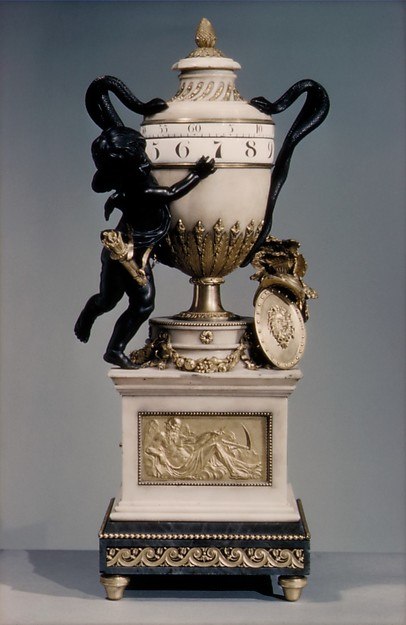
This mantel clock, held by The Metropolitan Museum of Art under accession number 29.180.4, is attributed to the workshop of the French clockmaker Jean-Baptiste Lepaute (1727–1802). It is dated to approximately 1775–1780. The construction of the timepiece incorporates several materials, including marble, bronze, and gilt-bronze for the housing and ornamental elements. The display features chapter rings made of white enamel. The mechanical movement is composed of brass and steel components. The object stands 28-3/8 inches (72.1 cm) in height, with a width and depth of 10 inches (25.4 cm) each. The design is characterized by a central vessel form supported by a pedestal, incorporating figurative sculpture and decorative metal mounts. It entered the museum's collection through the Bequest of Ogden Mills in 1929.

The mantel clock (29.180.4) showing the marble and gilt-bronze construction with the white enamel chapter rings.
The mantel clock (29.180.4) showing the marble and gilt-bronze construction with the white enamel chapter rings. — The Metropolitan Museum of Art — Bequest of Ogden Mills, 1929. Rights pending — permission not yet requested. Original source

Catalogue identity

Source
orbiscollectibles.com
Category
Clock · Mantel clock
Maker / attribution
Jean-Baptiste Lepaute
Reference
Not recorded
Catalogue / lot identifier
29.180.4
Source-reported date
ca. 1775–80
Source-reported place
France

Source-reported attribution and specifications are not independent authentication. A listing does not establish present ownership, current display, availability or permission to reproduce.

Object description

Construction and Materials

The clock is constructed from a combination of sculptural and functional materials. The main housing utilizes marble, which provides a structural body for the timekeeping mechanism. Gilt-bronze mounts are applied throughout the exterior, providing decorative accents to the pedestal and the vessel support. A dark-patinated metal is utilized for the figurative sculpture attached to the side of the central element.

The timekeeping display consists of white enamel chapter rings, which are positioned horizontally on the central vessel. The interior mechanism is documented as being fabricated from brass and steel components. The overall dimensions of the object are recorded as 28-3/8 inches in height, with a width and depth of 10 inches each.

Evidence for this section
  • “Marble, bronze and gilt-bronze; chapter rings of white enamel; movement of brass and steel”
  • “H. 28-3/8 x W. 10 x D. 10 in.”

Attribution and Origin

The object is attributed to the workshop of Jean-Baptiste Lepaute. The clockmaker, who lived from 1727 to 1802, was based in Paris, France. The museum documentation confirms the production location as French, Paris, and assigns a production date range of circa 1775 to 1780.

The piece is part of the collection held by The Metropolitan Museum of Art, identified by the accession number 29.180.4. It was acquired by the institution as part of the Bequest of Ogden Mills in 1929.

Evidence for this section
  • “Clock made by workshop of Jean-Baptiste Lepaute (French, 1727–1802), dated ca. 1775–80”
  • “The Metropolitan Museum of Art holds this object as 29.180.4”
  • “Bequest of Ogden Mills, 1929”

Visual Composition

Visually, the clock is arranged with a central urn or vessel-shaped body that contains the time-telling rings. This section is flanked by serpents and a dark-patinated figurative element. The central vessel rests upon a tiered base constructed of marble.

The pedestal base features a horizontal gilt-bronze relief depicting a reclining figure with a scythe, encased in a decorative frame. The entire structure is elevated by four small feet at the corners of the bottom base, which is also accented with a gilt-bronze frieze.

Evidence for this section
  • “Marble, bronze and gilt-bronze”
  • “The Metropolitan Museum of Art Collection Online”

Open research questions

  • What specific type of escapement or striking mechanism is housed within the vessel?
  • Does the internal movement bear any signatures or stamps confirming the workshop's mark?

Source evidence

Recorded claims and source quotations for Clock by Jean-Baptiste Lepaute
FieldSource-reported valueSource quotation
MakerWorkshop of Jean-Baptiste Lepaute“workshop of Jean-Baptiste Lepaute”
Dateca. 1775–80“ca. 1775–80”
MaterialsMarble, bronze, gilt-bronze, white enamel, brass, steel“Marble, bronze and gilt-bronze; chapter rings of white enamel; movement of brass and steel”
Height28-3/8 inches“H. 28-3/8”
Depth10 inches“D. 10 in.”
Accession number29.180.4“29.180.4”
OriginParis“French, Paris”

Visible details

  • Features a central vessel with horizontal enamel chapter rings
  • Includes a dark-patinated figurative element on the side
  • Mounted on a square base with a gilt-bronze frieze
  • Supported by four small feet

Research qualifications

  • The classification and workshop attribution are based solely on museum documentation
  • The specific mechanical details of the movement are not described beyond material composition

Photograph identity and source facts were screened before import; rights clearance remains pending.

Consulted source

Clock, Jean-Baptiste Lepaute, ca. 1775–80

Reviewed 2026-11-02 · Record 9410ff643b

Terms in this record

Glossary explanations for terms named in this object’s record.