
Skip to content
The Encyclopedia of Horology

Clock · Electric chronoscope

Chronoscope no. 17757

Partially verified

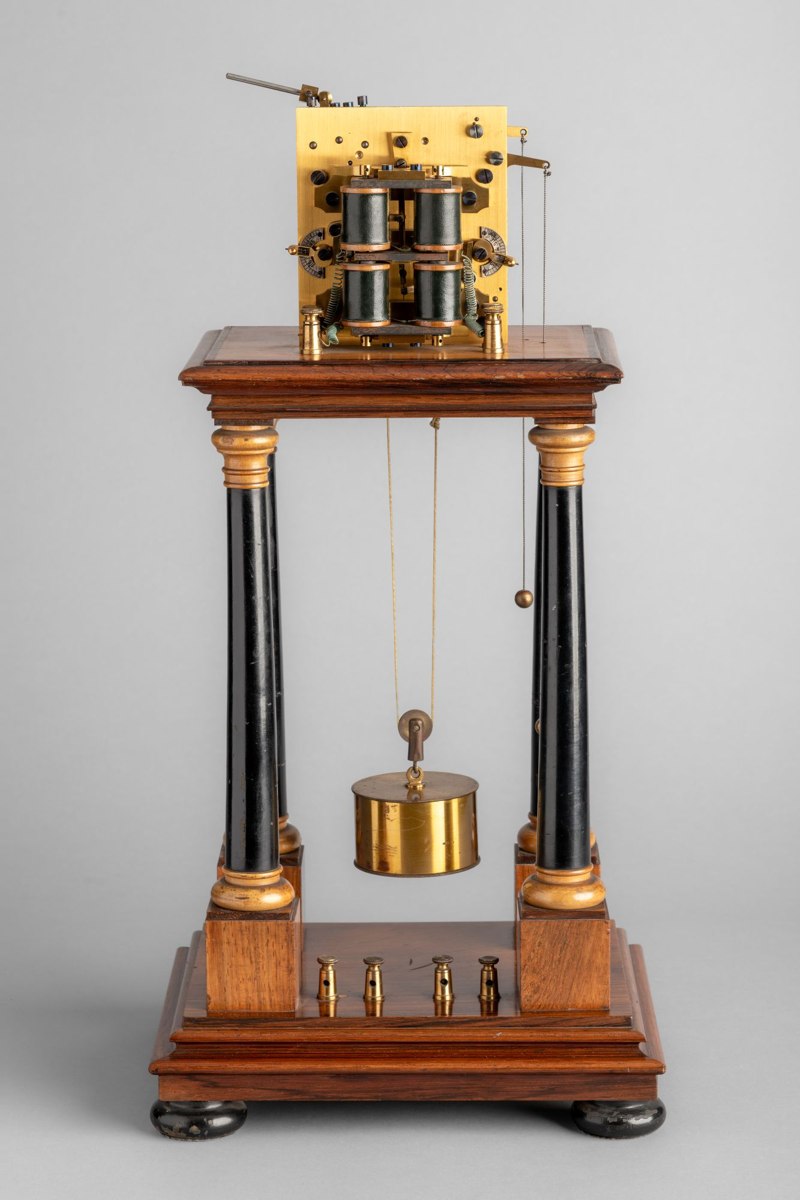
Catalogued under reference TCW 4019 by The Clockworks, this weight-driven electric chronoscope represents a short-duration precision timer designed by clockmaker and telegraph engineer Matthäus Hipp. Designed to register time intervals down to thousandths of a second, the apparatus operates with a fast-running wheel train started prior to measurement to overcome movement inertia. While Hipp originated the design, the dial is inscribed by successor firm Peyer Favager & Co of Neuchâtel, Switzerland, alongside serial number 17757. The movement rests atop a four-pillar wooden stand featuring electromagnetic coils, terminals, and a suspended driving weight.

Rear view of Hipp chronoscope no. 17757 showing the pillar stand, suspended cylindrical brass weight, and movement plate with electromagnetic coils
Rear view of Hipp chronoscope no. 17757 showing the pillar stand, suspended cylindrical brass weight, and movement plate with electromagnetic coils — The Clockworks. Rights pending — permission not yet requested. Original source

Catalogue identity

Source
theclockworks.org
Category
Clock · Electric chronoscope
Maker / attribution
Matthaus Hipp
Reference
TCW 4019
Catalogue / lot identifier
Source URL identifies the listing
Source-reported date
c. 1900
Country
Switzerland
Source-reported serial
17757

Source-reported attribution and specifications are not independent authentication. A listing does not establish present ownership, current display, availability or permission to reproduce.

Object description

Identity and Manufacturer Inscriptions

Catalogued under reference TCW 4019, this precision instrument is identified as a weight-driven electric chronoscope designed by clockmaker and telegraph engineer Matthäus Hipp. While Hipp developed the underlying design in the 1840s, the markings recorded in the collection source document production under Peyer Favager & Co of Neuchâtel, Switzerland. Specifically, the source records the dial inscription as 'Peyer Favager & Co | Neuchatel Suisse | No. 17757'.

The instrument bears serial number 17757, which appears both within the dial inscription and stamped 'On top of plate'. The institution assigns an approximate date of circa 1900 to the short-duration timer, categorising it under metrology and electric meters.

Evidence for this section
  • “This electric chronoscope was designed by clockmaker and telegraph engineer Matthaus Hipp.”
  • “On dial: Peyer Favager & Co | Neuchatel Suisse | No. 17757”
  • “On top of plate: 17757”
  • “Matthaus Hipp’s short duration timer, c.1900 – The Clockworks”

Physical Stand and Visible Movement Elements

Visual observation of the catalogued photograph shows the rear aspect of the apparatus mounted upon a stepped wooden base with four black columns. The columns are ebonised with gilt accents and support the upper movement assembly, while four electrical binding posts are positioned along the front edge of the base.

Suspended centrally between the columns is a cylindrical brass driving weight hanging from a cord and pulley, paired with a small spherical counterweight suspended to its right. Mounted on top of the pillar stand is a rectangular brass movement plate carrying four dark electromagnetic coils along with brass terminals. Because the recorded photograph shows a movement-facing perspective, the dial face and front dial indicators are not visible in this angle.

Evidence for this section
  • “Rectangular brass movement plate mounting four dark electromagnetic coils and brass terminals.”
  • “Suspended cylindrical brass driving weight hanging from a cord and pulley between four black columns.”
  • “Wooden stand featuring ebonised and gilt-accented columns resting on a stepped base with four front electrical binding posts.”
  • “Small spherical counterweight suspended from a cord to the right of the central driving weight.”

Mechanism Operation and Evidence Limitations

According to the source text, Hipp's weight-driven electric chronoscope is designed to measure intervals in thousandths of a second. To counter movement inertia, the mechanism relies on starting the fast-running wheel train prior to beginning the timing measurement, so that readings are taken while the train is already turning at a constant velocity.

Physical verification of these mechanical principles remains limited to the historical text in the source. The collection entry does not record internal wheel tooth counts, escapement condition, or modern operational testing. Additionally, because the provided photograph does not depict the front dial face, visual confirmation of the dial scales and hands is not possible from this source.

Evidence for this section
  • “Matthaus Hipp’s weight-driven electric chronoscope can measure intervals in thousandths of a second.”
  • “in the Hipp Chronoscope, since the train is started before the timer, the measurement is taken with a train of wheels already running at a constant velocity.”

Open research questions

  • What specific dial face markings, numerals, and hands are present on the unphotographed front dial of chronoscope no. 17757?
  • What specific escapement type and vibrating reed or governor arrangement are fitted within the upper movement plates?
  • Do Peyer Favager & Co factory ledgers confirm the exact production year for serial number 17757 within the c. 1900 timeframe?

Source evidence

Recorded claims and source quotations for Chronoscope no. 17757
FieldSource-reported valueSource quotation
Maker / DesignerMatthaus Hipp“This electric chronoscope was designed by clockmaker and telegraph engineer Matthaus Hipp.”
Serial Number17757“On top of plate: 17757”
Dial InscriptionPeyer Favager & Co | Neuchatel Suisse | No. 17757“On dial: Peyer Favager & Co | Neuchatel Suisse | No. 17757”
Collection ReferenceTCW 4019“Matthaus Hipp, Chronoscope, TCW 4019.”
Datec.1900“Matthaus Hipp’s short duration timer, c.1900 – The Clockworks”
CategoryMetrology > Electric meters“Category Metrology > Electric meters”
Design OriginFirst recorded in writing in 1848, developing an 1840 design by Sir Charles Wheatstone“First recorded in writing in 1848, Hipp’s design drew on and developed a model unveiled in 1840 by British engineer Sir Charles Wheatstone.”

Visible details

  • Rectangular brass movement plate mounting four dark electromagnetic coils and brass terminals.
  • Suspended cylindrical brass driving weight hanging from a cord and pulley between four black columns.
  • Wooden stand featuring ebonised and gilt-accented columns resting on a stepped base with four front electrical binding posts.
  • Small spherical counterweight suspended from a cord to the right of the central driving weight.

Research qualifications

  • The front dial face is not visible in this reverse or movement-facing angle.
  • The listing identifies the design creator as Matthäus Hipp, while the dial inscription attributes manufacture to Peyer Favager & Co.

Photograph identity and source facts were screened before import; rights clearance remains pending.

Consulted source

Matthaus Hipp’s short duration timer, c.1900 – The Clockworks

Reviewed 2026-10-21 · Record 714a4730e7

Terms in this record

Glossary explanations for terms named in this object’s record.