
Skip to content
The Encyclopedia of Horology

Tool · Drum chronograph

Chronograph - R. Ellery Design, Melbourne Observatory Workshop

Partially verified

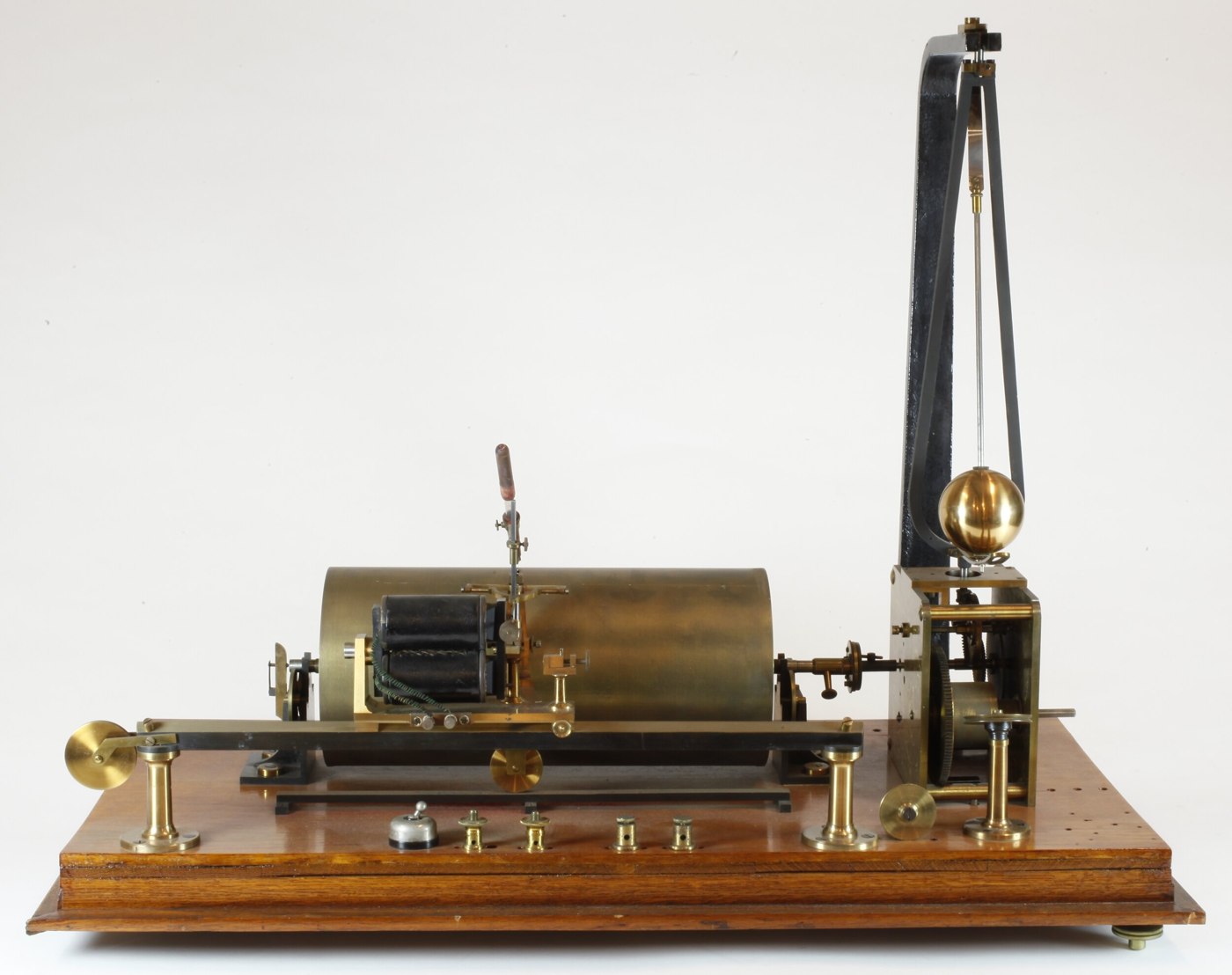
This drum chronograph is a scientific instrument designed by Robert Lewis John Ellery, the Government Astronomer in Victoria, and built at the Melbourne Observatory workshop. It dates to the 1860s or 1870s. The device is constructed on a wooden base with a large cylindrical brass drum for recording data. It features an electromagnetic mechanism connected to a recording pen, which produces marks on the drum when activated by an observer using a transit instrument. A centrifugal governor is mounted vertically on a black frame to maintain a constant speed for the rotating drum. This instrument was utilized at the Melbourne Observatory between 1870 and 1880 to record the transits of stars and other heavenly bodies, providing precise timing data for astronomical research. The configuration includes brass fittings and a prominent governor assembly, reflecting its purpose in observatory observational procedures.

The Melbourne Observatory chronograph, displaying the horizontal recording drum, the electromagnetic coil assembly, and the vertical centrifugal governor.
The Melbourne Observatory chronograph, displaying the horizontal recording drum, the electromagnetic coil assembly, and the vertical centrifugal governor. — Museums Victoria. Rights pending — permission not yet requested. Original source

Catalogue identity

Source
collections.museumsvictoria.com.au
Category
Tool · Drum chronograph
Maker / attribution
Robert Lewis John Ellery
Reference
Not recorded
Catalogue / lot identifier
ST 38319
Source-reported date
1860s-1870s
Source-reported place
Australia
Source-reported serial
ST 38319

Source-reported attribution and specifications are not independent authentication. A listing does not establish present ownership, current display, availability or permission to reproduce.

Object description

Design and Construction

The chronograph is built on a heavy wooden plinth that supports the primary mechanical assemblies. At the center lies a large, horizontally mounted brass drum, which serves as the recording surface. This drum is coupled to a gear train housed within a metal framework, which dictates the rotational speed. The entire system is supported by several brass pillars.

A prominent feature of the construction is the speed regulation system. A centrifugal governor with a spherical weight is mounted on a tall, black metal frame. This governor provides the necessary torque and speed consistency required for precise astronomical measurement. Adjacent to the drum is an electromagnetic assembly, consisting of two black-painted coils that respond to electrical impulses sent from a transit instrument.

Evidence for this section
  • “built at the observatory workshop in the 1860s or 1870s”
  • “The speed of rotation of the drum is accurately controlled by the centrifugal governor.”

Operational Function

This device functioned as a recording tool for astronomical observations. When an astronomer observed a star crossing the transit lines, they pressed a button connected to the chronograph. This action triggered an electrical impulse sent to the electromagnetic coils.

The activation of these coils moved a pen positioned over the drum. This motion created a physical mark on the drum surface at the exact moment the observation occurred. By synchronizing this pen movement with the rotation of the drum, observers could document the timing of celestial events with the necessary accuracy for meridian transit work.

Evidence for this section
  • “an electrical impulse to an electronmagnet moved the pen to one side, leaving a mark at the exact time that the star crossed the meridian.”
  • “used to record the transits of stars or other heavenly bodies.”

History and Provenance

It was constructed specifically within the Melbourne Observatory workshop during the mid-to-late nineteenth century, specifically the 1860s or 1870s.

The instrument remained in active use at the Melbourne Observatory located in South Yarra for a decade, spanning from 1870 to 1880.

Evidence for this section
  • “designed by Government Astronomer Robert Ellery and built at the observatory workshop in the 1860s or 1870s.”
  • “Transfer from Melbourne Observatory, 1945”

Open research questions

  • What specific type of marking medium was used on the brass drum surface?
  • Are there identifiable manufacturer marks or stamps on the brass components?

Source evidence

Recorded claims and source quotations for Chronograph - R. Ellery Design, Melbourne Observatory Workshop
FieldSource-reported valueSource quotation
MakerRobert Lewis John Ellery“Designer, name: Mr Robert Lewis John Ellery”
Registration numberST 38319“Registration number: ST 38319”
Date1860s-1870s“built at the observatory workshop in the 1860s or 1870s”
Dimensions80 cm x 40 cm x 65 cm“Overall Dimensions, dimensions: 80 cm (Length), 40 cm (Width), 65 cm (Height)”
OriginMelbourne Observatory Workshop“built at the observatory workshop in the 1860s or 1870s”

Visible details

  • Large brass recording drum mounted horizontally
  • Vertical centrifugal governor with a golden spherical weight
  • Electromagnetic mechanism with two black cylindrical coils
  • Mounted on a rectangular wooden base with brass support feet

Research qualifications

  • Specific date of manufacture remains defined only as the 1860s or 1870s
  • Exact construction components and internal gear mechanisms are obscured by external casing

Photograph identity and source facts were screened before import; rights clearance remains pending.

Consulted source

Chronograph - R. Ellery Design, Melbourne Observatory Workshop, Victoria, 1870s

Reviewed 2026-10-26 · Record 7dd22a3243

Terms in this record

Glossary explanations for terms named in this object’s record.