
Skip to content
The Encyclopedia of Horology

Clock · Incense clock

Chinese Incense Clock

Partially verified

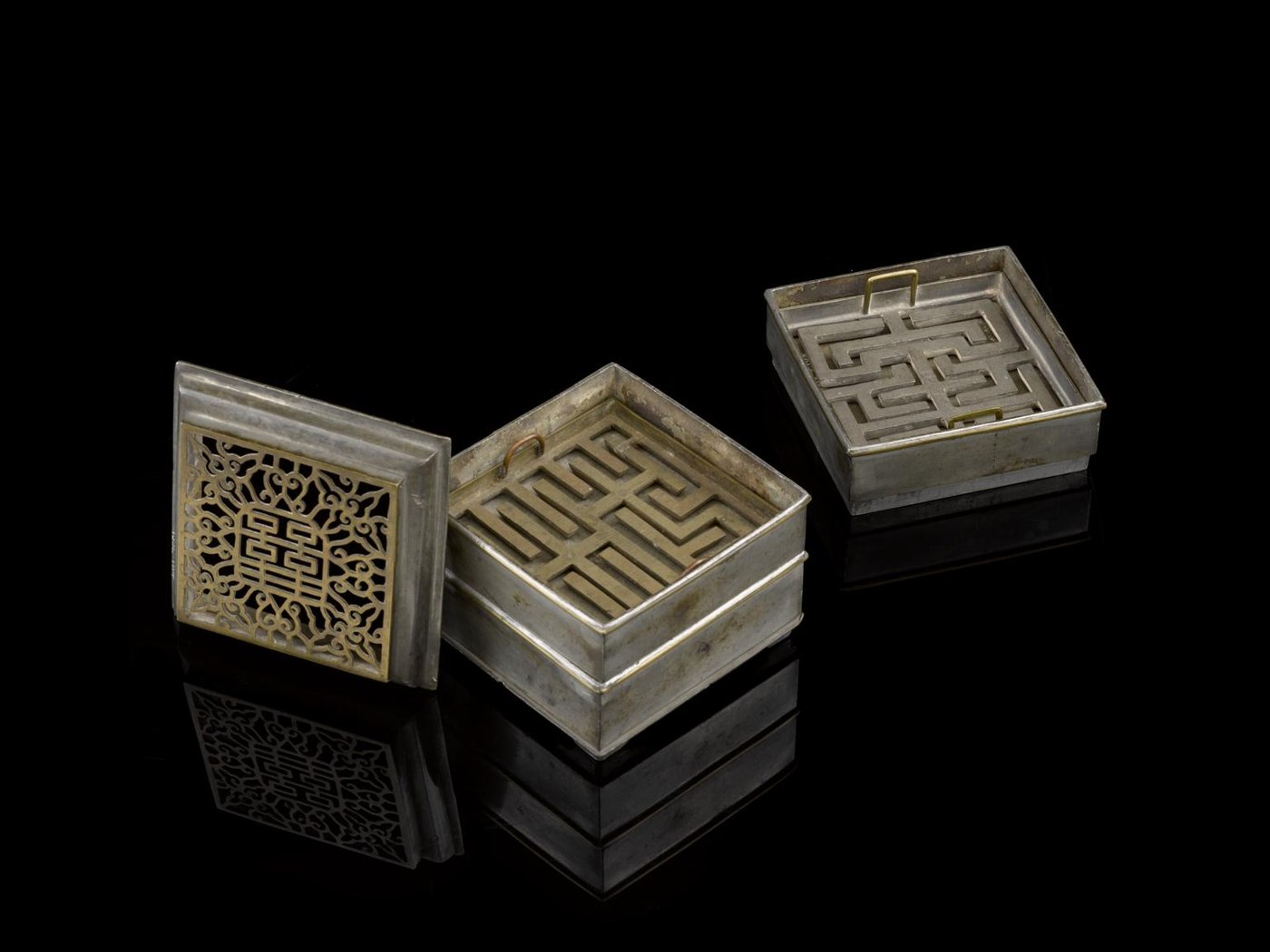
This Chinese incense clock is a timekeeping device that functions by burning powdered incense along a pre-measured path. The instrument consists of three trays, two maze-like stencils, a latticework lid, and a leveller. The lid is designed to shield the burning incense from air currents that might extinguish it. It features a decorative metal latticework incorporating the Chinese “double happiness” character, shuāng xǐ, which is associated with love and marriage. The base tray provides storage space for accessories such as a spatula or leveller. The clock was designed to accommodate the use of incense sticks of standardized lengths, often containing perfumes, allowing a user to track the passage of time through the sense of smell. , and is dated to the period between 1600 and 1950.

A Chinese incense clock consisting of three trays, two maze stencils, and a latticework lid displaying the 'double happiness' character.
A Chinese incense clock consisting of three trays, two maze stencils, and a latticework lid displaying the 'double happiness' character. — Science Museum Group. Rights pending — permission not yet requested. Original source

Catalogue identity

Source
collection.sciencemuseumgroup.org.uk
Category
Clock · Incense clock
Maker / attribution
Not established
Reference
Not recorded
Catalogue / lot identifier
1952-184
Source-reported date
1600-1950
Source-reported place
China

Source-reported attribution and specifications are not independent authentication. A listing does not establish present ownership, current display, availability or permission to reproduce.

Object description

Construction and Design

The incense clock is constructed from metal components arranged in a stacking configuration. The assembly comprises three distinct trays and a protective lid. The uppermost component is a latticework lid, which protects the incense burning path from ambient air. The lid is decorated with the "double happiness" character, or shuāng xǐ, integrated into the pattern.

Two maze stencils are included to guide the placement of the powdered incense. The trays themselves serve as the foundation for the burning process, with the base tray also designated for the storage of maintenance accessories such as a spatula or a leveller. The overall dimensions are 85 mm in height with a width and depth of 80 mm.

Evidence for this section
  • “consists of 3 trays, 2 “maze” stencils, a latticework lid and a leveller”
  • “This incense clock features the Chinese “double happiness” character, shuāng xǐ, as part of the latticework.”
  • “The design of the lid protects the incense from being extinguished by the air.”

Timekeeping Function

The object functions as a timekeeping instrument by utilizing the combustion of incense. Powdered incense is laid along a path determined by the maze stencils. Because the length of the incense sticks is standardized, the incense burns at a predictable rate. The inclusion of perfumes in the incense allows the user to mark time through the sense of smell.

The device relies on the consistent burn rate of the incense material to measure time. This method of timekeeping has been utilized in China for recreational, religious, and practical purposes for over a millennium. The maze stencils act as a template, allowing the user to select specific durations based on the path length defined by the stencil design.

Evidence for this section
  • “This clock measures time by burning powdered incense along a pre-measured path, with each stencil representing a different amount of time.”
  • “The length of incense sticks was standardised and the perfumes which could be incorporated within them enabled the user to keep time simply by using their sense of smell.”
  • “Incense clocks have been present in China for over a millennium, used for recreational, religious and practical purposes.”

Provenance and Attribution

The clock is identified by the accession number 1952-184. The object was donated to the collection by Mr. F. H. Nash.

The dating for the object is broad, spanning from 1600 to 1950. While the maker and location are provided, the historical context of the object within the collection rests on the attribution to the specified maker and place of origin.

Evidence for this section
  • “Accession number: 1952-184”
  • “made by Ming Hsin, Chao, China.”
  • “Credit: Mr. F. H. Nash”

Open research questions

  • What is the metallurgical composition of the trays and lid?
  • Can the manufacture date be narrowed down based on specific material analysis?

Source evidence

Recorded claims and source quotations for Chinese Incense Clock
FieldSource-reported valueSource quotation
Object nameclocks“Object name: clocks”
MakerMing Hsin“made by Ming Hsin, Chao, China.”
Place of originChao, China“made by Ming Hsin, Chao, China.”
Accession number1952-184“Accession number: 1952-184”
Measurements85 mm x 80 mm x 80 mm“overall: height = 85 mm x width = 80 mm x depth = 80 mm,”
Design featureDouble happiness character“This incense clock features the Chinese “double happiness” character, shuāng xǐ, as part of the latticework.”
Components3 trays, 2 maze stencils, 1 lid, 1 leveller“consists of 3 trays, 2 “maze” stencils, a latticework lid and a leveller”

Visible details

  • Includes a metal lid with intricate filigree work
  • Features the Chinese 'double happiness' symbol in the lid design
  • Consists of multiple stacking tray components
  • Maze-like metal stencils are used for the incense track

Research qualifications

  • The exact date of manufacture remains broad within a 350-year range
  • The function and usage history are documented generally for this type of object rather than this specific example

Photograph identity and source facts were screened before import; rights clearance remains pending.

Consulted source

Chinese Incense Clock

Reviewed 2026-10-26 · Record ed5afe2f29

Terms in this record

Glossary explanations for terms named in this object’s record.