
Skip to content
The Encyclopedia of Horology

Wristwatch · Reversible wristwatch

Cartier Tank Basculante

Partially verified

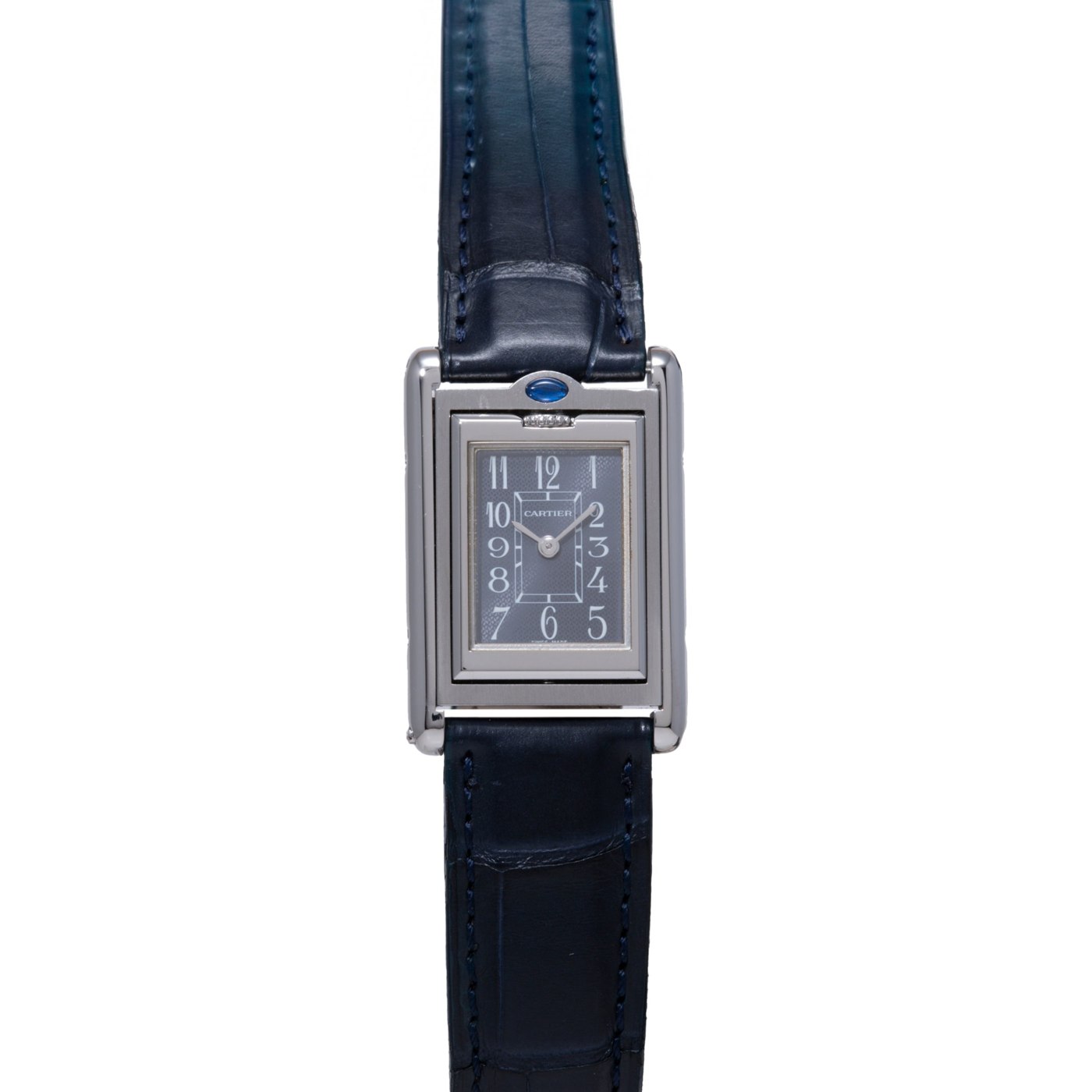
The Cartier Tank Basculante is a stainless steel reversible wristwatch first released in 1932. It features a carriage case design where the inner frame holding the dial and movement pivots within an outer rectangular housing. The watch utilizes a swinging frame mechanism that allows the case to flip, a feature designed to protect the dial side. This specific example measures 36mm x 24mm and is distinguished by a dark-colored dial with Arabic numerals and matching sword-style hands, differing from standard white or silver variants. The winding crown is positioned at the 12 o'clock location. The name is derived from the French word 'bascule', meaning seesaw, referencing the motion of the inner carriage. The watch is presented on a strap and displays a cabochon-style accent on the outer frame.

Front view of the Cartier Tank Basculante in stainless steel with a dark dial, shown with the case deployed.
Front view of the Cartier Tank Basculante in stainless steel with a dark dial, shown with the case deployed. — Analog:Shift. Rights pending — permission not yet requested. Original source

Catalogue identity

Source
analogshift.com
Category
Wristwatch · Reversible wristwatch
Maker / attribution
Cartier
Reference
AS12640
Catalogue / lot identifier
Source URL identifies the listing
Source-reported date
1932
Source-reported place
Switzerland

Source-reported attribution and specifications are not independent authentication. A listing does not establish present ownership, current display, availability or permission to reproduce.

Object description

Case Design and Mechanism

The Cartier Tank Basculante is characterized by its carriage case construction, which enables the watch head to pivot within a fixed outer frame. Unlike designs that utilize a slider mechanism, the Basculante employs a swinging frame that allows the carriage to flip, enabling the user to reverse the dial for protection. This motion provides the inspiration for the model's name, derived from the French word for 'seesaw'.

The outer housing provides a secure frame for the pivoting inner portion, which contains the movement and dial. The watch is fabricated in stainless steel and is sized at 36mm x 24mm. A notable detail is the placement of the winding crown at the 12 o'clock position, situated on the top edge of the internal carriage frame, which distinguishes it from conventional Tank models.

Evidence for this section
  • “a carriage case in which the dial and movement are housed pivoting inside an outer case”
  • “the Basculante employs a swinging frame”
  • “Hence the name, which comes from the French bascule”
  • “winding crown at 12 o'clock”

Dial and Hands

The dial displays Arabic numerals for the hour markers, arranged within a rectangular track. The display is complemented by a set of sword-style hands.

The dial incorporates subtle pattern work, adding texture to the face of the watch. The overall design maintains the geometric clarity associated with the Tank line, while the dark coloration of the dial and the specific choice of handset provide a distinct visual profile for this individual piece.

Evidence for this section
  • “This particular Basculante comes with a unqiue darker dial”
  • “Small details such as the winding crown at 12 o'clock and subtle pattern work on the dial make the Basculante truly original.”
  • “matching sword handset”

Historical Context

The Cartier Tank Basculante was released in 1932, one year following the introduction of the Jaeger-LeCoultre Reverso. While the two models share the functional purpose of a reversible case, they operate through different mechanical solutions. The Basculante's development followed the initial emergence of reversible watches during the early 1930s.

The model is cited as a variation within the broader Cartier Tank family. It is positioned by the manufacturer as a watch that emphasizes the reversible function, distinguishing it from the standard fixed-case iterations of the Tank design.

Evidence for this section
  • “Released in 1932, a year after the Jaeger-LeCoultre Reverso”
  • “it certainly shares functional similarities with the better-known model from Le Senrtier”
  • “The famed Cartier Tank comes in all shapes and sizes, perhaps none of them as unique and compelling as the Basculante.”

Open research questions

  • What movement caliber is housed within this specific case?
  • Does the caseback feature any specific hallmarks or engraving beyond the Cartier branding?

Source evidence

Recorded claims and source quotations for Cartier Tank Basculante
FieldSource-reported valueSource quotation
MakerCartier“Vendor: Cartier”
Release Year1932“Released in 1932”
Dimensions36mm x 24mm“Sized 36mm x 24mm”
Case MaterialStainless steel“in stainless steel”
Mechanism TypeSwinging frame“the Basculante employs a swinging frame”
Crown Position12 o'clock“winding crown at 12 o'clock”

Visible details

  • Dark-toned dial with white Arabic numerals
  • Outer frame features a blue cabochon stone
  • Winding crown positioned at the top of the inner carriage
  • Sword-shaped hands

Research qualifications

  • The specific production date of this exact watch is not confirmed
  • The source does not specify the movement caliber used within the carriage

Photograph identity and source facts were screened before import; rights clearance remains pending.

Consulted source

ساعت مچی Cartier Tank Basculante

Reviewed 2026-11-02 · Record 96febef5be

Terms in this record

Glossary explanations for terms named in this object’s record.