
Skip to content
The Encyclopedia of Horology

Clock · Prismatic desk clock

Cartier Pendule Mystérieuse à Prisme Desk Clock

Partially verified

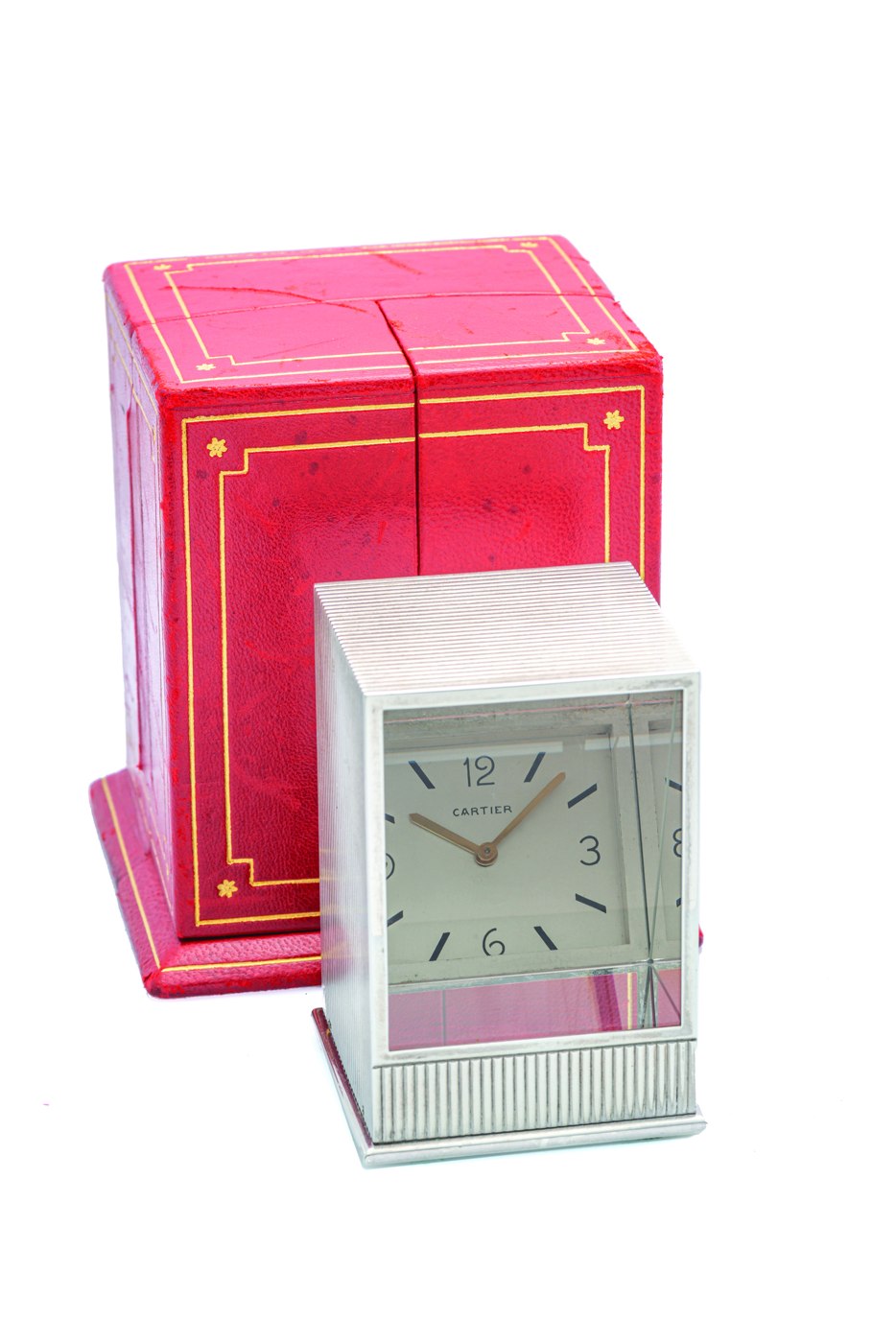
This Cartier desk clock, identified as the 'Pendule Mystérieuse à Prisme', dates to approximately 1950. The timepiece is housed in a vertical, rectangular silver cabinet characterized by a polished 'godronné' or fluted décor. The upper section of the clock contains two opposing rock crystal prisms, designed to reflect the dial and hands to the viewer, creating an optical illusion. The clock features a matte silver dial adorned with painted suspended Arabic numerals and radial indexes, complemented by gilded metal 'Bâton' hands. It utilizes a keyless-winding movement, which is adjusted through a crown located in a side recess. The base is secured by four screws. The clock is accompanied by its original fitted box, referred to as 'La petite boîte rouge'. The object displays signatures on the case, dial, and movement.

A front view of the Cartier Pendule Mystérieuse à Prisme, displaying the fluted silver case, prism optics, and the accompanying red fitted storage box.
A front view of the Cartier Pendule Mystérieuse à Prisme, displaying the fluted silver case, prism optics, and the accompanying red fitted storage box. — Antiquorum. Rights pending — permission not yet requested. Original source

Catalogue identity

Source
catalog.antiquorum.swiss
Category
Clock · Prismatic desk clock
Maker / attribution
Cartier
Reference
Not recorded
Catalogue / lot identifier
239
Source-reported date
Circa 1950
Source-reported place
France
Source-reported serial
Case No. 02 164; Movement No. 104 922 M

Source-reported attribution and specifications are not independent authentication. A listing does not establish present ownership, current display, availability or permission to reproduce.

Object description

Case and Dial Construction

The Cartier desk clock features a vertical, rectangular silhouette fabricated in silver. The exterior is finished with a 'godronné' or fluted decorative motif. Access to the manual winding and hand-setting mechanism is provided by a crown recessed into the side of the case, while the base is firmly secured via four lateral screws.

The dial is rendered in a matte silver finish, featuring painted Arabic numerals that appear suspended, paired with radial indexes. Visibility of the dial and the gilded metal 'Bâton' hands is facilitated by two opposing rock crystal prisms positioned in the upper housing. These prisms manipulate the light, creating an optical effect that requires the viewer to observe from specific angles.

Evidence for this section
  • “Cabinet with polished “godronné” (fluted) décor”
  • “two blocks of optical glass, placed in a cubic and vertical case, which by opposing their inclined faces in such a way that the dial and the hands are visible only from certain angles”

Movement and Technical Specifications

The timepiece is powered by an eight-day going movement, identified as a 19’’’ rhodium-plated caliber. The movement operates with a straight-line lever escapement and includes a cut bimetallic balance with poising screws and a blued steel flat balance spring. Regulation is managed by a polished index-regulator. The movement is signed by Cartier and functions with 15 jewels.

The technical architecture of the movement is based on the LeCoultre caliber 205 (or 19 LECBC).

Evidence for this section
  • “Movement 19’’’, rhodium plated, straight line lever escapement, cut bimetallic balance with poising screws”
  • “based on LeCoultre cal. 205 (or 19 LECBC), 15 jewels”
  • “Overhaul recommended, at buyer's expense”

Provenance and Markings

The clock is fully signed across its primary components, including the case, the dial, and the movement. The case bears the number 02 164, while the movement is identified by number 104 922 M.

The object is supplied with its original fitted case, known as 'La petite boîte rouge'. The dating of the piece is provided as circa 1950, aligning with the period during which Cartier utilized Jaeger-LeCoultre movements for these prism clock designs. An illegible master mark is present on the case, which the auction description suggests may be attributed to the workshop of Edmond Jaeger in Paris.

Evidence for this section
  • “Case No. 02 164 (with illegible master mark; probably by Edmond Jaeger, Paris)”
  • “Signature Case, Dial and Movement”
  • “Year Circa 1950”

Open research questions

  • Can the illegible master mark on the case be definitively linked to a specific workshop through comparative analysis of other 02 164 serial clocks?
  • Is there documentation confirming the exact production year within the 1950s for this specific movement serial number?

Source evidence

Recorded claims and source quotations for Cartier Pendule Mystérieuse à Prisme Desk Clock
FieldSource-reported valueSource quotation
MakerCartier“Brand Cartier, Paris”
MaterialSilver“Silver, keyless-winding”
Dimensions83.3 x 59.8 x 58.7 mm“Dimensions 83.3 x 59.8 x 58.7 mm”
Jewels15“15 jewels”
Case decorationGodronné“Cabinet with polished “godronné” (fluted) décor”
AccessoriesOriginal fitted box“Original fitted box (so-called “La petite boîte rouge”)”

Visible details

  • Vertical rectangular case with fluted silver decoration
  • Dual rock crystal prisms in the upper viewing section
  • Keyless winding crown located in a side recess
  • Fitted with a red leather storage box

Research qualifications

  • Master mark on the case is illegible and identified only as likely by Edmond Jaeger
  • Overhaul of the movement is recommended by the auction description
  • Exact caliber identification varies between 205 and 19 LECBC

Photograph identity and source facts were screened before import; rights clearance remains pending.

Terms in this record

Glossary explanations for terms named in this object’s record.