
Skip to content
The Encyclopedia of Horology

Pocket watch · Skeleton pocket watch

Carl Chasté Skeleton Pocket Watch

Partially verified

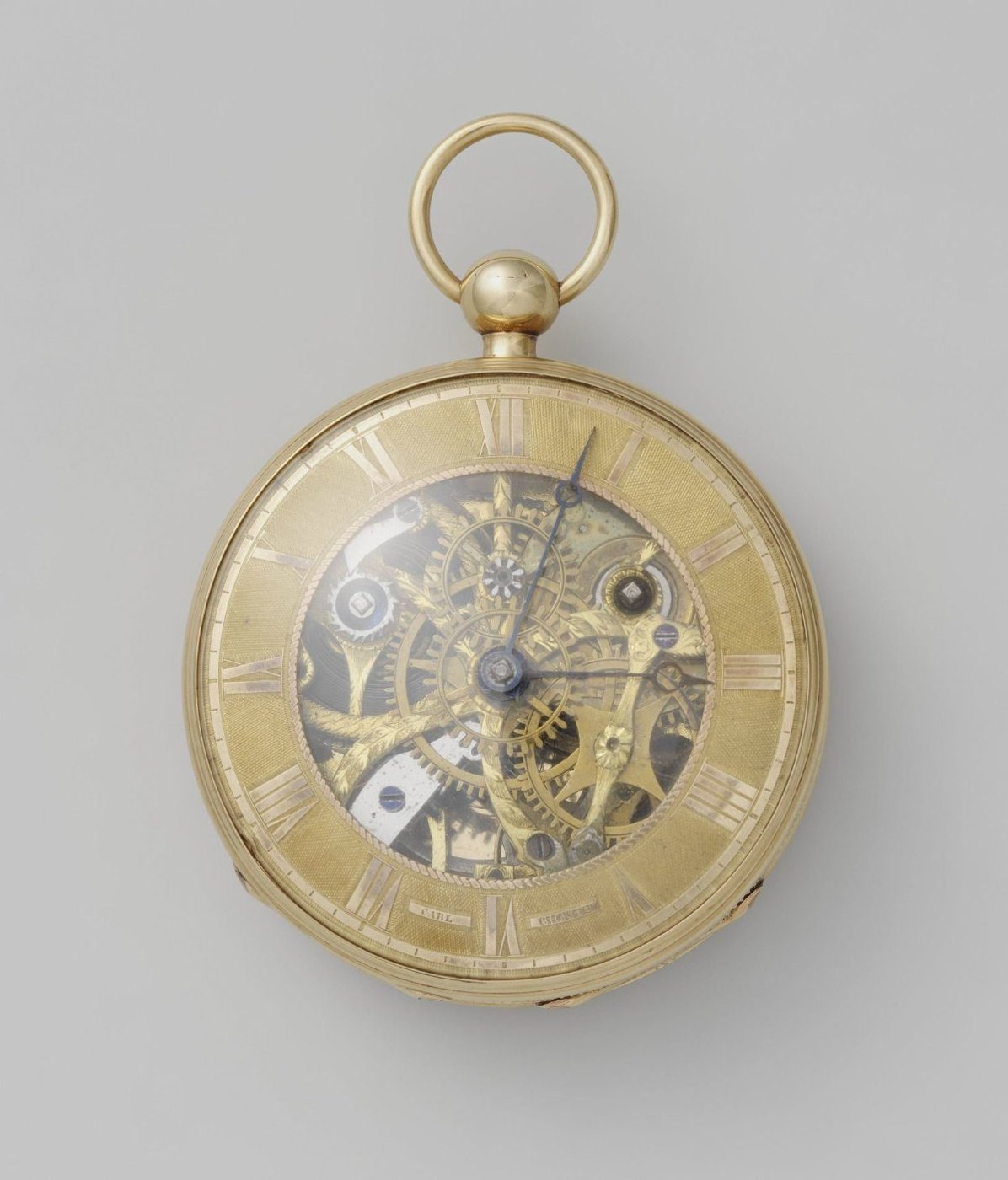
This gold skeleton pocket watch, identified by the Rijksmuseum as object BK-15081, is signed by Carl Chasté of Amsterdam. The watch dates from before 1815. Its construction features a gold case with a ribbed band (carure) and a back cover decorated with guilloché engraving, centered around a small circular panel. The dial design incorporates a hatched chapter ring featuring Roman hour numerals and a significant central aperture, which allows for the direct observation of the movement's gear train. The watch is also visible from the reverse, as the back plate has been replaced with glass to provide a view of the internal mechanism. The object was bequeathed to the museum in 1937 as part of the Maurits Elzas Collection.

Front view of the Carl Chasté skeleton pocket watch showing the gold case, Roman numerals on the dial, and exposed internal gear train.
Front view of the Carl Chasté skeleton pocket watch showing the gold case, Roman numerals on the dial, and exposed internal gear train. — Rijksmuseum. Rights pending — permission not yet requested. Original source

Catalogue identity

Source
www.rijksmuseum.nl
Category
Pocket watch · Skeleton pocket watch
Maker / attribution
Carl Chasté
Reference
Not recorded
Catalogue / lot identifier
BK-15081
Source-reported date
before 1815
Source-reported place
Netherlands

Source-reported attribution and specifications are not independent authentication. A listing does not establish present ownership, current display, availability or permission to reproduce.

Object description

Case and Dial Design

The watch is housed in a gold case, which is specifically described as a men's timepiece. The exterior of the back cover features an intricate guilloché pattern covering the surface, excluding a small central circular section. The middle case band, or carure, is finished with a distinct ribbed texture.

The front of the watch presents a gold dial featuring a textured, hatched chapter ring with Roman numeral markers. A large central aperture is cut into the dial, exposing the gold-colored gear train beneath.

Evidence for this section
  • “Gouden herenhorloge, de achterbodem geheel geguillocheerd met uitzondering van een kleine cirkel. De carure is geribd.”
  • “De wijzerplaat met gearceerde cijferring met gouden Romeinse uurcijfers heeft een cirkelvormige opening waardoor het radarwerk zichtbaar is”

Movement and Construction

The movement is constructed such that the gear train is revealed through both the dial side and the back of the watch. In order to achieve this display, the original back plate of the movement has been replaced with a glass panel, permitting a visual inspection of the internal components.

The museum suggests that while Carl Chasté is the signed merchant for this piece, the actual fabrication of the movement remains anonymous. Based on cataloguing records, there is a possibility that the movement was produced in Switzerland before 1815, though this remains an attribution of probability rather than certainty.

Evidence for this section
  • “aan de onderzijde, waar de platine vervangen is door glas.”
  • “uurwerkmaker: anoniem, Zwitserland (mogelijk)”

Signatures and Provenance

The watch bears the signature of Carl Chasté, which is marked on the copper border of the assembly. This signature identifies the shop responsible for the watch during the period before 1815.

The provenance of the item is documented through its history within the Maurits Elzas Collection.

Evidence for this section
  • “Gemerkt op de koperen rand: Carl Chasté.”

Open research questions

  • What is the origin of the movement components if confirmed to be Swiss?
  • Is there further documentation regarding the specific 'Landzaat' firm that sold the watch in 1930?

Source evidence

Recorded claims and source quotations for Carl Chasté Skeleton Pocket Watch
FieldSource-reported valueSource quotation
MakerCarl Chasté“winkelbedrijf: Carl Chasté, Amsterdam”
Movement makerAnonymous, possibly Swiss“uurwerkmaker: anoniem, Zwitserland (mogelijk)”
DateBefore 1815“voor 1815”
Case materialGold“Gouden herenhorloge”
Case decorationGuilloché“de achterbodem geheel geguillocheerd”
Case bandRibbed“De carure is geribd.”
SignatureCarl Chasté“Gemerkt op de koperen rand: Carl Chasté.”
ProvenanceMaurits Elzas Collection“whom bequeathed with 106 other watches, as part of the 'Maurits Elzas Collection'”

Visible details

  • Hatched chapter ring with Roman numerals
  • Visible skeletonized gear train through the center of the dial
  • Ribbed pattern on the middle case band
  • Glass back plate for movement visibility

Research qualifications

  • The identity of the movement maker is speculative
  • The exact date of manufacture is only confirmed as being before 1815

Photograph identity and source facts were screened before import; rights clearance remains pending.

Consulted source

Skeleton watch

Reviewed 2026-11-02 · Record 450b8edf9b

Terms in this record

Glossary explanations for terms named in this object’s record.