
Skip to content
The Encyclopedia of Horology

Clock · Wall clock

Camerer Cuss Holborn Town Hall wall clock

Partially verified

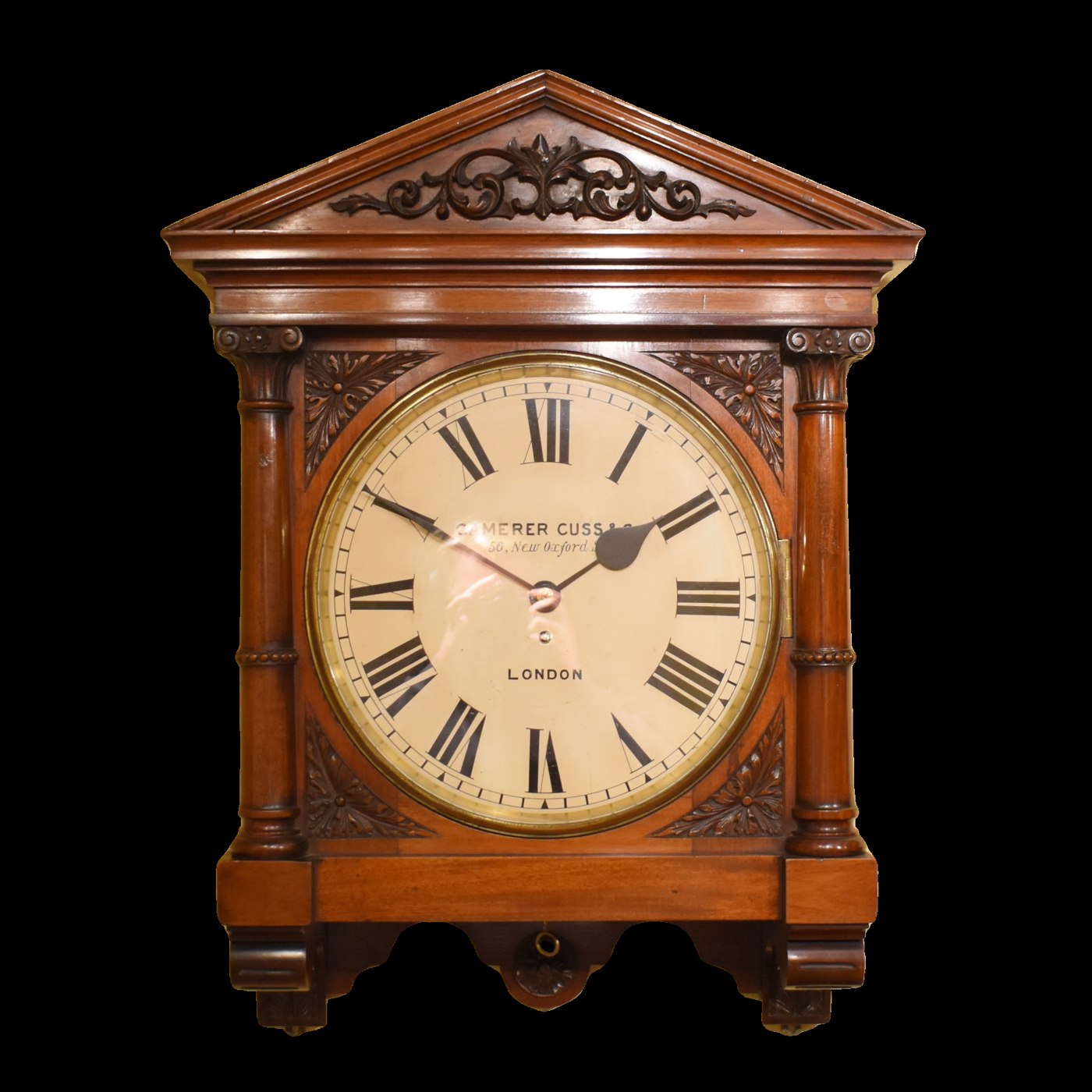
This wall clock is attributed to the London-based firm Camerer Cuss and is dated to circa 1880. The clock features a 14-inch dial housed within a wooden case, which the seller suggests is red walnut. The design incorporates architectural elements, specifically two carved pilasters with capitals flanking the dial and quarter-carved panels. The piece is powered by a substantial fusee movement of 8-day duration. The dial displays the retailer's name, 'Camerer Cuss & Co.' with their address at 56 New Oxford Street, London. The clock is associated by the source with the Holborn Town Hall, a structure completed in 1879. The source notes that the rear of the dial bears scratched inscriptions referencing the firm and the location. The clock remains in its original dial configuration, with reported signs of wear consistent with its age and environment.

Front view of the Camerer Cuss wall clock showing the architectural wooden case and the signed dial.
Front view of the Camerer Cuss wall clock showing the architectural wooden case and the signed dial. — The Clock & Watch Shop. Rights pending — permission not yet requested. Original source

Catalogue identity

Source
theclockandwatchshop.co.uk
Category
Clock · Wall clock
Maker / attribution
Camerer Cuss
Reference
Not recorded
Catalogue / lot identifier
Source URL identifies the listing
Source-reported date
circa 1880
Source-reported place
United Kingdom
Source-reported serial
CL-WL-1555

Source-reported attribution and specifications are not independent authentication. A listing does not establish present ownership, current display, availability or permission to reproduce.

Object description

Case and Dial Design

The wall clock is housed in a wooden case characterized by architectural detailing. The case includes a pediment top adorned with carved ornamentation. The central dial is 14 inches in diameter and is flanked by two prominent pilasters that terminate in carved capitals. Additional decorative carved panels are situated at the corners surrounding the dial face.

The dial is printed with Roman numerals and includes the retailer's signature, 'Camerer Cuss & Co.' alongside their address at 56 New Oxford Street and 'London'. According to the auction description, the dial is in original condition and displays signs of age-related wear. A small aperture for winding is present, and a rectangular access door is integrated into the lower portion of the case structure.

Evidence for this section
  • “The clock shows two pilasters either side of the 14 inch dial with carved Capitals and quarter carved panels around the dial.”
  • “The rear of the dial has Camerer Cuss writing and the words Town Hall scratched in.”

Movement and Function

The timepiece is powered by a substantial fusee movement. The fusee ensures a consistent force is delivered to the gear train as the mainspring unwinds.

The clock operates via a traditional winding system accessed through the dial. While specific internal dimensions of the movement are not provided, the housing suggests a robust construction intended for long-term service in a building environment.

Evidence for this section
  • “It has a substantial 'fusee' movement of 8 day duration”

Association and History

The source attributes the clock to the Holborn Town Hall, a building constructed in 1879 in the French Renaissance style.

Camerer Cuss operated from 56 New Oxford Street, a location in proximity to the town hall. The identification of the object's history is supported by the seller's report of inscriptions found on the reverse side of the dial, which specifically mention the firm and the name 'Town Hall' scratched into the material.

Evidence for this section
  • “This wall clock hung in Holborn Town Hall which is a beautiful building in the French Renaissance style built in 1879.”
  • “The rear of the dial has Camerer Cuss writing and the words Town Hall scratched in.”

Open research questions

  • What is the definitive provenance of the clock within the Holborn Town Hall archives?
  • Is there any evidence to confirm the wood type as red walnut through microscopic analysis?

Source evidence

Recorded claims and source quotations for Camerer Cuss Holborn Town Hall wall clock
FieldSource-reported valueSource quotation
MakerCamerer Cuss“Camerer Cuss”
Movement8 day fusee“substantial 'fusee' movement of 8 day duration”
Dial size14 inch“14 inch dial”
Case materialWood (attributed as Red Walnut)“We think the wood is Red Walnut.”
DateCirca 1880“Circa 1880.”
SKUCL-WL-1555“CL-WL-1555”

Visible details

  • The dial is signed 'Camerer Cuss & Co. 56 New Oxford St. LONDON'
  • The case features a pediment top with carved decorative elements
  • Two vertical pilasters flank the central clock dial
  • A small rectangular access door is visible on the lower front section of the case

Research qualifications

  • The identification of the wood as 'Red Walnut' is a speculative assessment by the seller
  • The history of the clock hanging specifically in the Holborn Town Hall entrance area is presented as a suggested scenario rather than confirmed provenance

Photograph identity and source facts were screened before import; rights clearance remains pending.

Consulted source

Camerer Cuss Holborn Town Hall Wall Clock

Reviewed 2026-11-02 · Record 1cce57c6b4

Terms in this record

Glossary explanations for terms named in this object’s record.