
Skip to content
The Encyclopedia of Horology

Clock · Table clock

Cabinet Clock

Partially verified

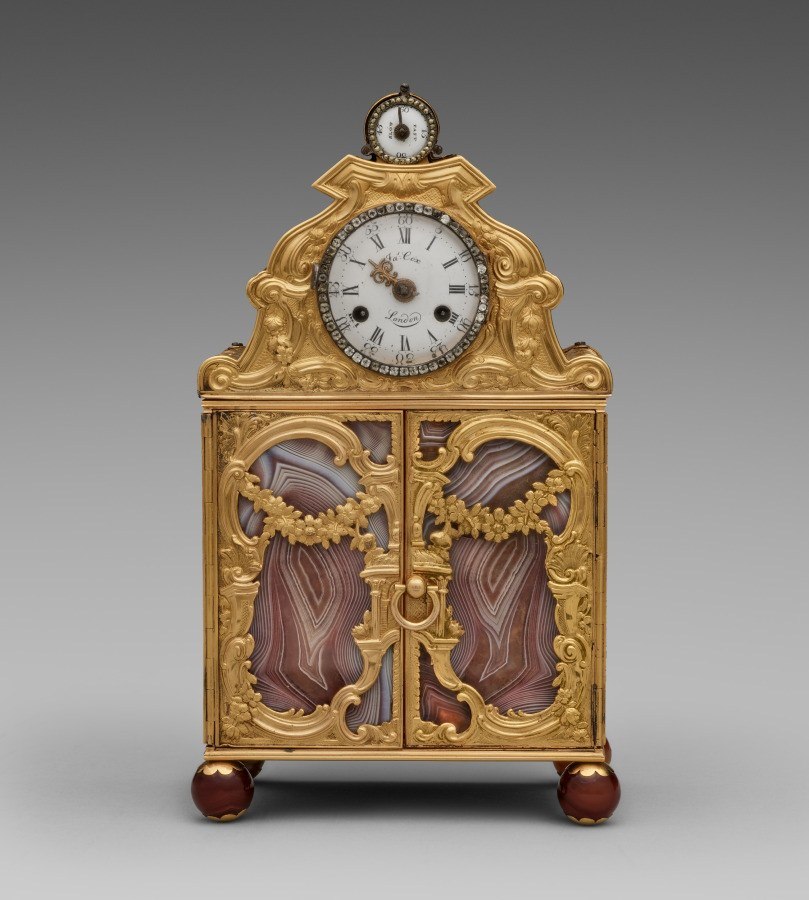
This miniature cabinet clock is attributed to the London goldsmith James Cox and dates to circa 1770–1775. The object features a highly ornate gold case construction measuring 16.5 x 8.9 cm, with two doors faced with panels of agate set within elaborate gilded scrolling frames. The primary white enamel dial is surrounded by a border of stones or paste, displaying Roman numerals for the hours and Arabic numerals for the minutes, signed 'Ja: Cox' and 'London'. A smaller secondary dial, similarly bordered, is mounted at the apex of the case. The doors of the lower cabinet section open to reveal two small interior drawers designed to hold the winding keys for the timepiece mechanism. Although this example was produced by a maker known for integrating mechanical musical devices, the current object no longer contains such a mechanism.

The miniature cabinet clock featuring an enamel dial signed by James Cox and agate panels on the doors.
The miniature cabinet clock featuring an enamel dial signed by James Cox and agate panels on the doors. — Cleveland Museum of Art. Rights pending — permission not yet requested. Original source

Catalogue identity

Source
clevelandart.org
Category
Clock · Table clock
Maker / attribution
James Cox
Reference
2009.77
Catalogue / lot identifier
2009.77
Source-reported date
c. 1770–75
Source-reported place
England

Source-reported attribution and specifications are not independent authentication. A listing does not establish present ownership, current display, availability or permission to reproduce.

Object description

Construction and Design

The cabinet clock stands 16.5 cm tall and utilizes a combination of materials, including gold, agate, glass, and white enamel. The lower cabinet features a pair of doors with panels of agate, encased within decorative gold filigree and scrolling metalwork. These doors provide access to internal storage drawers, which were designed specifically to house the winding keys for the clock assembly located above.

The primary dial is situated within a raised, pediment-like top section of the cabinet. It features a white enamel finish with black markings and is encircled by a decorative border. A secondary, smaller dial is positioned at the very top center of the clock structure, also featuring a matching border. The entire assembly rests upon four rounded feet, contributing to the overall miniature scale of the piece.

Evidence for this section
  • “gold, agate, enamel dial, glass”
  • “The doors of this miniature cabinet open to reveal two small drawers that held the winding keys for the clock above.”

Signature and Attribution

The object is attributed to the London-based goldsmith James Cox. The signature appears clearly on the face of the enamel dial, inscribed as 'Ja: Cox' with 'London' placed directly below the center of the dial. James Cox was recognized for his ability to produce intricate, luxury goods that often incorporated mechanical surprises.

While Cox is the credited maker of this cabinet clock, the provenance and historical context provided by the institution note that such items were often produced for export, particularly to the court of the Chinese emperor Ch'ien Lung during the late 18th century. The signature serves as the primary indicator of the piece's origin in the British capital.

Evidence for this section
  • “attributed to James Cox”
  • “Many of these timepieces were designed for export and sold to the Chinese emperor Ch'ien Lung (1711–1799)”

Mechanical and Functional Status

The cabinet clock was originally designed as part of a series of objects that often included integrated mechanical devices. However, the current example of this cabinet clock is documented as lacking these musical capabilities.

The interior of the clock demonstrates a specialized function regarding the management of its timekeeping component. The drawers behind the agate doors were explicitly intended for the retention of the winding keys, which ensures the operation of the timepiece. The absence of the musical mechanism is noted as a change from the production intention for similar luxury goods of the period.

Evidence for this section
  • “James Cox, the London goldsmith responsible for this clock and case, was known for creating such tuneful surprises, although this work no longer contains such a mechanism.”
  • “The doors of this miniature cabinet open to reveal two small drawers that held the winding keys for the clock above.”

Open research questions

  • What is the specific composition of the internal movement behind the enamel dial?
  • Are there visible remnants inside the cabinet that indicate how the now-missing musical mechanism was originally mounted?

Source evidence

Recorded claims and source quotations for Cabinet Clock
FieldSource-reported valueSource quotation
Datec. 1770–75“c. 1770–75”
MakerJames Cox“attributed to James Cox”
Materialsgold, agate, enamel dial, glass“gold, agate, enamel dial, glass”
Dimensions16.5 x 8.9 cm“16.5 x 8.9 cm”
Primary functiontimekeeping with integrated storage“The doors of this miniature cabinet open to reveal two small drawers that held the winding keys for the clock above.”

Visible details

  • Enamel dial signed 'Ja: Cox' and 'London'
  • Gilded metal frame with scrolling foliate ornamentation
  • Two doors inset with agate panels
  • Small secondary dial located at the top of the clock

Research qualifications

  • The internal musical mechanism, if originally present, is missing
  • The specific nature of the stone used for the feet remains unconfirmed

Photograph identity and source facts were screened before import; rights clearance remains pending.

Consulted source

Cabinet Clock

Reviewed 2026-11-02 · Record e75bfa29d2

Terms in this record

Glossary explanations for terms named in this object’s record.