
Skip to content
The Encyclopedia of Horology

Clock · Table clock

C. F. A. Voysey Tempus Fugit Clock

Partially verified

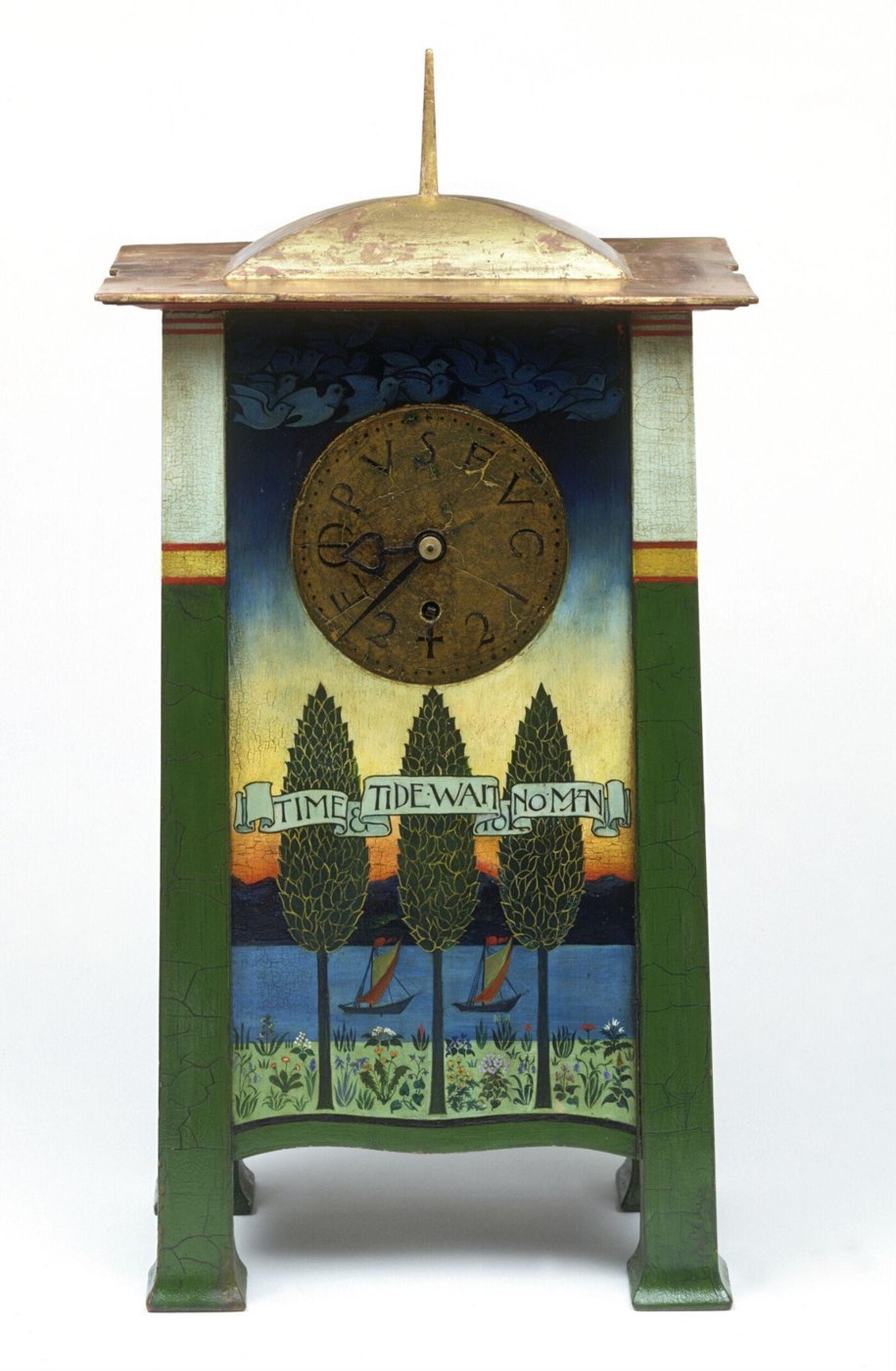
This architectural table clock, dated 1896, features a mahogany case designed and painted by the architect C. F. A. Voysey, with the physical construction attributed to Frederick Coote. The clock is powered by a conventional brass and steel movement produced by Camerer, Kuss & Co. The case exhibits hand-painted decoration in flat patterns, including depictions of cypress trees, floral motifs, and sailing boats. Across the front, a painted banner displays the phrase 'TIME & TIDE WAIT FOR NO MAN'. The circular clock face, made of metal, incorporates the Latin inscription 'TEMPUS FUGIT' in place of traditional numerals, framing the central clock hands. The timepiece stands on four flared legs and is surmounted by a gilded, domed top with a central spire.

Front view of the C. F. A. Voysey Tempus Fugit clock, displaying the dial with Latin inscription and the painted banner on the case.
Front view of the C. F. A. Voysey Tempus Fugit clock, displaying the dial with Latin inscription and the painted banner on the case. — Victoria and Albert Museum. Rights pending — permission not yet requested. Original source

Catalogue identity

Source
collections.vam.ac.uk
Category
Clock · Table clock
Maker / attribution
C. F. A. Voysey
Reference
Not recorded
Catalogue / lot identifier
W.5:1-1998
Source-reported date
1896
Source-reported place
England

Source-reported attribution and specifications are not independent authentication. A listing does not establish present ownership, current display, availability or permission to reproduce.

Object description

Construction and Design

The clock is housed in a mahogany case of an architectural form that rests on four flared feet. , utilizing patterns described as flat and childlike, similar to those he applied to his work in textiles and wallpaper design. A gilded dome with a central spire completes the upper section of the housing. The case was painted and gilded by C. F. A. Voysey

The movement driving the clock is a standard brass and steel mechanism manufactured by Camerer, Kuss & Co. The clock is 50.8 cm high, 27.1 cm wide, and 17.2 cm deep.

Evidence for this section
  • “Mahogany clock case with painted and gilded decoration”
  • “Movement made of brass and steel, by Camerer, Kuss & Co.”

Dial and Inscriptions

The clock face deviates from standard numeral display. Instead of Roman or Arabic numerals, the dial bears the Latin phrase 'TEMPUS FUGIT', translated as 'time flies', arranged around the periphery. This modification was a known feature of Voysey's clock designs by 1901. This object, acquired via the Art Fund, is a documented example of the 'Tempus Fugit' clock design produced by Voysey at the end of the nineteenth century.

Below the dial, a painted banner on the case body features the phrase 'TIME & TIDE WAIT FOR NO MAN', integrated into a landscape scene that includes cypress trees, flora, and sailing vessels, which further embellishes the front of the object.

Evidence for this section
  • “By 1901 he had exchanged the numerals for the Latin phrase tempus fugit”
  • “the numerals replaced by the letters TEMPUS FUGIT”

Provenance and History

Designed in 1895, the clock was associated with Voysey's exhibition history, including the 1896 Arts and Crafts Exhibition Society in London. The designer owned a similar clock, which is documented in photographs of his home, The Orchard, taken in 1901.

The specific item was purchased by John Jesse at the Portobello Market in 1970 with no recorded provenance. It was later placed on loan to the museum before being acquired for the collection with support from the Art Fund and the Friends of the V&A.

Evidence for this section
  • “John Jesse purchased this clock without a provenance at Portobello Market in 1970.”
  • “Purchased with Art Fund support and the Friends of the V&A”

Open research questions

  • Is there evidence of earlier provenance for this specific object before its 1970 market purchase?
  • Does the movement retain its original components or are there signs of later modifications?

Source evidence

Recorded claims and source quotations for C. F. A. Voysey Tempus Fugit Clock
FieldSource-reported valueSource quotation
Accession numberW.5:1-1998“Accession number: W.5:1-1998”
DesignerC. F. A. Voysey“Maker: C. F. A. Voysey (designer)”
Movement MakerCamerer, Kuss & Co.“Movement made of brass and steel, by Camerer, Kuss & Co.”
Case MakerFrederick Coote“probably made by Frederick Coote in London”
Dimensions50.8 cm x 27.1 cm x 17.2 cm“Height: 50.8 cm; Width: 27.1 cm; Depth: 17.2 cm”
InscriptionTEMPUS FUGIT and TIME & TIDE WAIT FOR NO MAN“the numerals replaced by the letters TEMPUS FUGIT”

Visible details

  • Clock face inscribed with 'TEMPUS FUGIT' in place of numerals
  • Hand-painted banner across the center reads 'TIME & TIDE WAIT FOR NO MAN'
  • Case stands on four flared feet and features a gilded dome top with a spire
  • Visible craquelure in the painted surfaces of the mahogany case

Research qualifications

  • Maker of the clock case is 'probably' Frederick Coote, rather than definitively confirmed
  • Exact provenance prior to 1970 purchase at Portobello Market is not recorded

Photograph identity and source facts were screened before import; rights clearance remains pending.

Consulted source

Clock

Reviewed 2026-10-26 · Record 045b1e3928

Terms in this record

Glossary explanations for terms named in this object’s record.