
Skip to content
The Encyclopedia of Horology

Wristwatch · Day-Date electronic tuning fork watch

Bulova Accutron Day-Date 'Holographic'

Partially verified

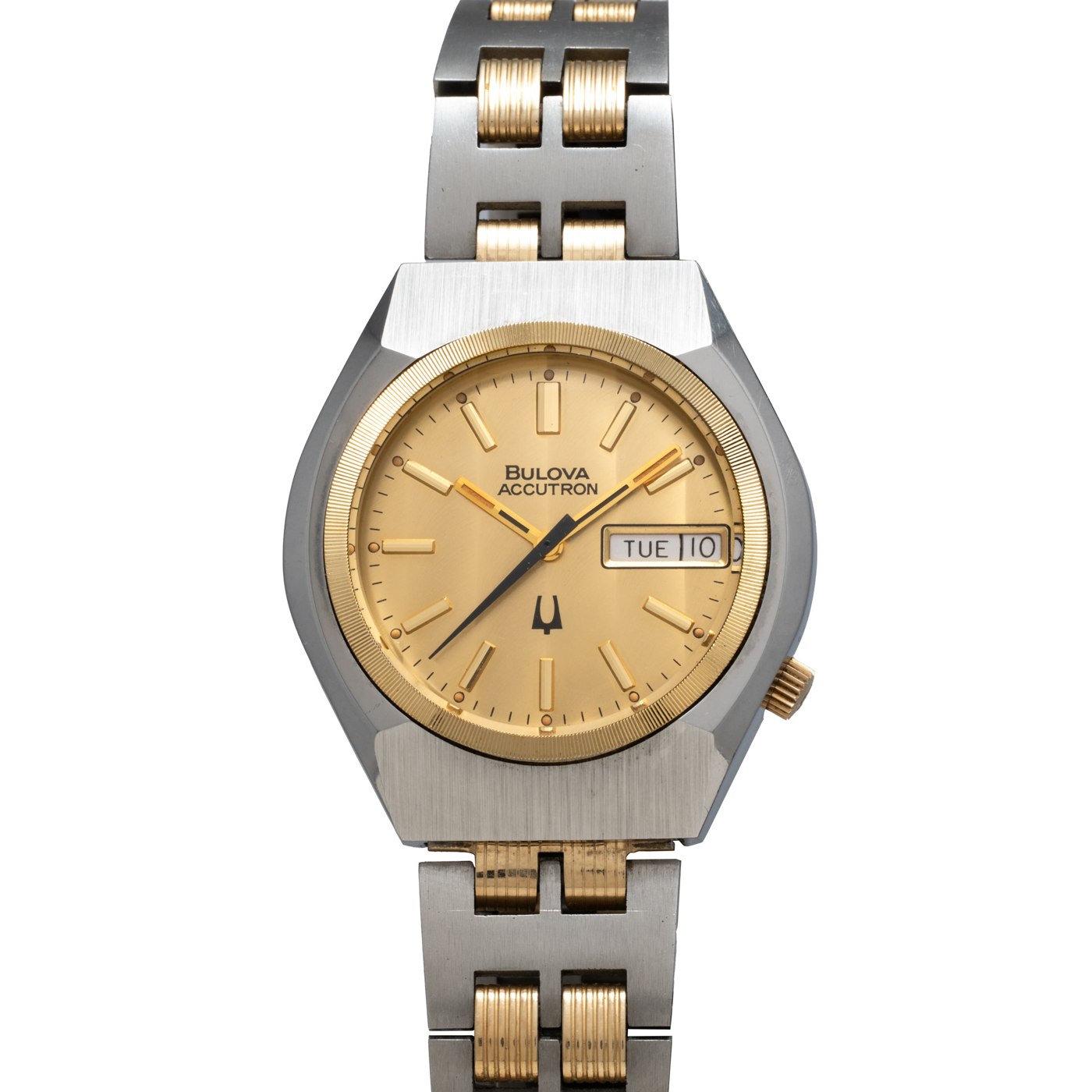
This Bulova Accutron Day-Date 'Holographic' is a vintage wristwatch produced in 1976. The watch features an electronically powered tuning fork movement, specifically the Caliber 218, which operates at 360 hertz. Unlike traditional mechanical movements, this system does not utilize a balance wheel. The timepiece is housed in a case featuring architectural proportions and is paired with a two-tone bracelet. The dial is described as a 'Holographic' champagne display with applied indexes. The watch includes a day and date complication with a display window positioned at the 3 o'clock mark. The crown is located at the 4 o'clock position. The production year is attributed to 1976 based on the 'N6' caseback date code, with the 'N' designating the 1970s and the '6' identifying the specific year.

Front view of the Bulova Accutron Day-Date, showing the champagne dial, day-date aperture, and two-tone bracelet.
Front view of the Bulova Accutron Day-Date, showing the champagne dial, day-date aperture, and two-tone bracelet. — Analog Shift. Rights pending — permission not yet requested. Original source

Catalogue identity

Source
analogshift.com
Category
Wristwatch · Day-Date electronic tuning fork watch
Maker / attribution
Bulova
Reference
Not recorded
Catalogue / lot identifier
Source URL identifies the listing
Source-reported date
1976
Source-reported place
United States

Source-reported attribution and specifications are not independent authentication. A listing does not establish present ownership, current display, availability or permission to reproduce.

Object description

Movement and Performance

The watch is powered by the Bulova Accutron Caliber 218. This movement operates via an electronically powered tuning fork system, which vibrates at a frequency of 360 hertz. The mechanism replaces the traditional balance wheel found in mechanical watches, providing a continuous sweep motion for the hands.

Bulova stated the performance of this movement was within one minute per month. This battery-driven system represents a shift from mechanical timekeeping to electronic oscillation during the 1970s.

Evidence for this section
  • “Powered by the legendary Accutron Caliber 218”
  • “an electronically powered tuning fork vibrates at 360 hertz”
  • “accuracy that Bulova claimed was within one minute per month”

Case and Dial Design

The watch features a two-tone aesthetic, combining silver and gold tones on both the case and the bracelet. The case is described as having architectural, substantial, and grounded proportions. A champagne-colored 'Holographic' dial serves as the primary visual element.

The dial includes applied indexes and a day-date complication, with the aperture located at the 3 o'clock position. The crown is offset to the 4 o'clock position, a design choice intended to facilitate easier setting and wear compared to earlier Accutron models.

Evidence for this section
  • “A lovely 'Holographic' champagne dial with applique indexes”
  • “returned the crown to a more conventional position (often at 4 o’clock)”
  • “The case proportions feel architectural, grounded, and substantial”

Identification and Dating

The object is identified as a 1976 production based on the 'N6' code marked on the caseback. The alphanumeric coding system used by Bulova during this era utilized the letter to represent the decade, with 'N' corresponding to the 1970s.

The number following the letter identifies the specific year, meaning 'N6' confirms 1976. This model is noted as a successor to the 214 series, incorporating design refinements such as the repositioned crown.

Evidence for this section
  • ““N6” caseback date code”
  • “The "N" signifies the 1970s decade, and the "6" indicates the specific year 1976”
  • “Introduced as the successor to the iconic 214”

Open research questions

  • Are there any additional hallmarks or engravings visible on the caseback that corroborate the 'N6' date code?
  • What is the specific material composition of the two-tone bracelet and case (e.g., gold-plated vs. solid gold)?

Source evidence

Recorded claims and source quotations for Bulova Accutron Day-Date 'Holographic'
FieldSource-reported valueSource quotation
MakerBulova“Bulova Accutron”
MovementAccutron Caliber 218“Powered by the legendary Accutron Caliber 218”
Frequency360 hertz“an electronically powered tuning fork vibrates at 360 hertz”
Production Year1976“produced in 1976 (as confirmed by its “N6” caseback date code)”
Crown Position4 o'clock“returned the crown to a more conventional position (often at 4 o’clock)”
Dial DescriptionHolographic champagne dial“A lovely 'Holographic' champagne dial”

Visible details

  • Champagne dial with holographic finish
  • Two-tone integrated link bracelet
  • Crown positioned at 4 o'clock
  • Applied indices and day-date window at 3 o'clock

Research qualifications

  • The source attributes the 1976 production date based on an 'N6' code on the caseback, which is not visible in the provided photos.
  • The specific 'holographic' label for the dial is a descriptor provided by the source, which may be a marketing name.

Photograph identity and source facts were screened before import; rights clearance remains pending.

Consulted source

ساعت Bulova Accutron Day-Date مدل Holographic

Reviewed 2026-11-02 · Record 84651e2b8d

Terms in this record

Glossary explanations for terms named in this object’s record.