
Movement and Mechanism
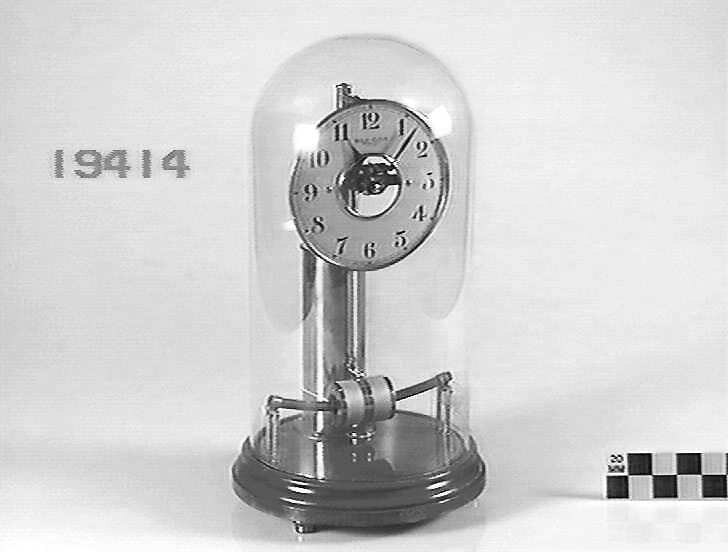
The timepiece operates via an electric impulse movement. The core of the design involves a curved magnet that oscillates by passing through a solenoid located at the end of the pendulum.
This oscillation is maintained by electric impulses received within a metal cylinder housing situated at the back of the clock unit. The technical design is supported by a 1921 British patent associated with the French inventors M. M. Moulen and M. P. Faure-Bulle.
Evidence for this section
- “Electric impulse movement.”
- “A curved magnet passes through the solenoid at end of pendulum. The solenoid receives electric impulses in metal cylinder at back of the clock.”
- “M. M. Moulen and M. P. Faure-Bulle of France took out a British patent for this clock, no. 16150 in 1921.”