
Skip to content
The Encyclopedia of Horology

Clock · Electric clock

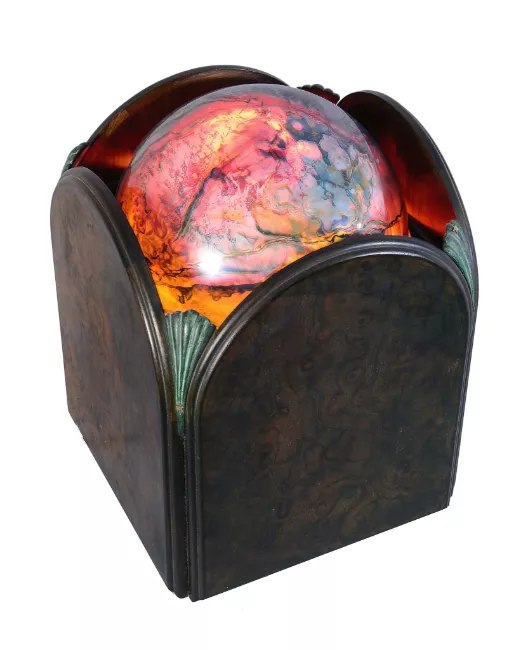
A unique burr walnut, brass, porcelain and glass electric Solar Timepiece

Partially verified

Source reports this unique electric solar timepiece was designed and made in 1976 by Royal College of Art students Sandra Campbell, Oliver Hood, and Karen Wagstaff on commission for Raymond M. Burton. The internal movement features a Horstmann Y-MK2 calendar time-switch, electric motors, and revolving cylinders of coloured glass housing light sources to simulate day and night. Time is indicated across concentric revolving domes: an inner porcelain dome rotating hourly and an outer marbled polychrome dome rotating every twelve hours against bronze fan clasp inserts.

Three-quarter exterior view of the assembled solar timepiece with illuminated dome
Three-quarter exterior view of the assembled solar timepiece with illuminated dome — Dreweatts. Rights pending — permission not yet requested. Original source

Catalogue identity

Source
auctions.dreweatts.com
Category
Clock · Electric clock
Maker / attribution
Sandra Campbell, Oliver Hood and Karen Wagstaff
Reference
Not recorded
Catalogue / lot identifier
76
Source-reported date
1976
Country
United Kingdom

Source-reported attribution and specifications are not independent authentication. A listing does not establish present ownership, current display, availability or permission to reproduce.

Object description

Commission and Identity

This electric solar timepiece was designed and made in 1976 by Sandra Campbell, Oliver Hood, and Karen Wagstaff, who were students at the Royal College of Art at the time of the commission. The clock was commissioned by Raymond M. Burton.

Documentation including a file of the clock's construction and instructions for use, as well as a file of correspondence regarding the project's development and funding, are recorded as part of the lot.

Evidence for this section
  • “Sandra Campbell, Oliver Hood and Karen Wagstaff of the Royal College of Art for Raymond M. Burton, London, 1976”
  • “The current lot was designed and built by three students of the Royal College of Art in 1975-76 after successfully winning the commission from Raymond M. Burton.”
  • “with a detailed file of the clock s construction and instructions for use together with another file of correspondence relating to the development and funding of the project”

Case Construction

The timepiece is housed in a caddy-moulded, four-sided, stained burr walnut sleeve cover with brass framing. Each side panel is arched and features patinated bronze fan-shaped clasp inserts at the angles, which are applied with gold stars. A brass plate on the control box is inscribed with the makers' names and the commission year.

The time is read against gold star markers applied to the bronze clasps. The twelve o'clock position is denoted by two gold stars, while the other three angles each feature one star.

Evidence for this section
  • “the whole contained within a caddy-moulded stained burr walnut four-sided brass-framed sleeve cover with each side panel formed as an arch with cast patinated bronze fan clasp inserts”
  • “applied with gold stars indicating the quarters to the angles”
  • “the control box applied with brass plate inscribed DESIGNED AND MADE, FOR, RAYMOND BURTON, BY, SANDRA CAMPBELL, OLIVER HOOD, & KAREN WAGSTAFF, ROYAL COLLEGE OF ART 1976”
  • “gold star markers applied to the bronze clasps set into the angles of the case with the twelve o clock position being denoted by two gold stars (in contrast to the other three which each only have one star)”

Mechanism and Dial

The internal mechanism features a posted brass chassis containing a Horstmann Y-MK2 calendar time-switch and a control box with six toggle switches. The movement includes an electric motor that drives motionwork for the hours and minutes, flanked by two horizontal revolving glass cylinders containing light sources.

The dial consists of two concentric revolving domes. The inner dome is made of translucent textured porcelain and revolves hourly, featuring a deep purple line as a minute hand. The outer dome rotates every twelve hours and features marbled polychrome decoration with a gilt fissure design as the hour hand.

Evidence for this section
  • “The movement with substantial posted brass chassis enclosing a HORSTMANN Y-MK2 calendar time-switch”
  • “twin horizontal revolving cylinders of coloured glass each enclosing a light source”
  • “inner geared to revolve every hour and made from translucent textured porcelain with overall uneven polychrome colouring incorporating a deep purple line serving as a minute hand”
  • “the outer revolving once every twelve hours and finished with marbled polychrome decoration incorporating a gilt fissure design as the hour hand”

Open research questions

  • Are the original project files currently in the possession of the owner?
  • What is the current mechanical state of the Horstmann Y-MK2 calendar time-switch?

Source evidence

Recorded claims and source quotations for A unique burr walnut, brass, porcelain and glass electric Solar Timepiece
FieldSource-reported valueSource quotation
MakersSandra Campbell, Oliver Hood and Karen Wagstaff“Sandra Campbell, Oliver Hood and Karen Wagstaff of the Royal College of Art for Raymond M. Burton, London, 1976”
Time-switchHorstmann Y-MK2 calendar time-switch“HORSTMANN Y-MK2 calendar time-switch”
Height28 cm (11 inches)“28cm (11ins) high”
Case ConstructionStained burr walnut four-sided brass-framed sleeve cover with cast bronze fan clasps“caddy-moulded stained burr walnut four-sided brass-framed sleeve cover with each side panel formed as an arch with cast patinated bronze fan clasp inserts”
Division of laborSandra Campbell, Oliver Hood, and Karen Wagstaff“Sandra Campbell was responsible for the ceramic elements, Oliver Hood the design and engineering, and Karen Wagstaff the clasp inserts.”

Visible details

  • Arched dark burr walnut sleeve case panels with rounded brass framing
  • Patinated green fan-shaped clasp inserts positioned at the corner angles
  • Luminous polychrome dome emerging from the top aperture with pink, orange, and blue marbling

Research qualifications

  • Internal Horstmann time-switch, chassis, motors, and revolving cylinders are completely enclosed within the case and not visible in this view
  • Accompanying project documentation files noted by the source are not depicted in this image

Photograph identity and source facts were screened before import; rights clearance remains pending.

Terms in this record

Glossary explanations for terms named in this object’s record.