
Skip to content
The Encyclopedia of Horology

Wristwatch · Split seconds chronograph

Breitling Duograph Ref. 766 'Rattrapante'

Partially verified

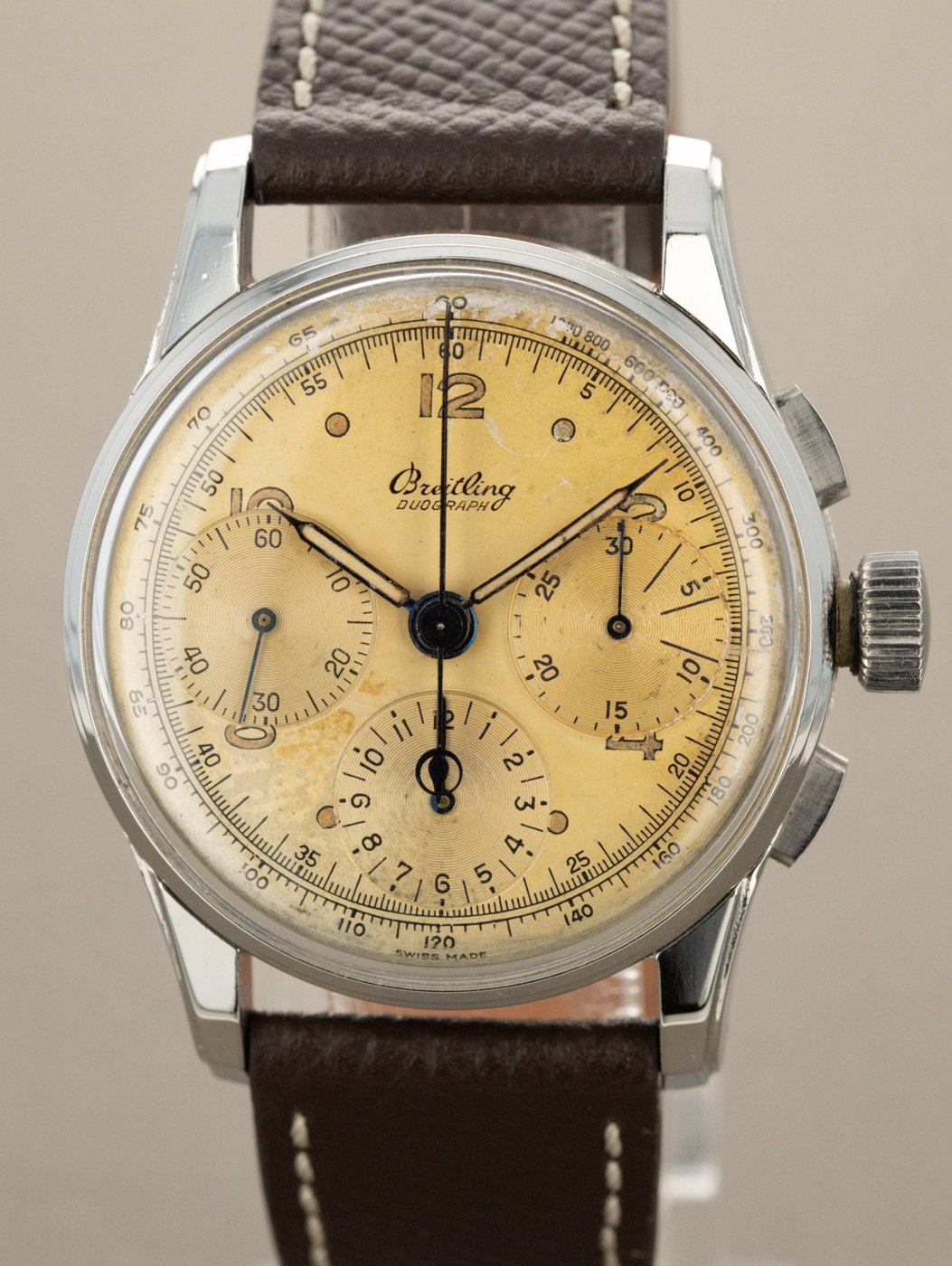
This vintage Breitling Duograph, reference 766, is a split-seconds, or 'rattrapante', chronograph dating to approximately 1951. The timepiece is housed in a 35mm case featuring stepped lugs and square pushers, with a snapback caseback. The crown located at 3 o'clock serves as the activation for the split-seconds function, while also facilitating winding and time-setting. The silver dial displays a uniform patina with patinated indices and blued-steel hands. The watch is powered by the Venus Caliber 185, a movement incorporating a three-register design and a mechanical split-seconds complication. The watch is presented on a strap and is described by the vendor as being in strong overall condition.

Frontal view of the Breitling Duograph Ref. 766 showing the silver dial, three-register layout, and blued-steel handset.
Frontal view of the Breitling Duograph Ref. 766 showing the silver dial, three-register layout, and blued-steel handset. — Oliver & Clarke. Rights pending — permission not yet requested. Original source

Catalogue identity

Source
www.oliverandclarke.com
Category
Wristwatch · Split seconds chronograph
Maker / attribution
Breitling
Reference
766
Catalogue / lot identifier
Source URL identifies the listing
Source-reported date
circa 1951
Source-reported place
Not established

Source-reported attribution and specifications are not independent authentication. A listing does not establish present ownership, current display, availability or permission to reproduce.

Object description

Case and Dial Design

The Breitling Duograph reference 766 is constructed with a 35mm case that includes distinctive stepped lugs and square chronograph pushers. The case architecture is completed by a snapback caseback. The crown, positioned at 3 o'clock, serves a dual purpose: standard winding and setting, and the activation of the split-seconds function.

The watch features a silver dial which has developed a uniform patina over time. It retains clear printing and features patinated indices. The time is indicated by a set of blued-steel hands, which provide contrast against the aged silver surface.

Evidence for this section
  • “The case comes in at 35mm and features gorgeous, prominent 'stepped' lugs, square pushers, a snapback caseback, and a crown at 3 o'clock”
  • “Inside, the silver dial has aged to show an attractive and largely uniform patina, while retaining clear printing throughout with patinated indices and a nicely matching blued-steel handset.”

Movement and Complication

The timepiece is powered by the Venus Caliber 185. This movement is notable for integrating both a three-register chronograph design and a split-seconds, or 'rattrapante', complication. The movement is contained within a form factor that the source identifies as comparable in size to other chronographs from the 1940s.

The 'rattrapante' function allows for the timing of intermediate intervals by using a split-seconds hand controlled by the crown. This mechanism represents the technical approach Breitling employed to expand its chronograph offerings during the 1940s and early 1950s.

Evidence for this section
  • “Powering this piece is the highly-complex Venus Caliber 185, which incorporate both the split-seconds function and a three-register design”
  • “the Duograph represented a significant step forward for the manufacture, combining the elegant proportions of the period with one of the most sophisticated complications available at the time: the split-seconds, or 'rattrapante,' chronograph.”

Condition and Attribution

The auction description reports the watch to be in strong overall condition. The watch dates to approximately 1951. The source notes that the Duograph was produced in various configurations of metal and dial designs, and that the reference 766 is considered an elusive model within the Breitling catalog.

As with many vintage pieces, the visual appearance of the dial is the result of aging, described as a uniform patina.

Evidence for this section
  • “The example that we have here Ref. 766 dating to circa 1951 and is offered in strong overall condition.”
  • “Duograph was offered in both steel and precious metals, with variations in case design, pushers, and dial configurations adding further character to an already elusive model.”

Open research questions

  • What is the specific movement serial number range for this 1951-era Venus 185?
  • Are there recorded production numbers for the reference 766 in this specific case configuration?

Source evidence

Recorded claims and source quotations for Breitling Duograph Ref. 766 'Rattrapante'
FieldSource-reported valueSource quotation
Reference766“Ref. 766”
MakerBreitling“Breitling”
MovementVenus Caliber 185“Venus Caliber 185”
Datecirca 1951“dating to circa 1951”
ComplicationSplit-seconds chronograph“split-seconds, or 'rattrapante,' chronograph”
Case featuresStepped lugs, square pushers, snapback“prominent 'stepped' lugs, square pushers, a snapback caseback”
Crown functionWinding, setting, and split-seconds activation“crown at 3 o'clock that functions as the split-seconds activation in addition to winding and setting the movement”

Visible details

  • Silver dial with aged patina
  • Blued-steel handset
  • Stepped lugs and square pushers
  • Three-register dial configuration

Research qualifications

  • Patina development is subjective to observation
  • Exact production year is estimated as 'circa 1951'

Photograph identity and source facts were screened before import; rights clearance remains pending.

Consulted source

ساعت مچی Breitling Duograph رفرنس 766

Reviewed 2026-11-02 · Record 40cb2866b0

Terms in this record

Glossary explanations for terms named in this object’s record.