
Skip to content
The Encyclopedia of Horology

Clock · Skeleton clock

Brass skeleton clock with fusee movement

Partially verified

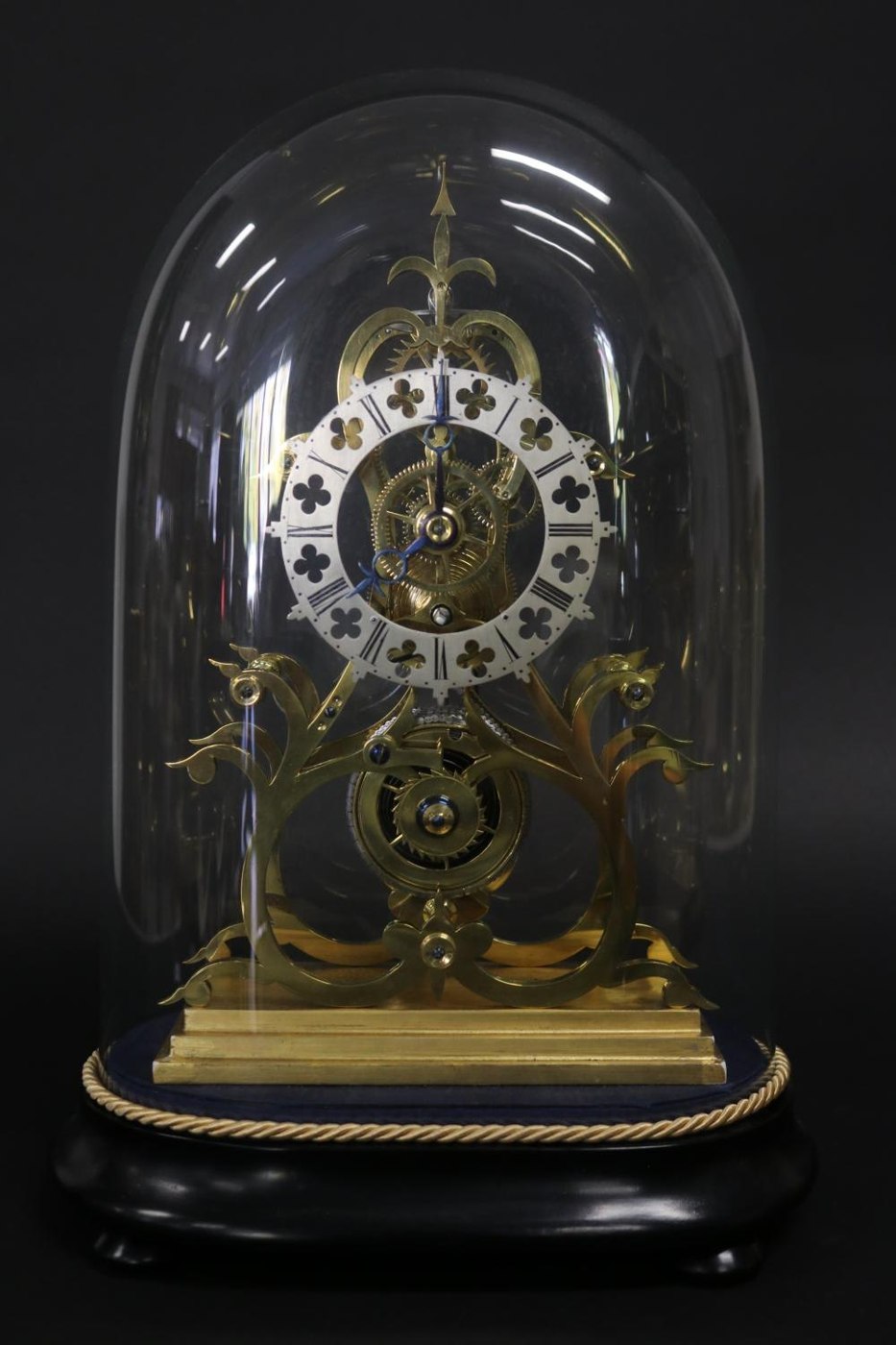
This skeleton clock is constructed with a prominent brass frame that exposes the mechanical movement to view. The clock is powered by a fusee mechanism, which is intended to provide constant force to the gear train. The dial features Roman numerals arranged around the perimeter, interspersed with decorative quatrefoil cutouts. The time is indicated by two metal hands. The entire clock assembly is mounted on a dark-colored plinth with small feet and is enclosed beneath a protective glass dome. The base of this arrangement is accented with decorative rope-style piping. The clock measures approximately 41 centimeters in height and 28 centimeters in width. It includes a pendulum but does not include a winding key. The open design allows for the observation of the interior gearing, wheels, and escapement components, which are housed within the brass structure.

A brass skeleton clock with a visible fusee movement and a pendulum, housed under a glass dome.
A brass skeleton clock with a visible fusee movement and a pendulum, housed under a glass dome. — Vickers & Hoad, via Invaluable. Rights pending — permission not yet requested. Original source

Catalogue identity

Source
orbiscollectibles.com
Category
Clock · Skeleton clock
Maker / attribution
Not established
Reference
Not recorded
Catalogue / lot identifier
Source URL identifies the listing
Source-reported date
Not established
Source-reported place
Not established

Source-reported attribution and specifications are not independent authentication. A listing does not establish present ownership, current display, availability or permission to reproduce.

Object description

Construction and Design

The skeleton clock is built upon a brass frame, designed to leave the movement visible from the sides and front. The frame itself displays decorative curves and mountings that support the central dial and the underlying gear train. The movement is defined by its use of a fusee, a mechanism designed to regulate power delivery within the timepiece.

The dial is a circular metal plate with Roman numerals engraved around the outer ring. Between these numerals are distinct quatrefoil-shaped apertures that allow further visibility of the internal mechanics. The clock is protected by a clear glass dome, which sits on a dark plinth with decorative rope piping along its base edge.

Evidence for this section
  • “features a prominent brass frame, allowing the inner workings of the timepiece to be visible”
  • “centers on a sophisticated fusee movement”
  • “featuring Roman numerals interspersed with decorative quatrefoil cutouts along the outer ring”
  • “housed under a protective, clear glass dome, which rests on a base trimmed with decorative rope piping”

Dimensions and Components

The physical proportions of the clock are documented as 41 centimeters high and 28 centimeters wide. The assembly stands on a plinth equipped with small feet to raise the structure above the surface on which it is placed.

The clock is supplied with a pendulum, which is visible suspended within the framework. The source notes that the winding key for the movement is absent from the provided example, and the operational status of the mechanism is untested.

Evidence for this section
  • “measures approximately 41 centimeters in height and 28 centimeters in width”
  • “The assembly is mounted upon a dark-colored plinth with small feet”
  • “It includes a pendulum but does not include a winding key”

Documentation and Attribution

The details provided in this record are derived from an auction listing by Vickers & Hoad. The documentation confirms the physical measurements and the presence of specific components such as the pendulum.

No specific manufacturer, date of origin, or country of manufacture is provided within the source material. The entry is classified as an individual type, and the observations are limited to the specific example shown in the provided photograph.

Evidence for this section
  • “Described from a single auction-house listing published on Invaluable”
  • “Auction-listing photograph of the example described as “Brass skeleton clock under glass dome, fusee movement, has pendulum but no key, untested, approx 41cm H x 28cm W””

Open research questions

  • Can the maker of this clock be identified through stylistic comparison with other fusee skeleton clocks?
  • What is the approximate date range for this specific style of quatrefoil skeleton clock?

Source evidence

Recorded claims and source quotations for Brass skeleton clock with fusee movement
FieldSource-reported valueSource quotation
Materialbrass, glass“brass, glass”
Height41cm“41 centimeters in height”
Width28cm“28 centimeters in width”
Movementfusee“fusee movement”
Dial featuresRoman numerals, quatrefoil motifs“Roman numerals interspersed with decorative quatrefoil cutouts”
Componentspendulum“includes a pendulum”

Visible details

  • Decorative quatrefoil cutouts are visible on the dial.
  • The movement is a fusee type.
  • The base features a rope-style trim.
  • The clock includes a pendulum but lacks a winding key.

Research qualifications

  • No maker, origin, or production date is provided in the source documentation.
  • The mechanical condition is untested as per the auction description.

Photograph identity and source facts were screened before import; rights clearance remains pending.

Consulted source

Brass skeleton clock with fusee movement under glass dome

Reviewed 2026-11-02 · Record 09f57ca701

Terms in this record

Glossary explanations for terms named in this object’s record.