
Skip to content
The Encyclopedia of Horology

Clock · Portal clock

Biedermeier Portal Clock

Partially verified

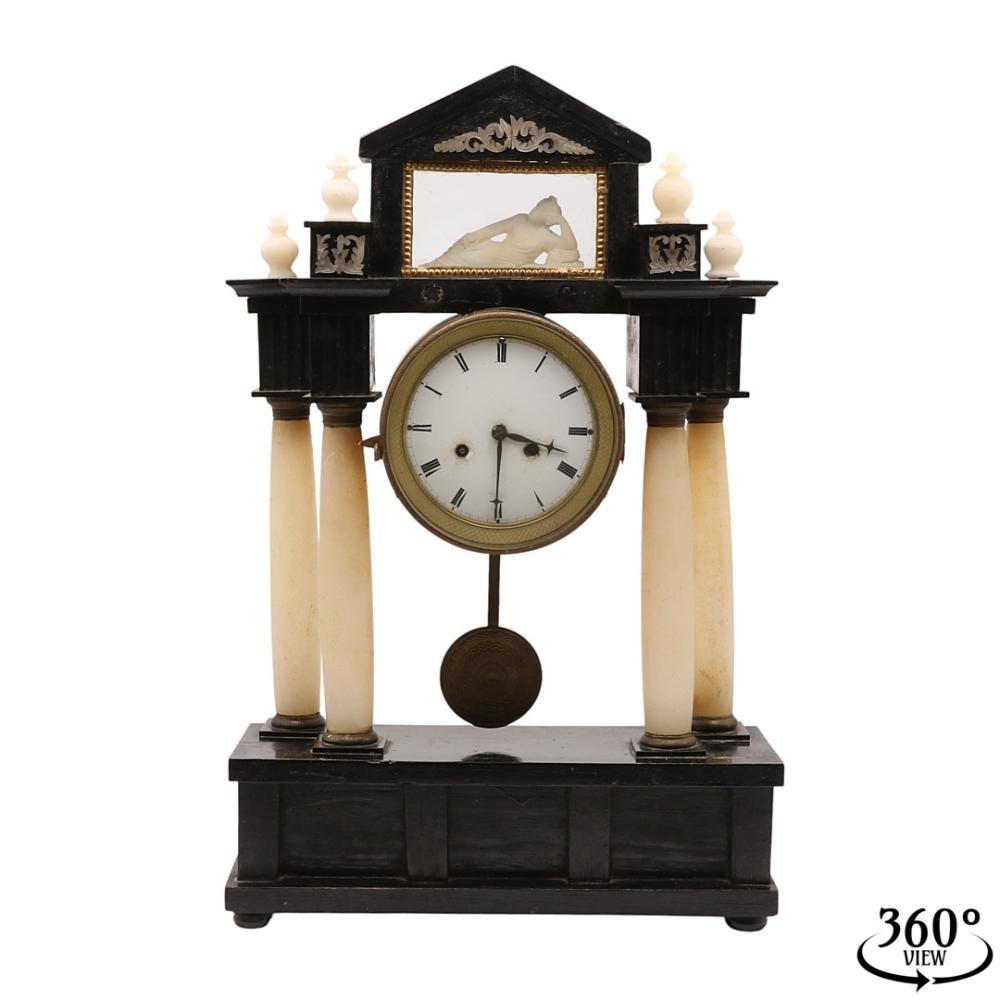
This Biedermeier-period portal clock, attributed to the maker M. Müller & Sohn of Vienna and dating to circa 1850, is a table clock constructed in an architectural style. The case is finished in blackened wood and features four alabaster columns supported by brass shoes, accented with brass capitals and mother-of-pearl appliqués. The pediment includes a glass-fronted section housing a small figure of a reclining philosopher. The clock face is a white enameled dial featuring Roman numerals for timekeeping. It is equipped with a brass pendulum that displays guilloché decoration. The movement provides a half-hour strike mechanism sounding on a gong. The overall dimensions are approximately 47 x 30.3 x 11 cm. The clock is supplied with its winding key and is described as being in working condition, though it shows signs of age-related wear including minor losses on the dial and the absence of a rear decorative strip.

Biedermeier portal clock with four alabaster columns and a reclining figure in the pediment.
Biedermeier portal clock with four alabaster columns and a reclining figure in the pediment. — Kunst- und Auktionshaus Quedlinburg (via Invaluable). Rights pending — permission not yet requested. Original source

Catalogue identity

Source
www.invaluable.com
Category
Clock · Portal clock
Maker / attribution
M. Müller & Sohn
Reference
Not recorded
Catalogue / lot identifier
567
Source-reported date
circa 1850
Source-reported place
Austria

Source-reported attribution and specifications are not independent authentication. A listing does not establish present ownership, current display, availability or permission to reproduce.

Object description

Architectural Case Construction

The table clock follows the traditional Biedermeier portal design, characterized by an architectural form constructed from blackened wood. The structure is supported by four vertical alabaster columns, which are set into brass shoes and surmounted by brass capitals. The upper portion, or pediment, features an integrated glass viewing window, behind which sits a sculptural figure of a reclining philosopher, a common decorative element in this style of Viennese timekeeper.

Additional decorative detail is provided through the application of mother-of-pearl throughout the case. Despite its age, the clock retains its structural form, measuring 47 centimeters in height, 30.3 centimeters in width, and 11 centimeters in depth. The auction description notes that one rear decorative strip is missing, though the primary architectural features remain intact.

Evidence for this section
  • “case of the pendulum clock made of blackened wood”
  • “four alabaster columns in brass shoes, brass capitals, mother-of-pearl appliqués”
  • “pediment with glass, behind which is the figure of a reclining philosopher”

Dial and Movement

The time is displayed on a white enameled dial featuring Roman numerals for the hour indices. The movement is explicitly signed "M. Müller & Sohn Wien," identifying the maker of the mechanism. The striking function of the clock is designed to execute a half-hour strike on an internal gong.

A brass pendulum is visible within the portal space, which features a guilloché pattern. The movement is accompanied by its original winding key. The auction description reports that the clock is currently in running order, although there are minor chips present on the enamel dial specifically located around the winding holes.

Evidence for this section
  • “white enameled dial with Roman numerals”
  • “movement signed "M. Müller & Sohn Wien,”
  • “pendulum with guilloché decoration”
  • “minor chips on the dial near the winding holes”

Provenance and Condition

The object is cataloged as Lot 567 by Kunst- und Auktionshaus Quedlinburg. The current condition is documented as age-appropriate, reflecting the expected wear for an object of this era. The description explicitly mentions the loss of a rear decorative strip as a notable issue alongside the dial damage near the winding points.

While the clock is verified to be in working order, no history regarding previous ownership or internal restoration is provided by the source.

Evidence for this section
  • “age-appropriate used condition”
  • “one rear decorative strip missing”
  • “clock is running”

Open research questions

  • What is the specific significance of the philosopher figure in the context of 19th-century Viennese portal clocks?
  • Can the provenance of this specific clock be traced beyond the Quedlinburg auction lot?

Source evidence

Recorded claims and source quotations for Biedermeier Portal Clock
FieldSource-reported valueSource quotation
MakerM. Müller & Sohn“M. Müller & Sohn Wien”
LocationVienna“Vienna”
Datecirca 1850“circa 1850”
MaterialBlackened wood, alabaster, brass“case of the pendulum clock made of blackened wood, table clock in antique-style architecture with four alabaster columns in brass shoes, brass capitals, mother-of-pearl appliqués”
Dimensions47 x 30.3 x 11 cm“47 x 30.3 x 11 cm (H x W x D)”
MechanismHalf-hour strike on gong“half-hour strike on gong”
ConditionWorking with specified wear“, age-appropriate used condition, minor chips on the dial near the winding holes, one rear decorative strip missing”

Visible details

  • Four alabaster columns with brass bases and capitals
  • Reclining philosopher figure housed within the pediment
  • Guilloché-decorated brass pendulum
  • Enamel dial with two winding holes

Research qualifications

  • Absence of one rear decorative strip
  • Minor chips around dial winding holes

Photograph identity and source facts were screened before import; rights clearance remains pending.

Consulted source

Biedermeier portal clock, M. Müller & Sohn, Vienna, circa 1850

Reviewed 2026-10-26 · Record 10870187a3

Terms in this record

Glossary explanations for terms named in this object’s record.