
Skip to content
The Encyclopedia of Horology

Clock · Portal clock

Biedermeier portal-form column clock with swan motif

Partially verified

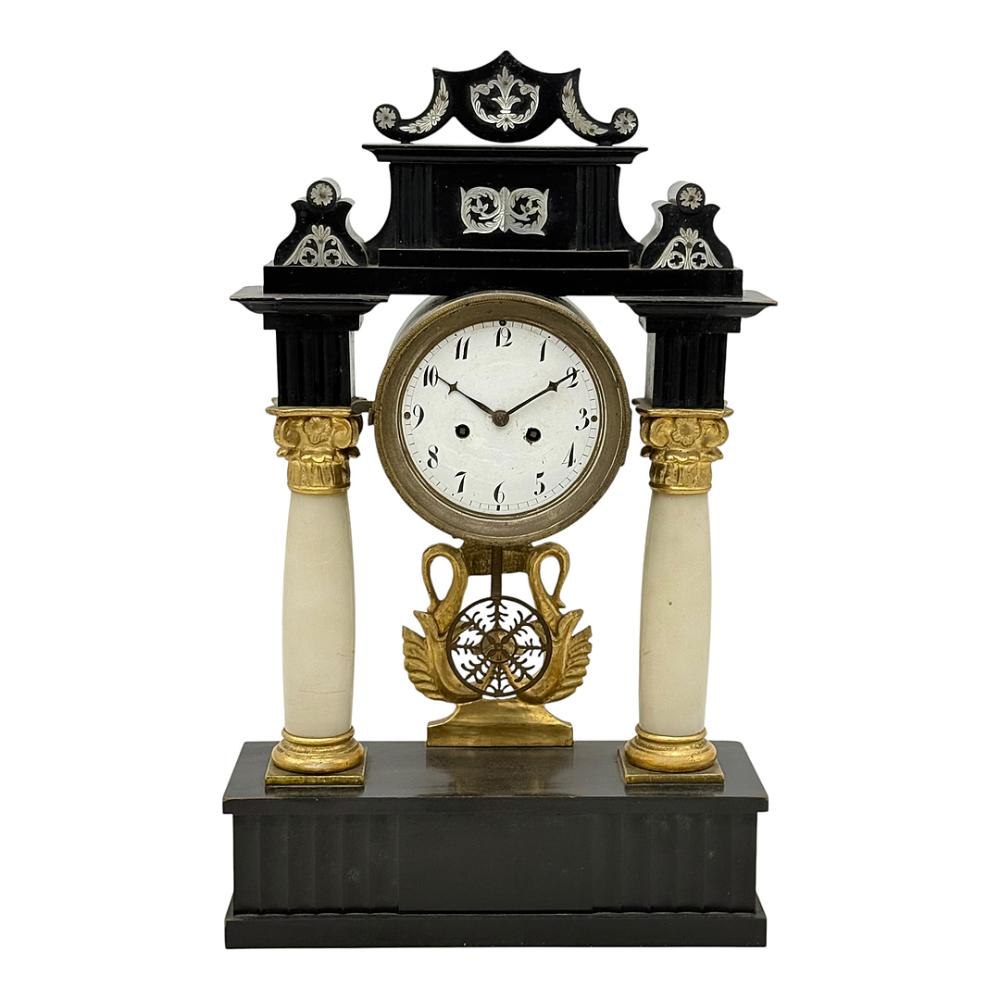
This portal-form column clock features an ebonised wood case supported by two white columns with gilded capitals and bases resting on a fluted rectangular plinth. The upper stepped entablature displays decorative appliqués with foliate motifs and cresting. Positioned between the columns, a drum-shaped case holds a white dial with Arabic numerals, two winding apertures, and black hands. Beneath the movement case sits a carved and gilded ornament depicting two confronted swans framing a pierced pendulum bob. The movement features half-hour and hour striking on a gong, though functionality was not tested.

Frontal view of the ebonised wood portal clock with white columns, dial, and swan ornament
Frontal view of the ebonised wood portal clock with white columns, dial, and swan ornament — Kunst- und Auktionshaus Quedlinburg. Rights pending — permission not yet requested. Original source

Catalogue identity

Source
www.invaluable.com
Category
Clock · Portal clock
Maker / attribution
Not established
Reference
Not recorded
Catalogue / lot identifier
733
Source-reported date
probably Biedermeier
Country
Not established

Source-reported attribution and specifications are not independent authentication. A listing does not establish present ownership, current display, availability or permission to reproduce.

Object description

Construction and Design

This portal-form column clock features an ebonised wood structure resting on a fluted rectangular plinth. The architectural design includes two white, finely veined columns, topped with gold-coloured Corinthian capitals and matching bases situated on brass-coloured plinths. The upper assembly comprises a stepped entablature with fluted pier sections, lateral finials, and a curved central crest with scrolled ends.

The front of the case is decorated with engraved appliqués displaying motifs such as palmettes, rosettes, leaf tendrils, and acanthus. A carved wood element with a gold-coloured finish, depicting two confronted swans, is positioned beneath the movement case to frame the pierced, round pendulum bob.

Evidence for this section
  • “Ebonised wood, column clock, also known as portal clock.”
  • “Rectangular base with fluting, supporting two white, finely veined columns with gold-coloured Corinthian capitals and gold-coloured bases on brass-coloured plinths.”
  • “Stepped entablature with fluted pier sections, lateral finials and a curved central crest with scrolled ends, the front with engraved decorative appliqués with palmettes, rosettes, leaf tendrils and acanthus.”
  • “Below the movement case a decorative element of two swans facing each other, carved wood with gold-coloured finish.”

Dial and Movement

The clock movement is contained within a drum-shaped case with a silver-coloured bezel. The white dial features black Arabic numerals, a minute track, and two winding holes. The hands are black and exhibit a lozenge-shaped thickening. The clock includes a pendulum with a pierced round bob.

The movement is described as having a half-hour and hour striking function on a gong. The source notes that the dial glass cover is missing and that the functionality of the movement has not been tested.

Evidence for this section
  • “Drum-shaped movement case with silver-coloured bezel.”
  • “White dial with black Arabic numerals, minute track, two winding holes and black hands with lozenge-shaped thickening.”
  • “Pendulum present, with pierced round pendulum bob.”
  • “Movement with half-hour and hour strike on a gong.”
  • “Condition commensurate with age, dial glass missing.”
  • “Function not tested.”

Period and Source Notes

The clock is categorized by the source as 'probably Biedermeier,' a style period associated with the Vienna region between 1820 and 1850. The auctioneer specifies that the condition, including signs of use and age, is to be regarded as normal for used items.

The auctioneer explicitly disclaims liability regarding the function, completeness, or operability of mechanical devices.

Evidence for this section
  • “probably Biedermeier”
  • “In the Vienna region such column clocks were very popular between 1820 and 1850.”
  • “For technical, mechanical, and electrical devices, the Auctioneer assumes no liability for function or completeness of parts, nor for the operability or functionality of the item.”

Open research questions

  • What is the specific material composition of the 'white, finely veined' columns?
  • Are there any visible stamps or signatures on the movement backplate?

Source evidence

Recorded claims and source quotations for Biedermeier portal-form column clock with swan motif
FieldSource-reported valueSource quotation
Case designEbonised wood column clock in portal form with two white columns“Ebonised wood, column clock, also known as portal clock. Rectangular base with fluting, supporting two white, finely veined columns”
Decorative motifCarved wood swan element with gold-coloured finish below movement“Below the movement case a decorative element of two swans facing each other, carved wood with gold-coloured finish.”
Striking mechanismHalf-hour and hour strike on a gong“Movement with half-hour and hour strike on a gong.”
Dimensions48 x 29 x 10 cm“48x29x10 cm (HxWxD).”
Reported condition defectMissing dial glass cover“Condition commensurate with age, dial glass missing.”

Visible details

  • Frontal view of black portal case with stepped pediment and foliate silver-tone appliqués.
  • White dial with Arabic numerals and twin winding apertures lacking a front protective glass.
  • Central gilded twin-swan carving framing a pierced openwork pendulum bob.

Research qualifications

  • Source notes movement function has not been tested.
  • Rear movement and internal mechanisms are not depicted in the provided view.

Photograph identity and source facts were screened before import; rights clearance remains pending.

Terms in this record

Glossary explanations for terms named in this object’s record.