
Skip to content
The Encyclopedia of Horology

Clock · Floor clock with flute mechanism

Berlin Flute Floor Clock by Ehrbar

Partially verified

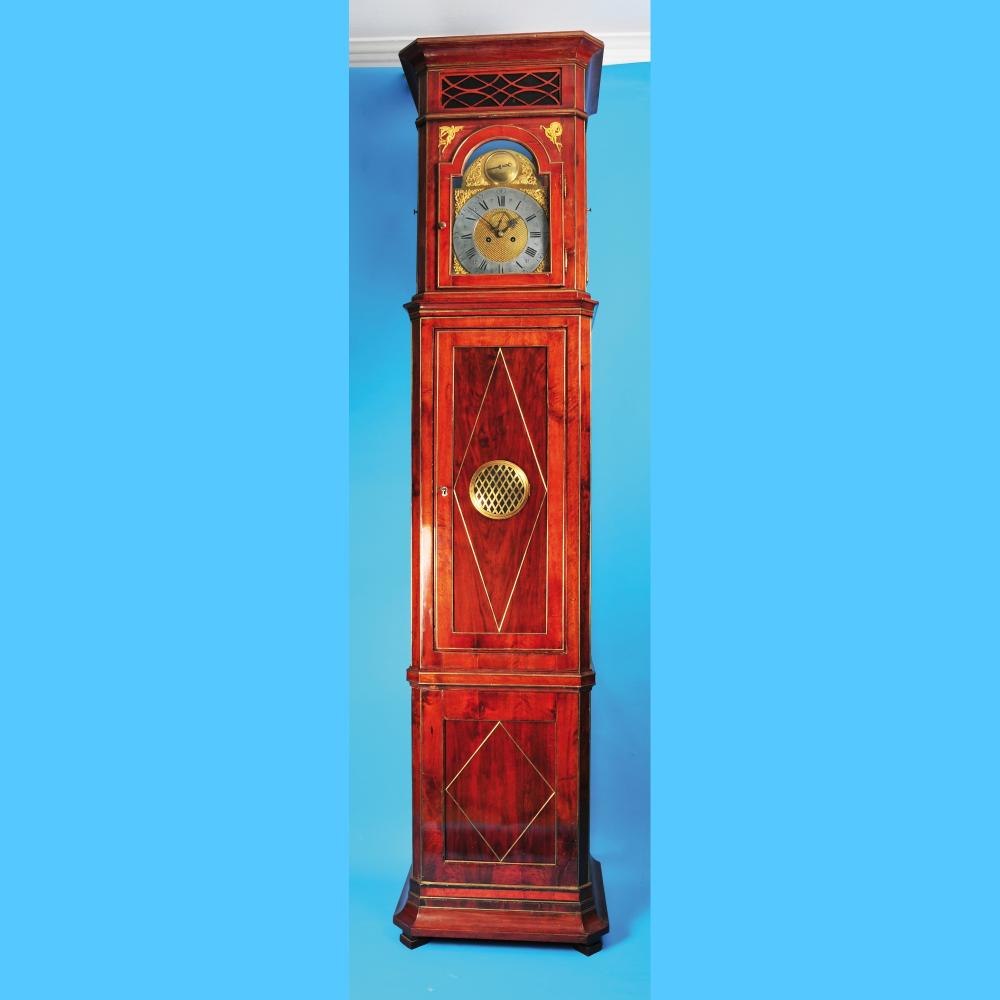
This large Berlin floor clock, signed "Ehrbar Berlin" on the dial, features an integrated flute musical mechanism. The clock is housed in a spruce case with mahogany veneer, finished with shellac polish and decorative brass inlay. The brass arch dial includes decorative corner mounts and a signed cartouche with a mode selector for "Spielen – Chlagen – Stille". The silvered chapter ring displays Roman numerals and an Arabic minute track, paired with iron hands and a chased center featuring a small seconds display. The internal 8-day brass full-plate movement is equipped with an anchor escapement and spring suspension for the pendulum. It includes a striking mechanism for the hour on a bell. The musical component operates via a large pinned wooden roller, playing a melody from Weber’s "Der Freischütz" through 38 open pipes, with a performance duration of approximately 4 minutes.

Full view of the Berlin flute floor clock in its wooden case.
Full view of the Berlin flute floor clock in its wooden case. — Galerie + Auktionshaus Peter Klöter (via Invaluable). Rights pending — permission not yet requested. Original source

Catalogue identity

Source
www.invaluable.com
Category
Clock · Floor clock with flute mechanism
Maker / attribution
Ehrbar
Reference
Not recorded
Catalogue / lot identifier
882
Source-reported date
Ende 18.Jh.
Source-reported place
Germany

Source-reported attribution and specifications are not independent authentication. A listing does not establish present ownership, current display, availability or permission to reproduce.

Object description

Case and Exterior

The clock is contained within a tall floor-standing case constructed from spruce and finished with mahogany veneer. The wood surfaces are treated with shellac polish and ornamented with brass inlay strips. The case design features a central circular brass grille on the waist door.

The brass arch dial is mounted with cast and cut corner decorations. A signed cartouche is positioned within the arch, which also holds a scale for the mechanical settings labeled "Spielen – Chlagen – Stille". The silvered chapter ring shows Roman numerals and an Arabic minute track. Time is indicated by cutout iron hands, and the dial center is chased with a small seconds indication.

Evidence for this section
  • “Holzgehäuse Fichte, Mahagoni furniert und Schelllack poliert, mit Messingleisten verziert”
  • “Messingbogenzifferblatt mit gegossenen ausgeschnittenen Eckverzierungen”

Movement and Mechanism

The timekeeping is powered by an 8-day brass full-plate movement. It utilizes an anchor escapement and features a pendulum supported by a spring suspension. The clock performs an hourly strike on a bell. The condition is reported as intact.

The integrated flute musical mechanism utilizes a large, pinned wooden roller. It is configured to play a melody from Weber’s "Der Freischütz". The air is produced by 38 open pipes, which the auction description notes as a rare feature. The musical sequence lasts approximately 4 minutes.

Evidence for this section
  • “8-Tage-Messingvollplatinenwerk mit Ankergang und Federaufhängung des Pendels”
  • “Große Berliner Bodenstanduhr mit Flötenspielwerk über sehr große, gestiftete Holzwalze”
  • “Spieldauer ca. 4 Minuten über 38 offene Pfeifen (selten)”

Provenance and Documentation

The maker, Ehrbar, is identified as a Berlin flute clockmaker. The auction description references documentation for this maker in Abeler's literature, specifically volume I, page 157. The object was offered as lot 882.

The musical selection is identified as "Was gleicht wohl auf Erden dem Jäger Vergnügen" from Carl Maria von Weber's opera "Der Freischütz".

Evidence for this section
  • “auf Zifferblatt signiert Ehrbar Berlin (Literatur Abeler I, S. 157) erwähnt Ende 18.Jh., Berliner Flötenuhrmacher”
  • “mit einer Melodie aus „Der Freischütz - Was gleicht wohl auf Erden dem Jäger Vergnügen“ von Karl Maria von Weber”

Open research questions

  • Are there any maker's marks or stamps on the movement plates to confirm the attribution to Ehrbar?
  • Does the current tuning of the 38 open pipes align with the original intended pitch for the Weber melody?

Source evidence

Recorded claims and source quotations for Berlin Flute Floor Clock by Ehrbar
FieldSource-reported valueSource quotation
MakerEhrbar“auf Zifferblatt signiert Ehrbar Berlin”
DateEnde 18.Jh.“erwähnt Ende 18.Jh.”
Height276 cm“H = 276 cm”
Case materialsSpruce and mahogany veneer“Holzgehäuse Fichte, Mahagoni furniert”
Movement8-day brass full-plate with anchor escapement“8-Tage-Messingvollplatinenwerk mit Ankergang”
Musical mechanism38 open pipes, pinned wooden roller“Spieldauer ca. 4 Minuten über 38 offene Pfeifen”

Visible details

  • Spruce case with mahogany veneer and brass stringing
  • Arch dial with Roman hour numerals and Arabic minute track
  • Flute mechanism with 38 open pipes
  • Mode selector lever on the dial arch

Research qualifications

  • Date attributed to the end of the 18th century
  • Reference to Abeler literature is reported by the auction description
  • Performance duration of 4 minutes reported by the auction description

Photograph identity and source facts were screened before import; rights clearance remains pending.

Terms in this record

Glossary explanations for terms named in this object’s record.