
Construction and Design
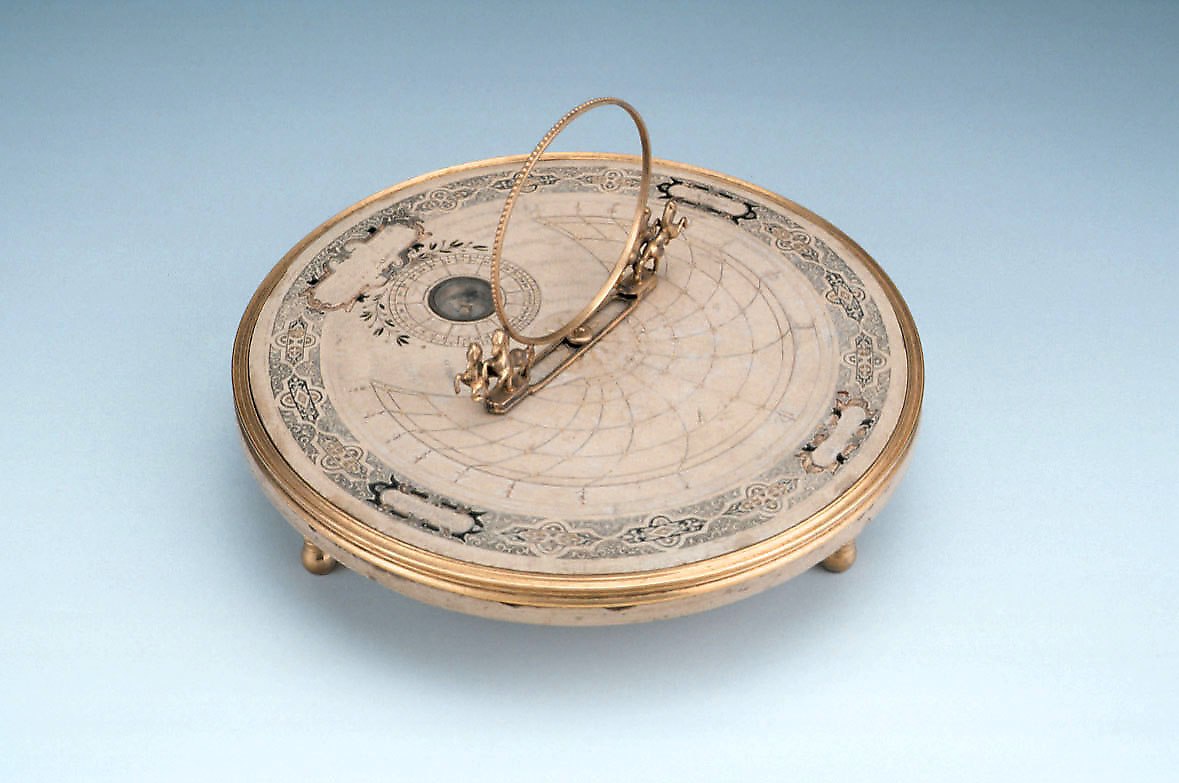
The azimuth dial consists of a circular tablet made of stone, which the museum notes might be Solenhofen stone. This tablet is held within a gilt brass rim and elevated on three brass feet. The surface is decorated with a circular band featuring incised, coloured, and gilt foliate patterns. Within this perimeter, the dial displays the cardinal points labelled as ORIENS, MERIDIES, and OCCIDENS, alongside a Latin biblical inscription from Genesis. An inset compass, measuring 18 mm, is positioned to assist the user in orienting the instrument to the meridian.
The gnomon is a central gilt brass component that can slide and rotate around a pivot. It includes a thin ring intended to cast a shadow and is adorned with pairs of rearing horse figures at both ends of the base slot. These figures serve as decorative elements on the pointers used for setting the solar date or the zodiac position. The overall design integrates functional timekeeping scales with structural aesthetic elements.
Evidence for this section
- “This sundial consists of a circular tablet of (Solenhofen?) stone, with a gilt brass rim and three brass legs.”
- “The gilt brass gnomon is free to slide on and rotate about a central pivot. Its base is a slot at either end of which is a pointer surmounted by a pair of decorative rearing horses.”