
Skip to content
The Encyclopedia of Horology

Clock · Automaton clock

Automaton clock by William Carpenter

Partially verified

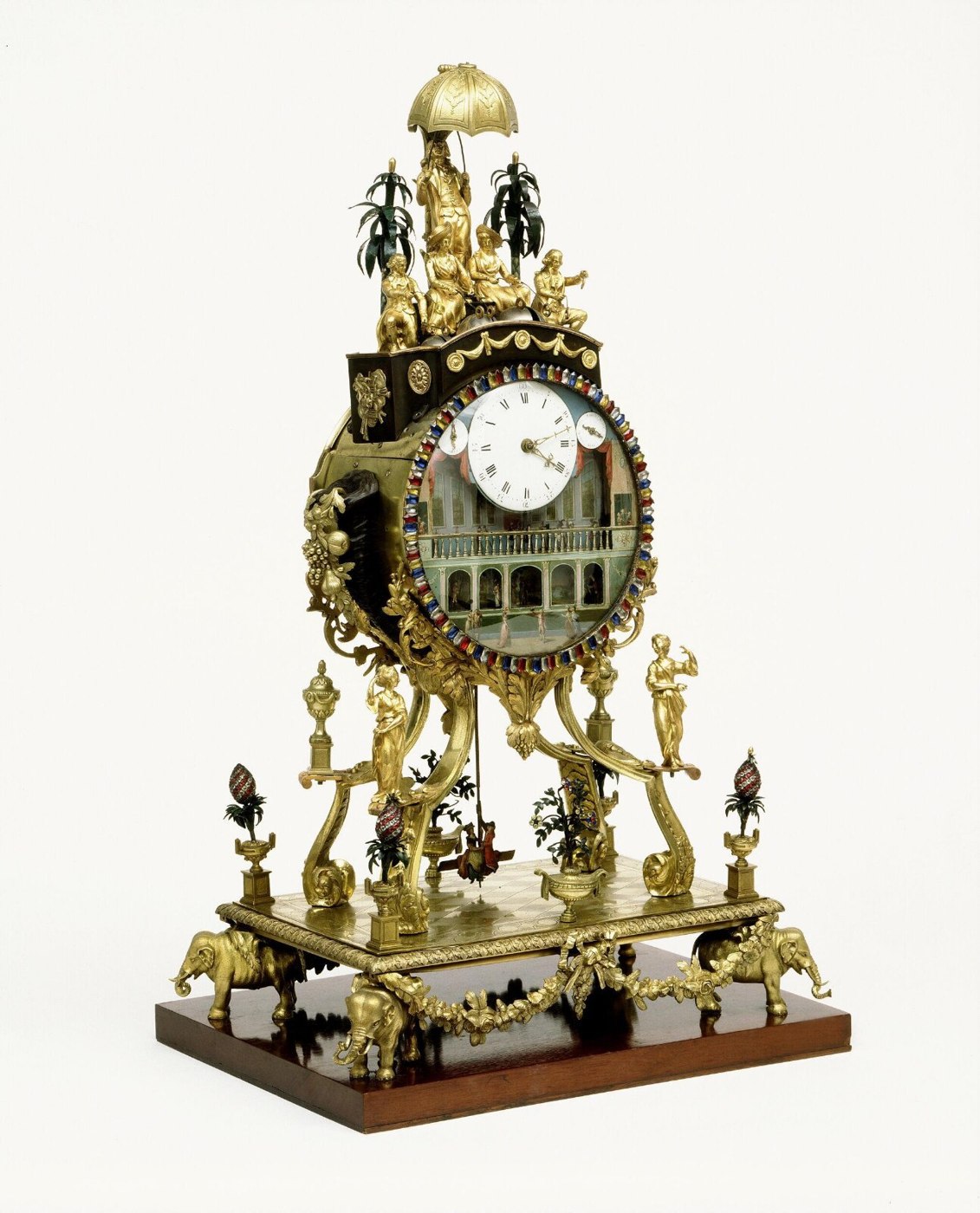
This automaton clock was created in London by William Carpenter, active in the Soho district between approximately 1770 and 1805. The object serves as both a timekeeper and a musical device, designed to perform a selection of six tunes, including dances, jigs, a song, and a march. The physical construction incorporates various automaton figures in 18th-century attire; standing figures chime the quarters and strike the hours, while seated figures operate the musical mechanism via bells positioned beneath their feet. The design includes a two-storey palace scene beneath the dial, featuring a lower arcade with landscape painting and an upper ballroom setting where costumed figures move laterally during musical playback. Measuring approximately 88.9 cm in height, the clock displays a signature reading "WILL.M CARPENTER LONDON" and was acquired as part of the Lt. Col. G. B. Croft-Lyons Bequest.

Automaton clock by William Carpenter, London, ca. 1780.
Automaton clock by William Carpenter, London, ca. 1780. — Victoria and Albert Museum, London. Rights pending — permission not yet requested. Original source

Catalogue identity

Source
collections.vam.ac.uk
Category
Clock · Automaton clock
Maker / attribution
William Carpenter
Reference
Not recorded
Catalogue / lot identifier
M.1108-1926
Source-reported date
ca. 1780
Source-reported place
London

Source-reported attribution and specifications are not independent authentication. A listing does not establish present ownership, current display, availability or permission to reproduce.

Object description

Case and Automaton Design

The clock is built with an elaborate exterior that functions as both a display and a housing for its internal mechanisms. The structure features a prominent central dial, which is framed by a decorative border of colored elements. Below the dial, the case is pierced to reveal a detailed depiction of a two-storey palace.

Automata figures are arranged on the exterior, including figures mounted above the clock holding bells. These figures serve functional roles, with standing figures chime the quarters and strike the hours, while seated counterparts are positioned to interact with the musical component.

Evidence for this section
  • “The area below the dial is pierced with the design of a palace with two storeys.”
  • “The figures dressed in 18th-century costume mounted on the clock, hold bells.”

Musical and Horological Function

The clock serves as a multi-functional device where timekeeping is secondary to its mechanical performance. It is designed to play a total of six musical selections including two dances, two jigs, a song, and a march. During these sequences, mechanical automation is activated, resulting in the lateral movement of costumed figures across the upper ballroom scene within the case.

The maker, William Carpenter, specialized in such complex musical clocks. While identified as an export piece for the Chinese market, it has also been suggested by researchers that the clock could have been intended for an Indian client, reflecting the broad interest in such complex timepieces among Eastern rulers and merchants during the late 18th century.

Evidence for this section
  • “The measurement of time was only one small feature of these clocks. This clock offered a choice of six tunes - two dances, two jigs, a song and a march.”
  • “As the music plays, rows of costumed figures move from left to right.”
  • “It has been suggested that this clock was made for an Indian client.”

Attribution and Provenance

William Carpenter is credited with the manufacture of this piece, having operated from London's Soho district between roughly 1770 and 1805. The object is officially signed "WILL.M CARPENTER LONDON". It is held by the museum under the accession number M.1108-1926, which arrived as part of the Lt. Col. G. B. Croft-Lyons Bequest.

The production date is estimated to be circa 1780. The object is classified as an automaton clock created for the Chinese market, though palace museums in Turkey and India also hold similar examples of these export timepieces which were often regarded as novelties or exotic toys.

Evidence for this section
  • “Made in London by William Carpenter (active 1770-1805)”
  • “Signed 'WILL.M CARPENTER LONDON'”
  • “These clocks were eagerly bought by Eastern rulers and merchants and were thought of as interesting toys.”

Open research questions

  • What is the internal construction of the chime and musical cylinder mechanism?
  • Are there any identifiable marks on the movement plates that confirm the production date?

Source evidence

Recorded claims and source quotations for Automaton clock by William Carpenter
FieldSource-reported valueSource quotation
MakerWilliam Carpenter“Made in London by William Carpenter (active 1770-1805)”
SignatureWILL.M CARPENTER LONDON“Signed 'WILL.M CARPENTER LONDON'”
Musical functionPlays six tunes“This clock offered a choice of six tunes - two dances, two jigs, a song and a march.”
Automaton featuresFigures move during music“As the music plays, rows of costumed figures move from left to right.”
OriginLondon“Made in London by William Carpenter”
Accession NumberM.1108-1926“M.1108-1926”

Visible details

  • Dial is surrounded by a border of colored glass or stone insets
  • Musical figures and a canopy structure are mounted above the clock housing

Research qualifications

  • The exact identity of the original client remains unverified, with suggestions pointing toward an Indian recipient
  • The specific function of all individual moving parts is described as a general automaton mechanism rather than a detailed technical movement breakdown

Photograph identity and source facts were screened before import; rights clearance remains pending.

Consulted source

Automaton clock

Reviewed 2026-11-02 · Record 914b99f50d

Terms in this record

Glossary explanations for terms named in this object’s record.