
Skip to content
The Encyclopedia of Horology

Clock · Column clock

Augsburg Column Clock

Partially verified

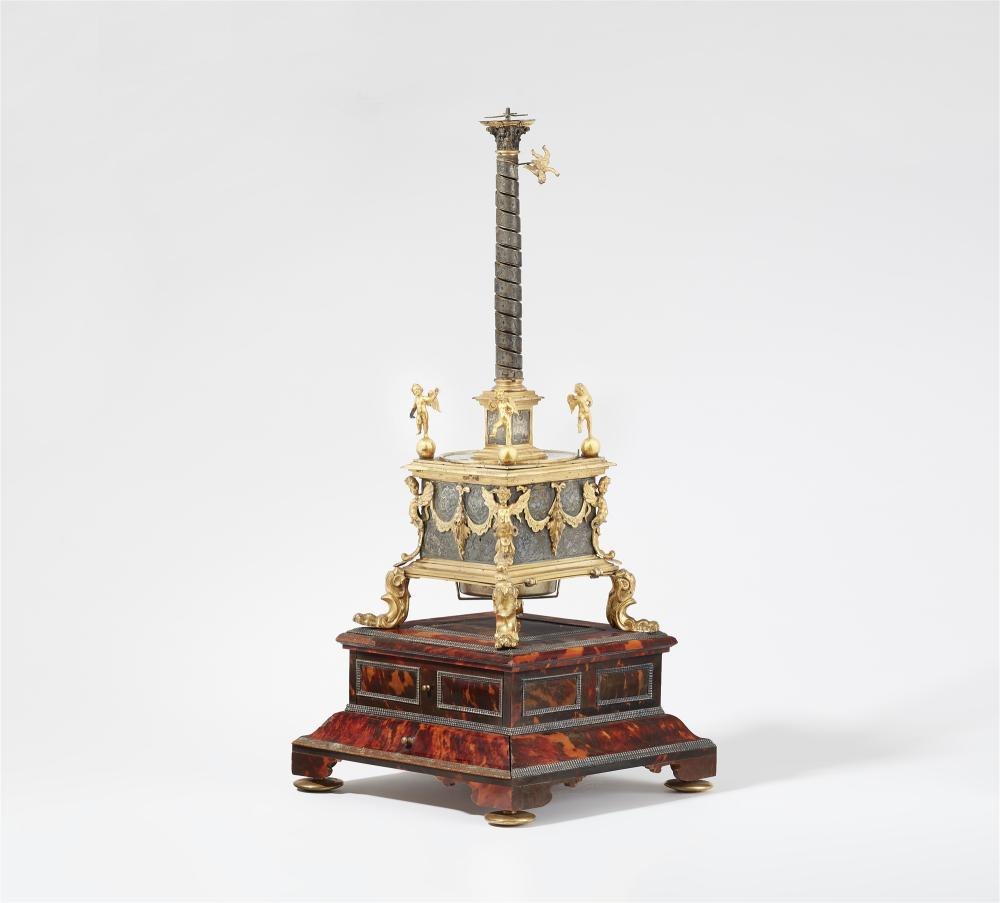
This Augsburg column clock, attributed to David Buschmann (1626-1701) and dated between 1660 and 1664, features a movement housed in a silver-plated cuboid case decorated with foliate engravings and ormolu appliques of winged herms and festoons. The movement is a day-running type with chain and fusee, incorporating a cast-iron escapement and a striking mechanism on a bell controlled by a pierced lock plate. A round column rises from the base, entwined by a spiral band with small Cupid figures serving as hour indicators, while a small dial at the capital indicates the hours in Roman numerals. The clock is set upon a softwood stand veneered in tortoiseshell, configured like a miniature cabinet with two front drawers and ebonised wood mountings. The silver-plated aperture ring above the case displays the date, month, and zodiac signs.

Full view of the column clock showing the silver-plated movement housing, spiral column with Cupid indicators, and the tortoiseshell veneered cabinet base.
Full view of the column clock showing the silver-plated movement housing, spiral column with Cupid indicators, and the tortoiseshell veneered cabinet base. — Lempertz (via Invaluable). Rights pending — permission not yet requested. Original source

Catalogue identity

Source
www.invaluable.com
Category
Clock · Column clock
Maker / attribution
David Buschmann
Reference
Not recorded
Catalogue / lot identifier
1670
Source-reported date
circa 1660 - 64
Source-reported place
Germany

Source-reported attribution and specifications are not independent authentication. A listing does not establish present ownership, current display, availability or permission to reproduce.

Object description

Movement and Construction

The clock features a day-running movement powered by a chain and fusee. The striking mechanism operates via a lock plate characterized by pierced tendril decoration and sounds on a bell. The escapement is constructed of cast iron.

The central column is designed with a spiral band featuring small figures of Cupid that indicate the hour. A secondary dial located at the capital of the column displays the hours using Roman numerals.

Evidence for this section
  • “Day-running with chain and fusee, striking via lock plate with pierced tendril decor, hourly striking to a bell.”
  • “The double hour indicators, here around the column and on top of it, are also considered to be an invention of the Buschmann family”

Case and Aesthetic

The main movement housing consists of a silver-plated cuboid case embellished with foliate engravings. The corners of this case are mounted with ormolu appliques depicting winged herms, complemented by festoons. An aperture ring, also silver-plated, sits above this section to show the date, month, and zodiac signs.

The entire structure rests on a base made of softwood, finished with tortoiseshell veneer and ebonised wood mountings. This base is shaped to resemble a small piece of furniture and includes two functional front drawers. This arrangement reflects a shift in period tastes toward cabinet furniture featuring integrated clock movements.

Evidence for this section
  • “The movement housed in a silver-plated cuboid case with foliate engravings and ormolu appliques of winged herms at the angles and festoons.”
  • “this column clock stands on a base finished with tortoiseshell and designed like a miniature piece of furniture with its two front drawers.”

Condition and Attribution

The auction description reports specific losses and wear associated with the clock. These include damage to the upper hour indicator positioned on the column and the four figures of Cupid being loose, with one foot and one attribute currently missing. There are also reported minor losses to the tortoiseshell veneer.

The attribution to David Buschmann relies on the identification of the work as a product of his Augsburg workshop. The Buschmann family developed a standardized range of objects, and similar column clocks have been documented by Klaus Maurice in the publication 'Die deutsche Räderuhr'.

Evidence for this section
  • “Damage to the upper hour indicator on the column, the four Cupids loose, the attribute and one foot missing, minor losses to the tortoiseshell.”
  • “The Buschmann family had developed a certain range in which individual objects could be produced repeatedly with minor optical and functional changes.”

Open research questions

  • What is the specific missing attribute previously held by one of the Cupid figures?
  • Can the provenance be traced further back than the Rhenish private collection?

Source evidence

Recorded claims and source quotations for Augsburg Column Clock
FieldSource-reported valueSource quotation
MakerDavid Buschmann“David Buschmann (1626 - 1701)”
Datearound 1660 - 64“David Buschmann, around 1660 - 64.”
MaterialsGilt and silver-plated brass, bronze, steel, iron, tortoiseshell, wood“Gilt and silver-plated brass/bronze, blued steel, cast iron escapement.”
MovementDay-running with chain and fusee“Day-running with chain and fusee, striking via lock plate with pierced tendril decor, hourly striking to a bell.”
Base dimensions58.2 cm height“total H 58.2, stand W 26.5, D 26.5 cm.”
Inscriptions on plaquesCONTRA FERVNTVR, VNA FERVNTVR, SVPRA FERVNTVR, INFRA FERVNTVR“the sun engraved "CONTRA FERVNTVR", "VNA FERVNTVR", "SVPRA FERVNTVR" and "INFRA FERVNTVR".”

Visible details

  • Cuboid movement case with foliate engravings
  • Spiral column with Cupid hour indicator
  • Tortoiseshell veneered base with two drawers
  • Movement backplate with floral engraving and signature

Research qualifications

  • Damage to the upper hour indicator on the column
  • Four Cupids described as loose with one attribute and one foot missing

Photograph identity and source facts were screened before import; rights clearance remains pending.

Consulted source

A museum quality Augsburg column clock

Reviewed 2026-10-26 · Record e292dc1f2b

Terms in this record

Glossary explanations for terms named in this object’s record.