
Skip to content
The Encyclopedia of Horology

Clock · Table clock

Astronomical Table Clock

Partially verified

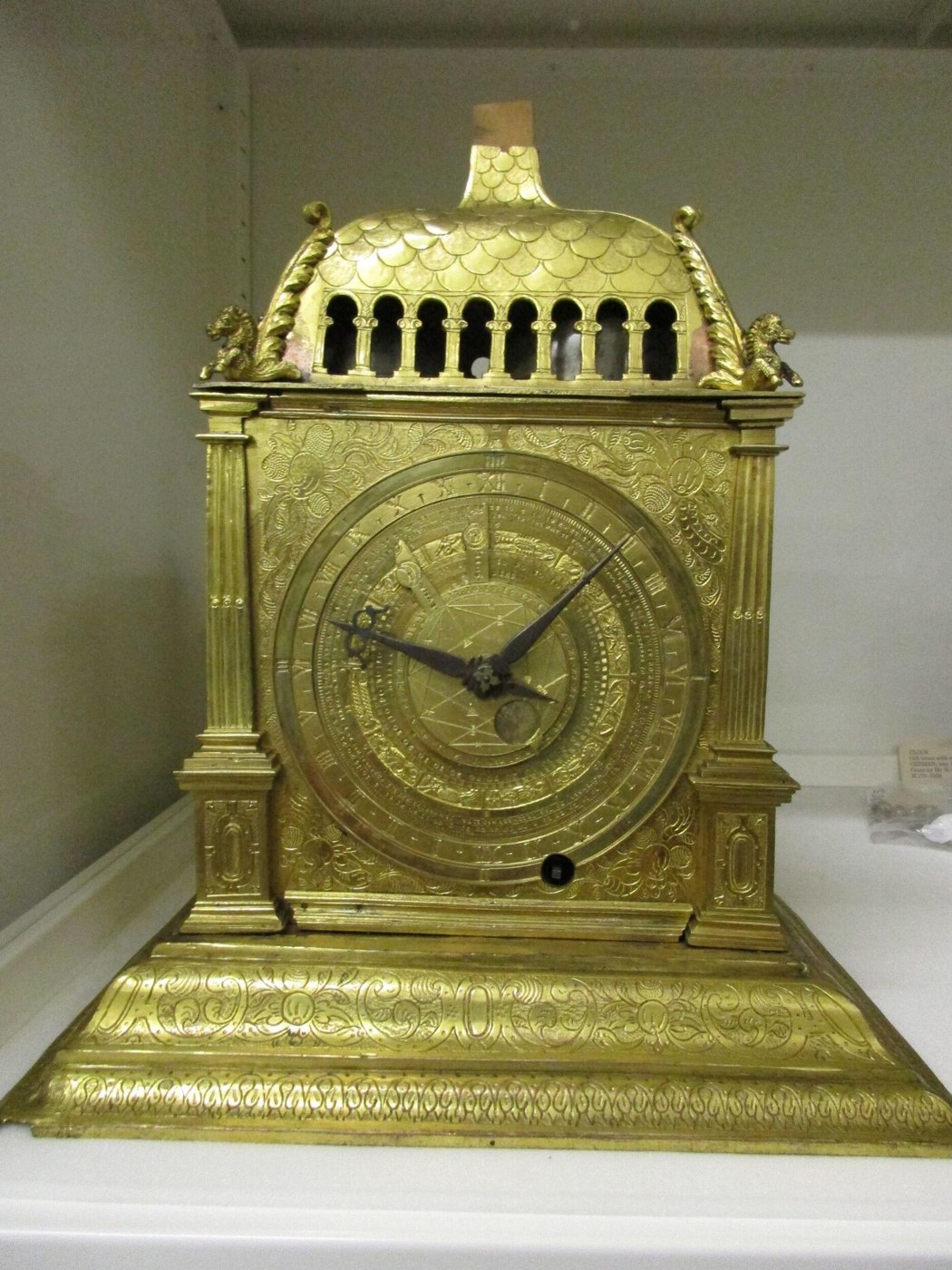
This astronomical table clock, held by the Victoria and Albert Museum, is constructed from gilt-bronze and measures 14.75 inches in height. The object features a rectangular form with dials on four faces, incorporating astronomical indications alongside timekeeping and an alarm function. It includes an arched top section with decorative detailing and is surmounted by a female figure. The physical description identifies it as a German-made clock from the 16th century, while the primary object type is attributed to Venice during the same period. The clock has a provenance linked to the collection of Jules Soulages (1803-1857), a lawyer from Toulouse, before its acquisition by the South Kensington Museum in the mid-19th century. A gilt-bronze figure of Minerva was added as a finial to the clock in September 1920, donated by Mr. J. Whitecombe Greene.

Front view of the astronomical table clock showing the main dial and the engraved gilt-bronze case.
Front view of the astronomical table clock showing the main dial and the engraved gilt-bronze case. — Victoria and Albert Museum. Rights pending — permission not yet requested. Original source

Catalogue identity

Source
collections.vam.ac.uk
Category
Clock · Table clock
Maker / attribution
Not established
Reference
Not recorded
Catalogue / lot identifier
638&A-1865
Source-reported date
1500-1600
Source-reported place
Venice

Source-reported attribution and specifications are not independent authentication. A listing does not establish present ownership, current display, availability or permission to reproduce.

Object description

Case and Dial Construction

The clock is housed in a rectangular gilt-bronze case that features extensive surface engraving of floral and foliate patterns. The structure includes an arched upper section, or dome, supported by a colonnaded gallery with figurative elements at the corners. The primary dial display is highly complex, integrated into the front panel of the case, and is designed to present multiple temporal and astronomical measurements simultaneously.

The timekeeping functionality is complemented by astronomical indications, which are visible across the central dial. This includes a circular arrangement reflecting zodiacal and lunar data. The overall design incorporates four faces, with the final dial featuring four distinct figures. The base of the clock is flared, providing a stable foundation that is decorated with a pattern consistent with the rest of the gilt-bronze casing.

Evidence for this section
  • “Rectangular table clock with 2 bells, and dials on four faces, last dial with 4 figures.”
  • “gilt-bronze case, Venetian, sixteenth century.”
  • “Time to the hour and alarm, striking set up, with astronomical indications”

Provenance and Acquisition

The object originated from the collection of Jules Soulages (1803-1857), a lawyer based in Toulouse.

The South Kensington Museum acquired the clock in installments between 1859 and 1865. A significant modification occurred in 1920 when a gilt-bronze figure of Minerva, donated by Mr. J. Whitecombe Greene, was added to the top of the clock to serve as a finial.

Evidence for this section
  • “From the collection of Jules Soulages (1803-1857), a lawyer from Toulouse”
  • “by the South Kensington Museum between 1859 and 1865 in installments for £11,0000.”
  • “The gilt bronze figure of Minerva was given by Mr J Whitecombe Greene and added as a finial September 1920.”

Attribution and Geographical Classification

The museum record lists the clock with two distinct geographical attributions. It is labeled as being of Venetian origin in the primary object details, with a production date range of 1500-1600. However, the physical description provided in the records suggests that the clock may be of German manufacture, also dated to the 16th century.

These attribution notes illustrate the complexities in assessing the origins of this astronomical instrument. The record does not reconcile these differing attributions, presenting both the Venetian and German possibilities for the provenance of the object's construction.

Evidence for this section
  • “Place of origin: Venice (made)”
  • “German, 16th century.”

Open research questions

  • What is the mechanical basis for the astronomical indications presented on the primary dial?
  • Can the conflicting attributions of Venetian versus German origin be reconciled through technical analysis of the movement?

Source evidence

Recorded claims and source quotations for Astronomical Table Clock
FieldSource-reported valueSource quotation
Object TypeAstronomical clock“Astronomical clock”
Accession Number638&A-1865“638&A-1865”
Dimensions14.75 inches“Height: 14.75 in”
MaterialsGilt-bronze“Gilt-bronze”
Date1500-1600“1500-1600”
Attributed OriginVenice (made)“Place of origin: Venice (made)”
ProvenanceJules Soulages“From the collection of Jules Soulages (1803-1857)”
ModificationMinerva finial added 1920“The gilt bronze figure of Minerva was given by Mr J Whitecombe Greene and added as a finial September 1920.”

Visible details

  • The gilt-bronze case features floral and foliate engraving on all visible sides.
  • The main dial incorporates astronomical indications, including signs of the zodiac and lunar tracking.
  • The clock is configured with an arched top, a colonnaded gallery, and sculpted figures at the corners.
  • The base is flared and features decorative engraved bands matching the case panels.

Research qualifications

  • The source provides conflicting origins, citing both Venice and Germany.
  • The Minerva finial added in 1920 is a later modification to the original 16th-century case.

Photograph identity and source facts were screened before import; rights clearance remains pending.

Consulted source

Astronomical clock

Reviewed 2026-10-26 · Record 083bcb1d00

Terms in this record

Glossary explanations for terms named in this object’s record.