
Skip to content
The Encyclopedia of Horology

Tool · Astronomical compendium

Astronomical compendium by Christopher Schissler

Partially verified

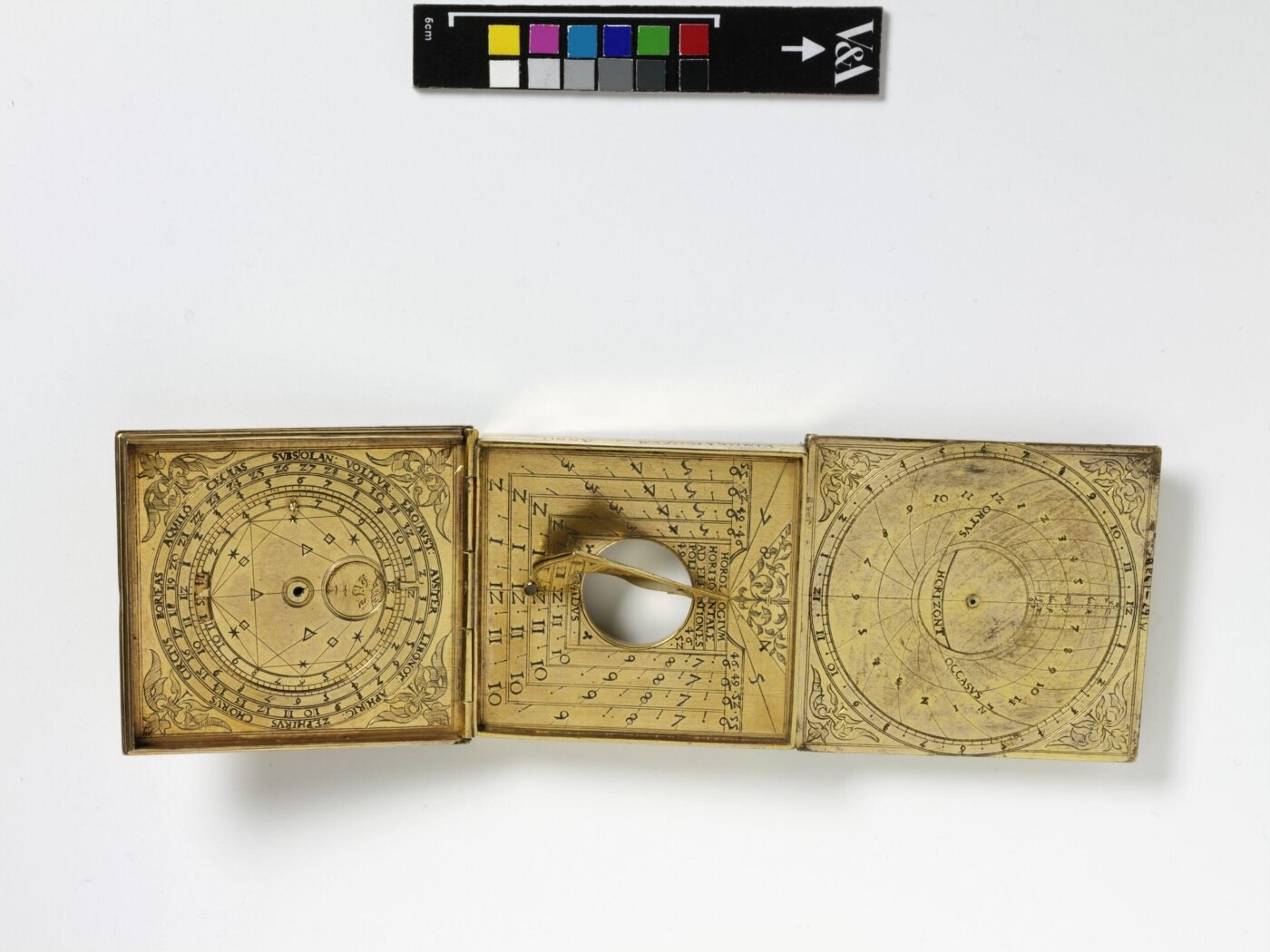
This astronomical compendium, created in 1557 by the German maker Christopher Schissler, is an instrument constructed from engraved, gilt copper. It consists of three rectangular leaves hinged together. The device serves multiple temporal and astronomical functions, featuring a sundial designed for four different latitudes, a nocturnal dial equipped with chronometric tables, a compass, and various reference tables for converting solar into lunar time and determining moon phases. The instrument also includes a table of latitudes covering cities such as London, Amsterdam, Oxford, and Paris. The decorative scheme includes engraved strapwork and floral ornamentation within the spandrels of the dials. The compendium was originally housed in a dark brown leather case with a brass hinge and clasp, though components of the compass mechanism are currently absent. The signature and date are engraved on the edges of the instrument.

An open astronomical compendium in gilt copper, featuring a sundial and celestial tables, dated 1557.
An open astronomical compendium in gilt copper, featuring a sundial and celestial tables, dated 1557. — Victoria and Albert Museum. Rights pending — permission not yet requested. Original source

Catalogue identity

Source
collections.vam.ac.uk
Category
Tool · Astronomical compendium
Maker / attribution
Christopher Schissler
Reference
Not recorded
Catalogue / lot identifier
M.167-1938
Source-reported date
1557
Source-reported place
Germany

Source-reported attribution and specifications are not independent authentication. A listing does not establish present ownership, current display, availability or permission to reproduce.

Object description

Construction and Design

The astronomical compendium is fabricated from sheet copper, which has been gilded and decorated with engraved patterns. The instrument is composed of three rectangular leaves connected by hinges, allowing the unit to be opened or folded for storage. The surfaces are densely engraved, with strapwork and floral ornamentation filling the spaces not occupied by scales or inscriptions.

The device incorporates several integrated components for timekeeping and celestial tracking. The layout includes a sundial configured for four latitudes, a nocturnal dial, and a sighting compass. The edges of the leaves provide mounting points for the internal mechanisms, and the frame is secured by a brass hinge and clasp system.

Evidence for this section
  • “Astronomical compendium of engraved and gilt copper with three hinged rectangular leaves”
  • “The spandrels formed by the dials and other suitable spaces are engraved with strapwork and floral ornament.”

Astronomical Functions

The instrument contains a series of mathematical and astronomical aids. Included are tables for calculating the conversion of solar time to lunar time, alongside a reference providing phases of the moon according to its age. A further table of latitudes lists various geographical locations, including cities across England, Scotland, and the continent, such as London, Amsterdam, Oxford, and Paris.

The nocturnal dial includes its own set of chronometric tables. Additionally, the compendium features a table designed for the conversion of equal hours into planetary hours. These diverse functions suggest the instrument was intended for varied astronomical calculations beyond simple timekeeping.

Evidence for this section
  • “Tables for converting solar into lunar time and for giving phases of the moon according to age”
  • “Table of latitudes for various places (of which a large proportion are English/Scottish)”
  • “Table of conversion of equal into planetary hours.”

Signatures and History

The instrument is signed by Christopher Schissler on its edges, identifying him as the maker and specifying the location of production in Augsburg, Germany. The inscription is dated 1557. Schissler operated a workshop that gained recognition for the production of specialized scientific instruments, including sundials and compendia.

Historical records link the workshop to the manufacture of instruments for Tycho Brahe, the astronomer. The compendium was later integrated into the museum's collection, registered under the accession number M.167-1938.

Evidence for this section
  • “The edges of the instrument are inscribed CRISTOPHORUS SCHISSLER ME FECIT AVGVSTE VINDELICORVM ANNO DOMINI 1557.”
  • “Schissler's workshop was famous. He specialised in sundials and compendia and produced instruments for the great Danish astronomer, Tycho Brahe.”

Open research questions

  • What specific scientific or navigation tasks were intended for the 'English/Scottish' latitudes listed?
  • How did the missing compass glass and needles impact the historical operation of this specific model?

Source evidence

Recorded claims and source quotations for Astronomical compendium by Christopher Schissler
FieldSource-reported valueSource quotation
Object typeAstronomical compendium“Object type: Astronomical compendium”
MakerChristopher Schissler“made by Christopher Schissler”
Date1557“Date: 1557”
Place of manufactureAugsburg, Germany“Augsburg, Germany; dated 1557”
Accession numberM.167-1938“Accession number: M.167-1938”
MaterialsCopper, gilt and engraved“Copper, gilt and engraved”
InscriptionsCRISTOPHORUS SCHISSLER ME FECIT AVGVSTE VINDELICORVM ANNO DOMINI 1557“CRISTOPHORUS SCHISSLER ME FECIT AVGVSTE VINDELICORVM ANNO DOMINI 1557”

Visible details

  • Hinged three-leaf construction
  • Engraved strapwork and floral ornament in spandrels
  • Latitude table including cities such as London and Paris
  • Brass folding gnomon present

Research qualifications

  • Missing compass needles and glass
  • Condition of the original leather case is not detailed beyond its physical description

Photograph identity and source facts were screened before import; rights clearance remains pending.

Consulted source

Astronomical compendium

Reviewed 2026-10-26 · Record 4ac5de354f

Terms in this record

Glossary explanations for terms named in this object’s record.

Other astronomical compendium records