
Skip to content
The Encyclopedia of Horology

Tool · English astronomical compendium

Astronomical Compendium

Partially verified

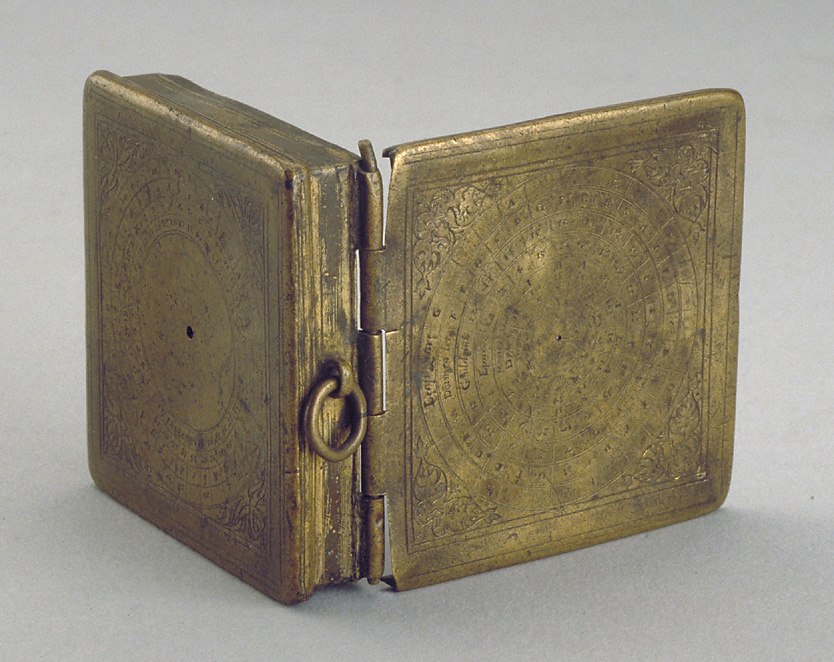
This astronomical compendium, held by the British Museum (MLA 1886, 5-11.6), is a remnant of a larger instrument consisting only of a hinged gilt brass case and lid. Measuring 58 x 58 x 14 mm, the object is unsigned and attributed to English origin, dating to approximately 1600. The external and internal surfaces are heavily engraved with concentric rings containing data for ecclesiastical calculations, including Dominical letters, Epacts, Golden numbers, and the date of Quadragesima and Easter. Central rings on the lid facilitate zodiacal and monthly solar calculations, while the spandrel spaces feature foliate engraving. The interior of the box remains empty, and the case retains a ring for suspension. This instrument was presented to the museum by A.W. Franks in 1886 , documented in F. A. B. Ward's catalogue of European scientific instruments.

View of the open gilt brass case showing the engraved concentric calculation rings on the lid and box base.
View of the open gilt brass case showing the engraved concentric calculation rings on the lid and box base. — British Museum, London. Rights pending — permission not yet requested. Original source

Catalogue identity

Source
www.mhs.ox.ac.uk
Category
Tool · English astronomical compendium
Maker / attribution
Not established
Reference
Not recorded
Catalogue / lot identifier
MLA 1886, 5-11.6
Source-reported date
circa 1600 ?
Source-reported place
England

Source-reported attribution and specifications are not independent authentication. A listing does not establish present ownership, current display, availability or permission to reproduce.

Object description

Case and Exterior Decoration

The instrument is contained within a square-shaped, hinged gilt brass case. The exterior surfaces are densely engraved with concentric rings used to assist the user with astronomical and ecclesiastical calculations. The layout includes specific tables for the 'Leap Yare', Dominical Letters, Golden numbers, and Epacts.

The spandrels in the corners of both the lid and the box are adorned with foliate decorative motifs. A small ring is fixed to the central hinge, which would have allowed for the instrument to be suspended when in use. The case measures 58 x 58 x 14 mm.

Evidence for this section
  • “The outside of the lid is engraved with concentric rings”
  • “In the spandrel spaces is foliate decoration”
  • “The instrument has a ring for suspension”

Inner Lid and Functional Data

The interior of the lid features a quartered heraldic shield representing the families of Stanhope, Mauleval, Longvilers, and Lexington. The central rings on the lid are specifically dedicated to solar calculations, indicating when the sun enters a particular zodiacal sign. These rings are labeled with the initials of months and the names of zodiacal symbols.

The exterior of the box provides further tables, including the identification of Prime Numbers, the Dominical Letter, and the calculations for Quadragesima and Easter Sunday. While the engraving remains clear, the interior of the box itself is currently empty, lacking the internal components that would have once comprised the complete instrument.

Evidence for this section
  • “The inside of the lid has a shield, quartered with the arms of Stanhope, Mauleval, Longvilers and Lexington”
  • “The central rings are used to calculate the day when the sun enters a particular zodiacal sign”
  • “The inside of the box is empty”

Documentation and Provenance

This object was acquired by the British Museum in 1886, having been presented by A.W. Franks. It is classified as an astronomical compendium of English origin, with the dating suggested as circa 1600. No signature of a maker is present on the object.

The instrument is referenced in the academic literature, specifically in F. A. B. Ward's 1981 work, 'A Catalogue of European Scientific Instruments in the Department of Medieval and Later Antiquities of the British Museum'. The current condition reflects that only the brass case and lid have survived, with the rest of the internal astronomical apparatus missing.

Evidence for this section
  • “Unsigned”
  • “The instrument was presented by A.W. Franks in 1886”
  • “described in F. A. B. Ward, A Catalogue of European Scientific Instruments in the Department of Medieval and Later Antiquities of the British Museum”
  • “Only the brass case and lid remain of this astronomical compendium”

Open research questions

  • What specific internal components would have originally been contained within the box to complete its function?
  • Does the armorial shield provide a definitive link to a specific owner or patron in the circa 1600 timeframe?

Source evidence

Recorded claims and source quotations for Astronomical Compendium
FieldSource-reported valueSource quotation
Dimensions58 x 58 x 14 mm“58 x 58 x 14 mm”
MaterialGilt brass“Gilt brass”
Inventory numberMLA 1886, 5-11.6“MLA 1886, 5-11.6”
ProvenancePresented by A.W. Franks in 1886“The instrument was presented by A.W. Franks in 1886”
HeraldryShield featuring arms of Stanhope, Mauleval, Longvilers, and Lexington“shield, quartered with the arms of Stanhope, Mauleval, Longvilers and Lexington”
EngravingConcentric rings for Easter and zodiacal calculations“The outside of the lid is engraved with concentric rings, the first four used to calculate the date of Easter”

Visible details

  • Hinged gilt brass construction
  • Engraved concentric calculation rings
  • Foliate decorative spandrels
  • Suspension ring attached to the spine

Research qualifications

  • Date is attributed with uncertainty ('circa 1600 ?')
  • Internal components are missing as the box is empty

Photograph identity and source facts were screened before import; rights clearance remains pending.

Consulted source

Astronomical Compendium

Reviewed 2026-10-26 · Record ae3f5ebcf7

Terms in this record

Glossary explanations for terms named in this object’s record.