Skip to content
The Encyclopedia of Horology

Tool · English astronomical compendium

Astronomical Compendium by Humfrey Cole

Partially verified

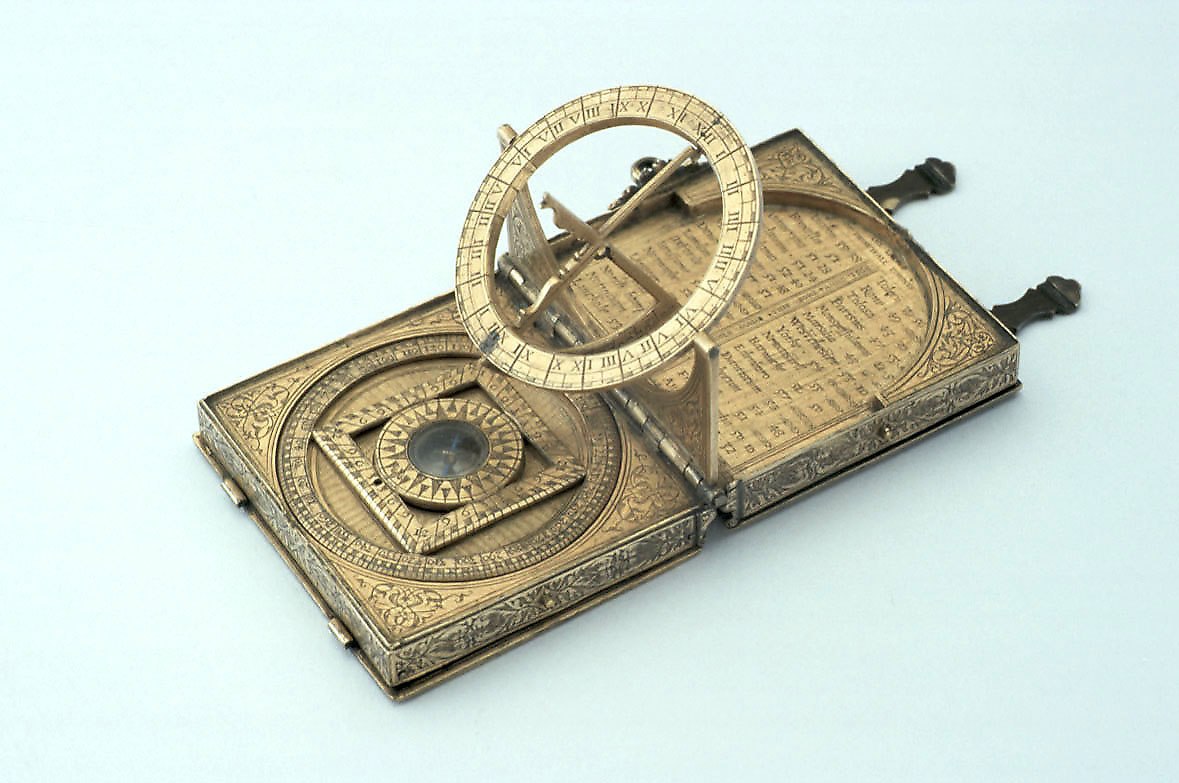
This gilt brass astronomical compendium, measuring 66 x 60 x 20 mm, was made in London by Humfrey Cole and dated 1568. Constructed in the form of a book with an external suspension ring, it functioned as a multi-purpose scientific instrument for its first owner, the printer and publisher Richard Jugge. The device contains a quadrant with folding sights, a compass with a geometrical square, and a universal equinoctial sundial. Internally, the instrument features a table of latitudes for 33 towns and a calendar covering the months of January to June. The front cover bears a circular engraving of Jugge's canting badge, surrounded by foliate strapwork. Some components, including the plummet for the dial, the calendar for July to December, and the original back cover and clasps, are no longer present. The instrument remains in the collection of the Museum of the History of Science, Oxford.

The astronomical compendium open, showing the universal equinoctial sundial, compass, and table of latitudes.
The astronomical compendium open, showing the universal equinoctial sundial, compass, and table of latitudes. — Museum of the History of Science, Oxford. Rights pending — permission not yet requested. Original source

Catalogue identity

Source
www.mhs.ox.ac.uk
Category
Tool · English astronomical compendium
Maker / attribution
Humfrey Cole
Reference
36313
Catalogue / lot identifier
36313
Source-reported date
1568
Source-reported place
London

Source-reported attribution and specifications are not independent authentication. A listing does not establish present ownership, current display, availability or permission to reproduce.

Object description

Construction and Design

The compendium is constructed from gilt brass in the form of a book, designed with an integrated suspension ring that allowed the user to wear the device as a pendant. Two projections on the front cover indicate that clasps were originally fitted to hold the device closed.

Internally, the instrument is divided into several sections, including a quadrant, a compass unit, a universal equinoctial sundial, a table of latitudes, and a partial calendar. The instrument is designed for portability, with specific compartments for drawing tools, although these tools are currently missing.

The interior of the back cover is blank, distinguishing it from the ornate treatment of the other surfaces.

Evidence for this section
  • “The instrument is in the form of a book”
  • “The back cover and clasps are presumably replacements.”
  • “The inside of the back cover is uncharacteristically blank”

Scientific Functions

The compendium serves as a versatile tool for calculation and observation. On the inner front cover, a quadrant with folding sights allows the user to measure the height of the sun or buildings using either a 'Quadrans Astronomicus' or a 'Quadrans Geometricus' scale. A plumb bob was originally attached at the vertex for use with these scales.

The instrument includes a compass with a blued needle set in a silvered bowl, surrounded by a 32-point compass rose. This is integrated into a removable unit that also incorporates a geometrical square and a circle of degrees. A universal equinoctial sundial is hinged between the two main leaves, with a quadrant slot to adjust the dial according to latitude.

A table listing the latitudes of 33 major towns is engraved on one leaf, while the opposite side contains a calendar for the first half of the year. The calendar is marked with golden letters, zodiacal signs, and various saint's days, following a layout derived from Leonard Digges' publications.

Evidence for this section
  • “The compendium includes a quadrant , room for drawing instruments , a compass , a universal equinoctial sundial”
  • “The compass has a blued needle in a silvered bowl”
  • “Hinged between the two main leaves is a universal equinoctial dial.”

Provenance and Inscriptions

The instrument is signed by the maker, Humfrey Cole, with an inscription placed between two columns of town names. The engraving 'HVMFRAY . COOLE . MADE . THIS . BOKE + ANNO . 1568 .' explicitly identifies the maker and the date of production.

The front cover prominently displays a circular badge belonging to the first owner, Richard Jugge, who was a Master of the Stationers' Company. The badge is an allusion to his name, featuring a nightingale (which sings 'jug jug') and a tree. This same symbol was utilized by Cole in his 1572 map engraving for Jugge's edition of the Bishops' Bible, suggesting a long-standing association between the maker and the publisher.

Evidence for this section
  • “Signed by Humfrey Cole”
  • “HVMFRAY . COOLE . MADE . THIS . BOKE + ANNO . 1568 .”
  • “The format would have appealed to the first owner, the printer and publisher Richard Jugge, whose badge appears on the front cover.”

Open research questions

  • What is the specific material composition of the original back cover and clasps, and are they contemporary with the 1568 manufacture?
  • What is the full provenance of the object between its ownership by Richard Jugge and its acquisition by the Museum of the History of Science?

Source evidence

Recorded claims and source quotations for Astronomical Compendium by Humfrey Cole
FieldSource-reported valueSource quotation
MakerHumfrey Cole“Signed by Humfrey Cole”
Date1568“Dated 1568; London”
Dimensions66 x 60 x 20 mm“66 x 60 x 20 mm closed”
MaterialGilt brass“Gilt brass”
Inventory Number36313“Inventory number 36313”
Original OwnerRichard Jugge“first owner, the Elizabethan printer and publisher Richard Jugge”
Location of SignatureInternal leaf“HVMFRAY . COOLE . MADE . THIS . BOKE + ANNO . 1568 .”

Visible details

  • The universal equinoctial dial features a rotating hour ring with Roman numerals.
  • The interior contains a compass with a blued needle and a 32-point rose.
  • Engraved foliate decoration appears on the exterior case and internal plates.

Research qualifications

  • The back cover and clasps are described as likely replacements.
  • The calendar is incomplete, lacking the portion from July to December.
  • The plummet originally used for the equinoctial dial is missing.

Photograph identity and source facts were screened before import; rights clearance remains pending.

Consulted source

Astronomical Compendium

Reviewed 2026-10-26 · Record bbcf84970b

Terms in this record

Glossary explanations for terms named in this object’s record.