
Skip to content
The Encyclopedia of Horology

Clock · German astronomical clock

Astronomical Clock

Partially verified

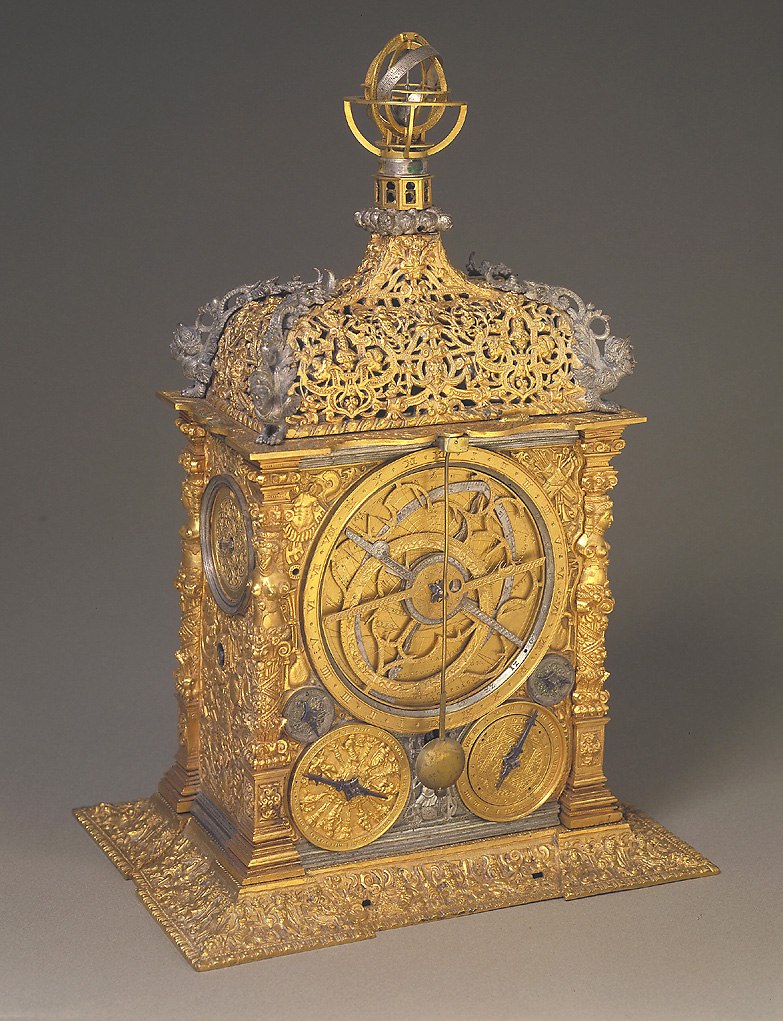
This astronomical clock is constructed from gilt brass, measuring 214 x 151 x 323 mm. It is unsigned and dated to approximately 1575, with a German origin. The clock is characterized by a richly decorated case and a pierced gilt brass cupola surmounted by an armillary sphere, which features a central earth, graduated rings for constellations and winds, and a celestial meridian with an hour circle. The main face contains a mechanical astrolabe with a sidereal-rotating rete and pointers for the sun and moon, including a dragon-shaped pointer for the lunar nodes. The plate is reversible, calibrated for latitudes of 48 degrees and 40 degrees. Additional circles on the side faces facilitate the chime functions. A small compass is integrated into the base. The abbreviation 'CR' is inscribed on the back of the astrolabe quadrant, though its attribution to a specific maker remains speculative.

The gilt brass astronomical clock showing the astrolabe dial and the upper armillary sphere.
The gilt brass astronomical clock showing the astrolabe dial and the upper armillary sphere. — Istituto e Museo di Storia della Scienza, Firenze. Rights pending — permission not yet requested. Original source

Catalogue identity

Source
www.mhs.ox.ac.uk
Category
Clock · German astronomical clock
Maker / attribution
Not established
Reference
Not recorded
Catalogue / lot identifier
3370
Source-reported date
circa 1575
Source-reported place
Germany

Source-reported attribution and specifications are not independent authentication. A listing does not establish present ownership, current display, availability or permission to reproduce.

Object description

Case and External Features

The astronomical clock is housed in a gilt brass case that is extensively decorated and ornamented throughout its surfaces. The structure is capped by a pierced gilt brass cupola, which serves as a mount for a functional, manually adjustable armillary sphere. This sphere features a representation of the earth at its center, surrounded by rings that are graduated and marked with the names of winds and various constellations.

In addition to the celestial display at the top, the base of the clock contains a small, integrated compass. The side faces of the clock are equipped with circular dials that perform functions related to the internal chime mechanism.

Evidence for this section
  • “The brass case is gilded and richly decorated.”
  • “Above the dome is an armillary sphere which can be manipulated by hand.”
  • “a small compass is contained in the base.”

Astronomical Display and Astrolabe

The primary face of the clock is dominated by a large circular plate which functions as a mechanical astrolabe. This component incorporates a rete capable of rotating in a sidereal day, fitted with specific pointers designed to track the sun and the moon. A pointer shaped like a dragon indicates the lunar nodes.

The astrolabe plate is designed to be reversible, allowing for use in different geographical locations. One side is calibrated for a latitude of 48 degrees, corresponding to regions such as Bavaria or Vienna, while the reverse is calibrated for a latitude of 40 degrees, corresponding to the Madrid area. An hour circle is positioned externally and is numbered twice from I to XII, completing the functional display.

Evidence for this section
  • “The largest circle has a mechanical astrolabe , with an external horary circle.”
  • “The plate is reversible, with one side calibrated for the latitude of 48( (Bavaria, Vienna), and the other side calibrated for 40? (the Madrid area).”
  • “Under the rete is the pointer for the nodes, in the shape of a dragon.”

Signatures and Attribution

The clock is unsigned in the traditional sense, though the letters 'CR' are inscribed twice on the reverse of the quadrant containing the astrolabe. This inscription has led to speculation regarding the maker's identity, with some suggesting it may refer to Cristofor Crofler, a maker documented as having created a clock for Maria Cristina di Lorena.

However, historical records regarding this attribution are inconclusive. The theory is not supported by substantial evidence and remains unconfirmed. As a result, the identity of the specific instrument maker remains an open question within the study of this object.

Evidence for this section
  • “The abbreviation 'CR' has been inscribed twice on the back of the quadrant with the astrolabe.”
  • “Although we cannot be sure of the identity of the instrument maker, the abbreviation might possibly stand for Cristofor Crofler”
  • “This attribution is not supported by any strong evidence, however, and does not seem to be especially probable.”

Open research questions

  • What is the mechanical relationship between the side dials and the chime function?
  • Are there specific archival documents linking the 'CR' mark to other known works of this period?

Source evidence

Recorded claims and source quotations for Astronomical Clock
FieldSource-reported valueSource quotation
MaterialGilt brass“Gilt brass”
Dimensions214 x 151 x 323 mm“214 x 151 x 323 mm”
Latitude Calibrations48 degrees and 40 degrees“The plate is reversible, with one side calibrated for the latitude of 48( (Bavaria, Vienna), and the other side calibrated for 40? (the Madrid area).”
InscriptionsCR“The abbreviation 'CR' has been inscribed twice on the back of the quadrant with the astrolabe.”
OriginGerman“German manufacture”
Datecirca 1575“circa 1575”
Holding InstitutionIstituto e Museo di Storia della Scienza, Firenze“Istituto e Museo di Storia della Scienza, Firenze”

Visible details

  • Pierced gilt brass cupola with armillary sphere
  • Dragon-shaped pointer for the lunar nodes
  • Reversible astrolabe plate for two latitudes
  • Integrated small compass in the base

Research qualifications

  • Attribution to Cristofor Crofler is speculative and lacks strong evidence
  • The precise maker remains unidentified despite the 'CR' inscription

Photograph identity and source facts were screened before import; rights clearance remains pending.

Consulted source

Astronomical Clock

Reviewed 2026-10-26 · Record 77f87c36a9

Terms in this record

Glossary explanations for terms named in this object’s record.