
Skip to content
The Encyclopedia of Horology

Tool · Persian-inscribed astrolabe, Indian subcontinent

Astrolabe by Ḍiyā’ ad-Dīn Muḥammad

Partially verified

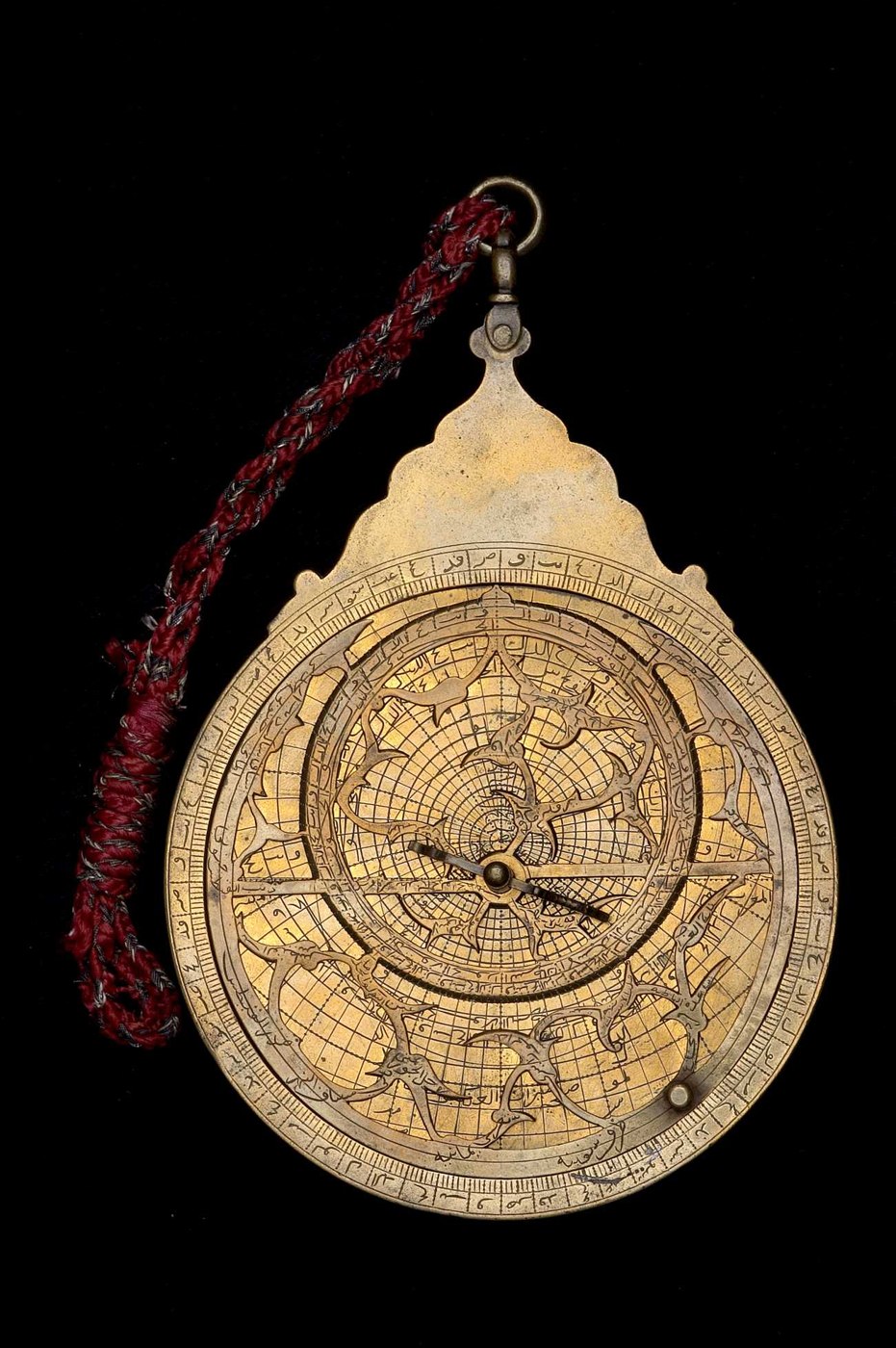
This brass planispheric astrolabe was produced in Lahore in 1653/4 (A.H. 1064) by the maker Ḍiyā’ ad-Dīn Muḥammad. It features an Indo-Persian type throne with an integrated base and a trefoil shackle. The mater and limb are constructed from a single piece of brass, with the latter featuring a degree scale. The rete is of the foliate type, containing 37 stars marked with foliate pointers and an ecliptic scale. The instrument includes five plates covering latitudes from 22° to 66°. The back of the instrument is engraved with 11 scales, including altitude, declination, sine/cosine, cotangent, shadow square, zodiacal signs, and lunar mansions. The maker’s signature is engraved on the back. The astrolabe was presented to the museum by J. A. Billmeir in 1957. The current alidade is identified as a replacement, distinguishable from the remainder of the instrument by its metal composition and finish.

Front view of the 1653/4 brass astrolabe showing the foliate rete and throne assembly.
Front view of the 1653/4 brass astrolabe showing the foliate rete and throne assembly. — History of Science Museum, University of Oxford. Rights pending — permission not yet requested. Original source

Catalogue identity

Source
www.mhs.ox.ac.uk
Category
Tool · Persian-inscribed astrolabe, Indian subcontinent
Maker / attribution
Ḍiyā’ ad-Dīn Muḥammad
Reference
Not recorded
Catalogue / lot identifier
1957-84/163
Source-reported date
1653/4 (A.H. 1064)
Source-reported place
Lahore
Source-reported serial
38862

Source-reported attribution and specifications are not independent authentication. A listing does not establish present ownership, current display, availability or permission to reproduce.

Object description

Construction and Design

The astrolabe is crafted from brass and adheres to the Indo-Persian design tradition. It features a throne of this specific type with an integrated base, supporting a trefoil-style shackle and a plain, round-section ring. The mater and limb are fashioned as a single-piece construction, with a tab positioned at the base to facilitate the secure rotation of the plates.

The rete is characterized by a foliate design, incorporating a single knob and 37 individual star pointers, each shaped as a leaf. The instrument accommodates five internal plates, which provide coverage for latitudes ranging from 22° to 66°. The central attachment is secured using a pin and a decorative, life-like horse figure.

Evidence for this section
  • “The throne is of the indo-persian type made of brass attached with integrated base”
  • “The mater and limb are of one-piece construction”
  • “The rete is of the foliate (single knob) type.”
  • “The rete is attached using a pin & horse. The pin is held in place by a rather ornate and life-like horse.”

Scales and Inscriptions

The rear of the instrument is densely marked with 11 distinct astronomical scales. These include traditional features such as altitude, declination, cotangent, and shadow squares, alongside more complex layouts for lunar mansions and zodiacal signs. These scales provide a comprehensive set of functions for calculating celestial positions.

The instrument carries a formal signature of the maker on the back. This inscription identifies the creator as the least of the servants, Ḍiya ad-Dīn ’ibn Muḥammad, and dates the work to the year 1064 A.H. (1653/4).

Evidence for this section
  • “The back contains 11 scales of the following types: Altitude; Declination; Sine/Cosine; Cotangent; Shadow square; Zodiacal signs; Lunar Mansions.”
  • “The back is inscribed: with a maker's signature marked as عمل اقم العباد ضيا و الدين ابن قايم محمد اسطرلابى ١٠٦٤ سنه (The work of the least of the servants, the astrolabist Ḍiya ad-Dīn ’ibn Muḥammad, year 1064).”

Provenance and Condition

The astrolabe entered the collection in 1957 through a presentation by J. A. Billmeir, who had acquired the object shortly before between 1955 and 1957. It holds the inventory number 38862 and the accession number 1957-84/163.

Regarding the condition of the constituent parts, the report notes that the alidade is not original to the instrument. This component is classified as a replacement because both its metal composition and surface finish exhibit clear differences when compared to the original brass elements of the astrolabe.

Evidence for this section
  • “Presented by J. A. Billmeir in 1957”
  • “Billmeir bought it during the period 1955-57.”
  • “The alidade is almost certainly a replacement; the metal and the finish are distinctly different from the rest of the instrument.”

Open research questions

  • What is the specific material composition of the replacement alidade compared to the main instrument?
  • Are there remaining traces of original lacquer or surface treatment on the primary brass components?

Source evidence

Recorded claims and source quotations for Astrolabe by Ḍiyā’ ad-Dīn Muḥammad
FieldSource-reported valueSource quotation
MakerḌiyā’ ad-Dīn Muḥammad“Maker Ḍiyā’ ad-Dīn Muḥammad”
Place of ManufactureLahore“Place Lahore”
Date1653/4 (A.H. 1064)“Date 1653/4 (A.H. 1064)”
Inventory Number38862“Inventory no. 38862”
MaterialBrass“Material Brass”
ProvenancePresented by J. A. Billmeir in 1957“Presented by J. A. Billmeir in 1957”
InscriptionSignature of Ḍiya ad-Dīn ’ibn Muḥammad“عمل اقم العباد ضيا و الدين ابن قايم محمد اسطرلابى ١٠٦٤ سنه”
Alidade statusReplacement“The alidade is almost certainly a replacement; the metal and the finish are distinctly different from the rest of the instrument.”

Visible details

  • Foliate rete with 37 star pointers
  • Indo-Persian style throne
  • Eleven distinct scales on the back
  • Trefoil-type shackle at the apex

Research qualifications

  • The alidade is reported as a non-original replacement
  • The exact origin of the cord present in photos is not documented

Photograph identity and source facts were screened before import; rights clearance remains pending.

Consulted source

Astrolabe, inventory 38862 (Lahore, 1653/4 (A.H. 1064))

Reviewed 2026-10-26 · Record ecb386fdb1

Terms in this record

Glossary explanations for terms named in this object’s record.