
Skip to content
The Encyclopedia of Horology

Clock · Skeleton clock

Antique Fusee Skeleton clock

Partially verified

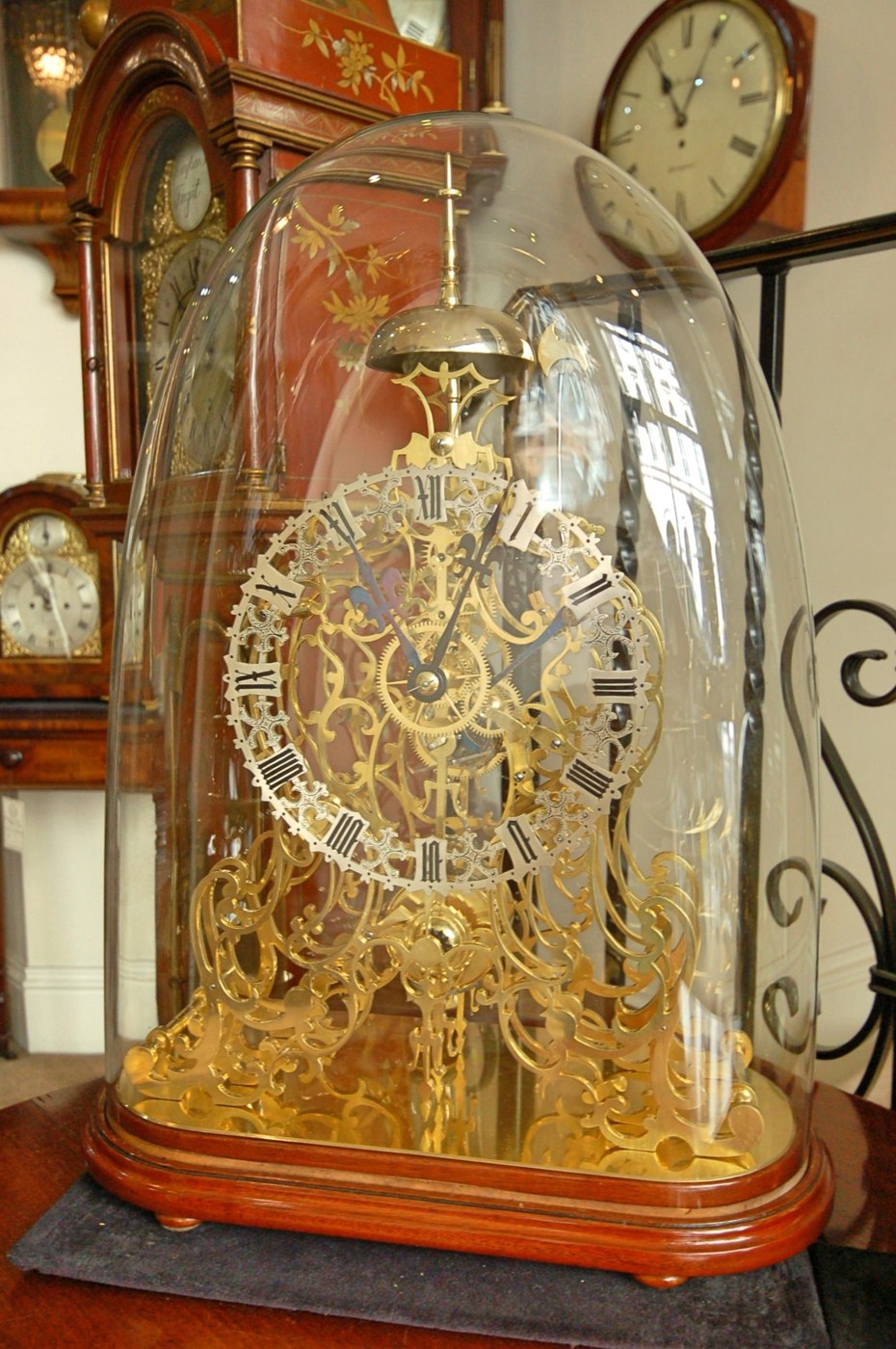
This antique skeleton clock, dated to circa 1860, is constructed with a brass triple-plate frame featuring pierced, fretted detailing. The movement utilizes a fusee mechanism for consistent power delivery from the spring, providing an eight-day duration. Time is indicated on a pierced, silver-plated dial decorated with engraved patterns and Roman numerals, complemented by dark decorative hands. The strike train features an hour passing strike, with the hammer acting upon a metal bell mounted at the top of the structure. The clock is set upon a polished wooden base and enclosed within an oval glass dome. Regulation is performed by a wood rod compensated pendulum featuring a large cylindrical weight. The gear train is designed with six-spoke wheels. The open architecture reveals the inner mechanics and geometry of the brass plates, allowing for full visibility of the movement components.

The antique fusee skeleton clock positioned on a wooden base and protected by a glass dome.
The antique fusee skeleton clock positioned on a wooden base and protected by a glass dome. — Pendulum of Mayfair. Rights pending — permission not yet requested. Original source

Catalogue identity

Source
zamanito.com
Category
Clock · Skeleton clock
Maker / attribution
Pendulum of Mayfair
Reference
Not recorded
Catalogue / lot identifier
Source URL identifies the listing
Source-reported date
circa 1860
Source-reported place
Not established

Source-reported attribution and specifications are not independent authentication. A listing does not establish present ownership, current display, availability or permission to reproduce.

Object description

Frame and Architecture

The clock features a skeletonized construction, which removes traditional casing to expose the internal brass movement. The frame is designed as a triple-plate structure composed of brass, characterized by intricate pierced and fretted curves. This open design renders the geometry of the plates and the moving components visible from multiple angles.

The entire assembly is secured to a polished wooden base, which serves as the foundation for the clock. Protection is provided by an oval-shaped glass dome, which covers the movement while maintaining visibility of the mechanical assembly within. The structural arrangement prioritizes the display of the brasswork and the gear train operation.

Evidence for this section
  • “بدنه ساعت از طراحی سه صفحه‌ای (Triple plate) برنجی با برش‌های منحنی و فرم‌دار ظریف بهره می‌برد.”
  • “ساختار اسکلتی به بیننده اجازه می‌دهد تا جزئیات قطعات متحرک و هندسه صفحات برنجی را به طور کامل مشاهده کند.”

Movement and Timekeeping

At the core of the clock's function is a fusee spring-driven movement, engineered to provide a constant force to the gear train throughout its eight-day power reserve. The wheels within the gear train are manufactured with a six-spoke design. Regulation of the timekeeping is managed via a wood rod compensated pendulum, which is weighted by a substantial cylindrical bob.

The clock includes a strike function described as an hour passing strike. This mechanism is configured to sound a single blow on a metal bell positioned at the highest point of the clock structure. The interaction between the strike train and the bell occurs at the top of the movement frame.

Evidence for this section
  • “سازوکار ساعت با بهره‌گیری از سیستم فیوزی نیروی فنر را یکنواخت انتقال می‌دهد.”
  • “سیستم تنظیم زمان به وسیله یک آونگ با میله چوبی جبران‌ساز (Wood rod compensated pendulum) و وزنه استوانه‌ای بزرگ و چشمگیر کنترل می‌شود.”

Dial and Hands

The dial is designed to complement the skeletonized frame, featuring a pierced and fretted aesthetic that matches the surrounding brasswork. The surface is silver-plated and decorated with engraved detailing. Time is marked by Roman numerals integrated into the ring.

Readability is provided by dark, decorative hands that contrast with the reflective silver-plated dial and the polished brass of the movement plates. These elements are designed to be read easily against the background of the exposed gear train and plate geometry.

Evidence for this section
  • “صفحه ساعت به صورت مشبک و برش‌خورده (Pierced fretted) طراحی شده، روکش نقره‌اندود دارد و با نقوش حکاکی‌شده و ارقام رومی تزیین شده است.”

Open research questions

  • What is the specific maker or origin of this clock design?
  • What is the technical significance of the wood rod compensation in this specific model of skeleton clock?

Source evidence

Recorded claims and source quotations for Antique Fusee Skeleton clock
FieldSource-reported valueSource quotation
TypeSkeleton clock“ساعت اسکلتی (Skeleton Clock)”
Datecirca 1860“حدود ۱۸۶۰”
Power reserve8 days“مدت‌زمان کارکرد ۸ روزه”
MovementFusee spring driven“مکانیزم باکیفیت کوک فیوزی (Fusee) فنری”
ConstructionTriple plate brass“بدنه ساعت از طراحی سه صفحه‌ای (Triple plate) برنجی”
Striking mechanismHour passing strike“سیستم نواختن زنگ در رأس هر ساعت (Hour passing strike)”
DialPierced silver-plated“صفحه ساعت به صورت مشبک و برش‌خورده (Pierced fretted) طراحی شده، روکش نقره‌اندود دارد”

Visible details

  • Pierced, fretted brass frame structure
  • Six-spoke wheel design within the gear train
  • Hour passing strike hammer and bell assembly
  • Silver-plated chapter ring with Roman numerals

Research qualifications

  • Condition of the mainspring and fusee chain or line is not stated
  • Integrity of the brass plates and authenticity of the glass dome have not been verified by the source

Photograph identity and source facts were screened before import; rights clearance remains pending.

Consulted source

Antique Fusee Skeleton clock C1860

Reviewed 2026-11-02 · Record 8807a805e6

Terms in this record

Glossary explanations for terms named in this object’s record.