
Skip to content
The Encyclopedia of Horology

Clock · Water clock

Anaphoric clock reconstruction

Partially verified

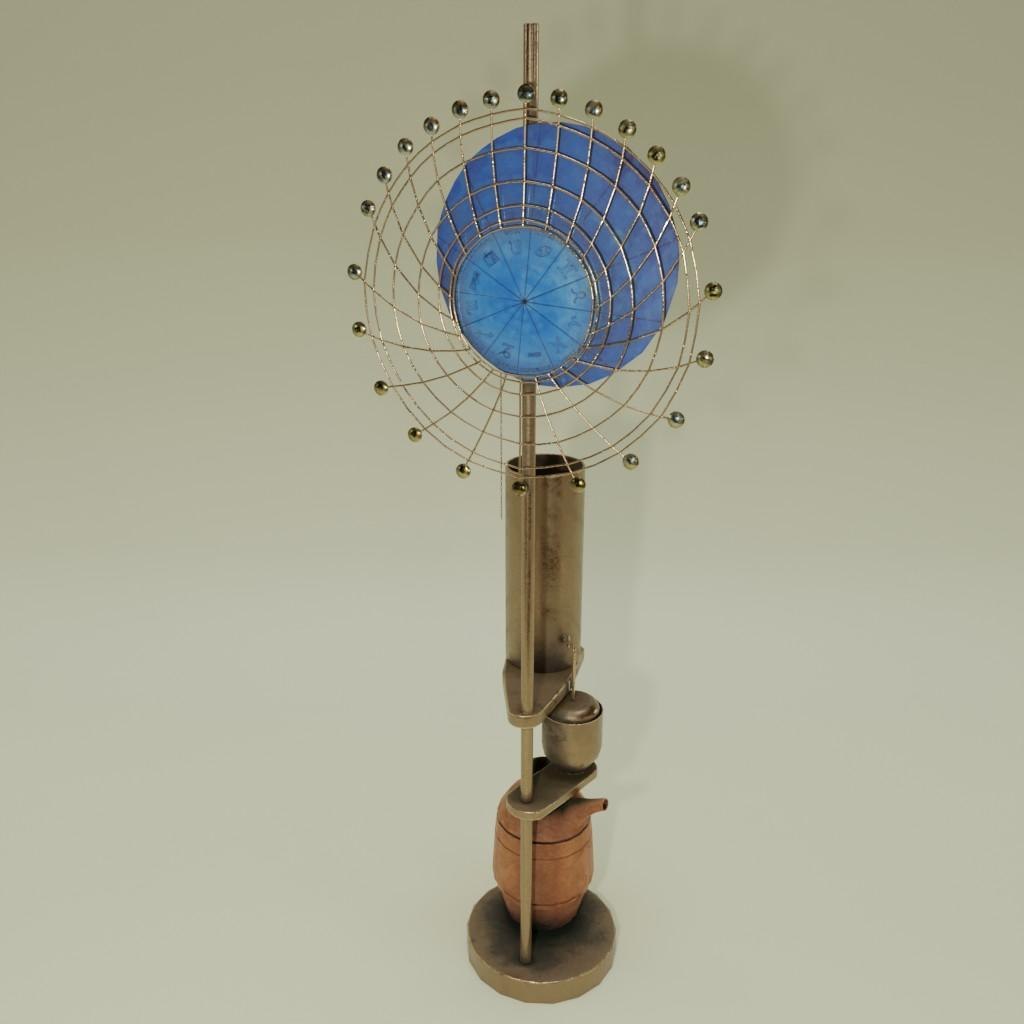
The anaphoric clock is a reconstruction held by the Kotsanas Museum of Ancient Greek Technology, credited to maker Kostas Kotsanas. It functions as a hydraulic timepiece designed to track 365 hours of the year. The mechanism features a rotating cam disc representing the sky and the zodiac cycle, positioned behind a bronze grid. This grid comprises seven homocentric circles denoting month intervals and twenty-four curved rods representing the hours based on the analemma diagram. The rotation of the disc is facilitated by a pulley, a flexible chain, and a weight-float system. Isochronous water flow is maintained by a self-regulated controller of the Ktesibios type, which governs the water level. Each day, a pointer is adjusted manually to a position on the disc periphery corresponding to the days of the zodiac. The device aims to visually represent ancient Greek timekeeping technology through these mechanical and hydraulic principles.

The anaphoric clock reconstruction showing the zodiac disc, bronze grid, and hydraulic control assembly.
The anaphoric clock reconstruction showing the zodiac disc, bronze grid, and hydraulic control assembly. — Kotsanas Museum of Ancient Greek Technology via Europeana. Rights pending — permission not yet requested. Original source

Catalogue identity

Source
orbiscollectibles.com
Category
Clock · Water clock
Maker / attribution
Kostas Kotsanas
Reference
Not recorded
Catalogue / lot identifier
Source URL identifies the listing
Source-reported date
Not established
Source-reported place
Ancient Greece

Source-reported attribution and specifications are not independent authentication. A listing does not establish present ownership, current display, availability or permission to reproduce.

Object description

Mechanical Construction

The clock functions through a complex arrangement of hydraulic and mechanical parts. At the core of the display is a blue cam disc inscribed with a celestial and zodiacal chart, which rotates behind a fixed bronze framework. This framework is constructed from a series of seven homocentric circles and twenty-four intersecting curved rods, creating a grid that correlates the passage of hours with the specific month of the year as defined by the analemma.

Movement of the disc is powered by the regulated vertical descent or ascent of water within the system. A pulley system connects the rotating component to a weight-float, which responds to the changing levels of water within the central vessel. The precision of this movement is dependent on the consistent outflow of water, which is maintained by an integrated controller designed according to the Ktesibios model for constant level regulation.

Evidence for this section
  • “A cam disc - on which a drawing represented the sky and the zodiac cycle – rotated behind a bronze grid.”
  • “The rotation of the disc was achieved through a pulley and a flexible chain with a counterweight and a weight-float which was lowered or lifted through the isochronous (=equal time) descent or ascent of the water level.”
  • “This isochronous descent or ascent was ensured by the isochronous water outflow through a self-regulated controller of the constant level of the Ktesibios type.”

Display and Operation

The object is designed to track time across the full duration of a year. The interface consists of 365 points located along the periphery of the rotating disc, each representing a day in the zodiacal cycle. A pointer is moved daily by an operator to the correct position, ensuring the displayed information remains synchronized with the calendar date.

The integration of the grid and the rotating disc allows for the visualization of time in relation to the celestial cycle. The curved rods on the bronze grid provide a visual reference for hour tracking that accounts for the variation in the solar year, as necessitated by the ancient design protocols that this reconstruction follows.

Evidence for this section
  • “The grid consisted of 7 homocentric circles defining the month intervals and 24 curved rods defining the hours”
  • “Every day a pointer was placed successively on the corresponding one of the 365 holes of the disc periphery, which defined the days of the zodiac.”

Attribution and Provenance

The clock is identified in public records as a creation of Kostas Kotsanas. It is presently part of the permanent collection of the Kotsanas Museum of Ancient Greek Technology, which documents the device as a representation of ancient hydraulic timekeeping.

The museum record establishes the object's identity within their collection, noting its function and historical association with the technologies of Ancient Greece. No individual catalogue number is currently associated with this specific specimen in the provided source material, though it is registered within the aggregation systems of the Europeana Foundation.

Evidence for this section
  • “held by Kotsanas Museum of Ancient Greek Technology.”
  • “The museum record gives place associated: Ancient Greece; maker recorded: Kostas Kotsanas.”

Open research questions

  • What are the specific materials used in the construction of the blue zodiac disc and bronze framework?
  • What are the precise height and diameter dimensions of this specific museum reconstruction?

Source evidence

Recorded claims and source quotations for Anaphoric clock reconstruction
FieldSource-reported valueSource quotation
MakerKostas Kotsanas“maker recorded: Kostas Kotsanas.”
Holding InstitutionKotsanas Museum of Ancient Greek Technology“held by Kotsanas Museum of Ancient Greek Technology.”
FunctionHydraulic clock indicating 365 hours“It was a brilliant hydraulic clock which indicated, with accuracy, the 365 different hours of the year.”
Mechanism typeKtesibios constant level controller“isochronous water outflow through a self-regulated controller of the constant level of the Ktesibios type.”
Design featureAnalemma-based grid“The grid consisted of 7 homocentric circles defining the month intervals and 24 curved rods defining the hours according to the “hour – month” diagram (“analemma”).”
Rotation methodPulley, chain, and weight-float“The rotation of the disc was achieved through a pulley and a flexible chain with a counterweight and a weight-float”

Visible details

  • Blue rotating zodiac cam disc
  • Bronze grid with homocentric circles and curved rods
  • Cylindrical water level control vessel at base
  • Manual pointer for daily adjustment on disc periphery

Research qualifications

  • The item is a reconstruction, not an original antique timepiece
  • Materials and specific dimensions remain unverified

Photograph identity and source facts were screened before import; rights clearance remains pending.

Consulted source

The “anaphoric” clock

Reviewed 2026-11-02 · Record c8d5311770

Terms in this record

Glossary explanations for terms named in this object’s record.

Other water clock records