
Skip to content
The Encyclopedia of Horology

Clock · Water clock

Water Clock by E.S. Nurse

Partially verified

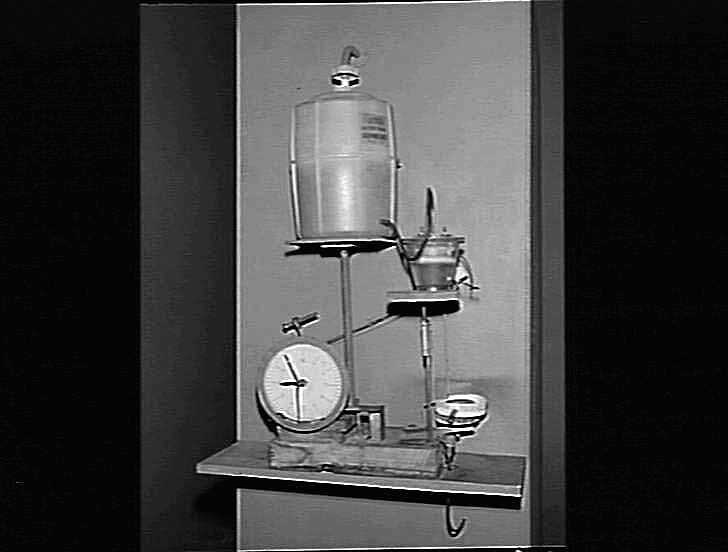
This water-driven, pendulum-controlled clock was designed and constructed by Captain Edwin S. Nurse in 1968 in Heathmont, Victoria, Australia. Constructed as a retirement project by a former Royal Australian Navy mechanical engineer, the device utilizes basic materials, including aluminium sheet for the wheels, galvanized iron wire for bearings, and a plastic reservoir. The mechanism operates via a horizontal pendulum that gains weight from water drops, which subsequently powers a ratchet-based gear train. The movement consists of three wheels, each with sixty teeth, which drive the hour and minute indicators. The clock functions without temperature compensation and consumes approximately 2.25 litres of water per day. The designer intended the mechanism to be replicable using simple hand tools, such as pliers, a soldering iron, and tin snips. It is held in the Museums Victoria collection following its bequest in 1972.

Full view of the water clock, showing the water reservoir, horizontal pendulum, and the gear train mounted on a central stand.
Full view of the water clock, showing the water reservoir, horizontal pendulum, and the gear train mounted on a central stand. — Museums Victoria. Rights pending — permission not yet requested. Original source

Catalogue identity

Source
collections.museumsvictoria.com.au
Category
Clock · Water clock
Maker / attribution
Captain Edwin S. Nurse
Reference
Not recorded
Catalogue / lot identifier
ST 29857
Source-reported date
1968
Source-reported place
Australia

Source-reported attribution and specifications are not independent authentication. A listing does not establish present ownership, current display, availability or permission to reproduce.

Object description

Mechanical Construction and Design

The clock is built from readily available, repurposed materials, reflecting the designer's intent that the device could be reproduced in a domestic setting using standard hand tools. The primary structural components consist of aluminium sheet for the wheels and bent galvanized iron wire for the spindle bearings. A rubber tube connects a primary water container to a constant-level reservoir, which delivers individual water drops to the end of a horizontal pendulum.

The pendulum's downward motion, prompted by the weight of the water, triggers a ratchet that drives the gear train. Once the drop is discharged, the pendulum resets. The transmission system is composed of three wheels, each featuring sixty teeth, which operate the clock hands via cams and ratchets. The bearings are designed to roll rather than rub to minimize friction during operation.

Evidence for this section
  • “The wheels are cut from aluminium sheet and the teeth twisted through ninety degrees by hand using pliers.”
  • “To reduce friction the pendulum bearings are of the rolling type, the wire rolling (not rubbing) on its supports.”
  • “The gear train of the clock is very simple, consisting of three wheels of sixty teeth each mounted on co-axial shafts connected to the hands”

Operational Characteristics

The clock operates through a continuous water flow, which must be calibrated by adjusting the height of a valve-controlled reservoir. This adjustment ensures that the drop rate aligns with the frequency of the pendulum swings. Once the pendulum captures a water drop, the resulting weight shift provides the necessary energy to advance the gear train. The water is eventually collected in a lower discharge reservoir, utilizing surface tension to complete the cycle.

Performance is reported as being accurate to approximately one minute per day. The device does not feature any form of temperature compensation, meaning its performance is subject to environmental fluctuations. The clock requires a daily replenishment of approximately two and a quarter litres of water to maintain its functional state.

Evidence for this section
  • “The rate of water flow is adjusted to provide, as nearly as possible, one water drop for each pendulum swing.”
  • “Although the construction appears to be rough it is accurate to one minute per day.”
  • “The clock is not compensated for temperature and is accurate to approximately one minute per day.”

History and Provenance

The clock was invented and constructed by Captain Edwin S. Nurse, a retired mechanical engineer from the Royal Australian Navy, in 1968. Based in Heathmont, Victoria, Nurse described his activities as those of a 'gadgeteer,' focusing on the creation of various mechanical devices during his retirement. The clock serves as a specific instance of his engineering work during this period.

The object entered the collection at Museums Victoria in 1972, following a period of loan and a subsequent bequest from the maker. The museum documents the clock as a unique development in water-driven horological mechanisms, noting that, according to their research, the specific configuration of the pendulum drive and the gear train assembly does not correspond to other known timekeeping devices.

Evidence for this section
  • “This is a unique water driven clock invented by Captain Edwin S. Nurse, R.A.N. (Retired) of Heathmont, Victoria.”
  • “Acquisition: Loan & Subsequent Bequest from Captain E. S. Nurse RAN (retired), Aug 1972”
  • “As far as can be ascertained this method of drive and the mechanism are unlike anything else in the world.”

Open research questions

  • What is the specific geometry of the cams utilized to drive the hour hand?
  • How does the surface tension collection method for the discharged water perform over extended periods of operation?

Source evidence

Recorded claims and source quotations for Water Clock by E.S. Nurse
FieldSource-reported valueSource quotation
MakerCaptain Edwin S. Nurse“Maker, name: Captain Edwin S. Nurse - Royal Australian Navy (RAN)”
Date of manufacture1968“Australia, 1968”
Registration numberST 29857“Registration number: ST 29857”
Mechanism operationWater drop driven“The clock is operated by a pendulum which is driven by drops of water.”
Wheel materialAluminium“The wheels are cut from aluminium sheet”
Daily water consumptionApproximately 2.25 litres“It uses about two and a quarter litres of water a day.”
AccuracyApproximately one minute per day“accurate to approximately one minute per day.”

Visible details

  • Three gear wheels with sixty teeth each
  • Horizontal pendulum mechanism
  • Galvanized iron wire used for bearings
  • Plastic reservoir for water supply

Research qualifications

  • Claim of being unique in the world
  • Accuracy statement of one minute per day

Photograph identity and source facts were screened before import; rights clearance remains pending.

Consulted source

Water Clock - E.S. Nurse, Australia, 1968

Reviewed 2026-10-26 · Record 257e4c5d23

Terms in this record

Glossary explanations for terms named in this object’s record.