
Skip to content
The Encyclopedia of Horology

Clock · Longcase clock

Amsterdam longcase clock

Partially verified

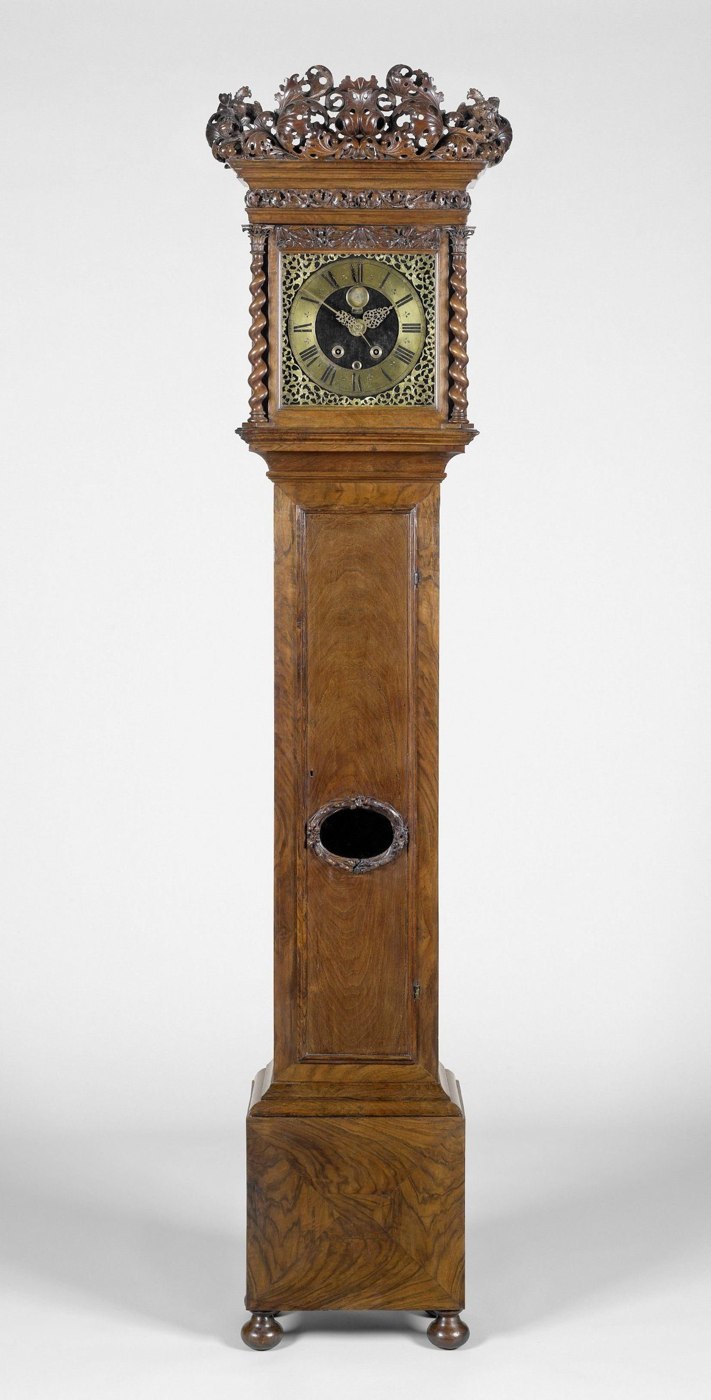
This Dutch longcase clock, dating from circa 1690–1695, is attributed to Amsterdam-based horologist Steven Huygens. Standing 228.5 cm tall, the clock features a primary construction of oak veneered with burl walnut. The design reflects the adoption of the English longcase style in the Netherlands during the late 17th century, though it retains distinct local characteristics in its decorative carving. The hood is framed by spirally-turned Corinthian columns and quarter-columns, surmounted by an elaborate cresting of pierced acanthus foliage featuring eagles at the corners. The dial is framed by brass leaf scrollwork and indicates time, date, and lunar phase. The central trunk door contains an oval aperture framed by carved leaf borders, and the case rests upon a base supported by bun feet. The signature "Huijgens Amsterdam" is inscribed directly onto the dial face, confirming the maker of the timepiece.

Full view of the Amsterdam longcase clock showing the walnut-veneered cabinet, the carved cresting with eagles, and the dial signed by Steven Huygens.
Full view of the Amsterdam longcase clock showing the walnut-veneered cabinet, the carved cresting with eagles, and the dial signed by Steven Huygens. — Rijksmuseum. Rights pending — permission not yet requested. Original source

Catalogue identity

Source
www.rijksmuseum.nl
Category
Clock · Longcase clock
Maker / attribution
Steven Huygens
Reference
Not recorded
Catalogue / lot identifier
BK-16479
Source-reported date
ca. 1690 - ca. 1695
Source-reported place
Netherlands

Source-reported attribution and specifications are not independent authentication. A listing does not establish present ownership, current display, availability or permission to reproduce.

Object description

Case Construction and Design

The clock case is constructed with an oak wood core, which is subsequently veneered in burl walnut. The structure is built to stand 228.5 centimeters in height. The trunk features a door equipped with an oval aperture surrounded by an ornate leaf border. This central section sits upon a wider base pedestal, which is supported by bun feet.

The upper hood section is framed by spirally-turned Corinthian columns and matching quarter-columns. The clock is topped by a decorative cresting composed of pierced acanthus foliage. Eagles are positioned at the corners of this cresting. While the architectural form and overall decoration draw inspiration from English clocks of the period, the carvings display a specific Amsterdam aesthetic.

Evidence for this section
  • “Staande klok belijmd met wortelnotenhout op een eikenhouten kern.”
  • “De klokkast heeft geslingerde Corinthische zuilen- en kwartzuilen en is versierd met gestoken blad- en bloemranken.”
  • “De vorm en versiering van de kast zijn gebaseerd op Engelse klokken. Alleen het snijwerk heeft een herkenbare Amsterdamse stijl.”

Dial and Horological Function

The clock is equipped with a brass dial surrounded by ornate leaf scrollwork behind glass. The horological movement provides three specific functions: the indication of the time, the date, and the phase of the moon. The long pendulum design, consistent with Dutch clockmaking trends following the introduction of the technology from England around 1680, allowed for improved timing precision.

The dial is signed by the horologist "Huijgens Amsterdam." The presence of the lunar display and calendar complicates the dial layout, which is held within the sturdy, columned hood of the case. The movement is attributed to Steven Huygens of Amsterdam, who operated during the late 17th century.

Evidence for this section
  • “De wijzerplaat, achter glas en door messing bladranken omgeven, geeft de tijd, datum en maanstand aan”
  • “Door de lange slinger was de tijdmeting nauwkeuriger dan op andere soorten klokken.”
  • “signatuur, wijzerplaat: ‘Huijgens Amsterdam’”

Provenance and Documentation

The object is catalogued by the Rijksmuseum under the accession number BK-16479. The museum acquired the piece in 1950. It is identified as part of the permanent collection and is currently classified as being in the public domain.

Historical documentation maintained by the museum classifies the item as a mechanical clock produced in Amsterdam. While the specific furniture maker remains anonymous, the clockmaker is identified as Steven Huygens.

Evidence for this section
  • “Objectnummer BK-16479”
  • “aankoop 1950”
  • “uurwerkmaker: Steven Huygens, Amsterdam”
  • “Datering ca. 1690 - ca. 1695”

Open research questions

  • Does the movement retain the original verge or anchor escapement as manufactured by Steven Huygens?
  • Are there secondary marks on the backplate or internal components that further corroborate the dating of 1690–1695?

Source evidence

Recorded claims and source quotations for Amsterdam longcase clock
FieldSource-reported valueSource quotation
MakerSteven Huygens“uurwerkmaker: Steven Huygens, Amsterdam”
Object numberBK-16479“Objectnummer BK-16479”
Dimensions228.5 cm x 56.5 cm x 32 cm“hoogte 228,5 cm x breedte 56,5 cm x diepte 32 cm”
MaterialsOak core with walnut veneer“eikenhout, belijmd met notenhout”
SignatureHuijgens Amsterdam“signatuur, wijzerplaat: ‘Huijgens Amsterdam’”
InspirationEnglish longcase design“De vorm en versiering van de kast zijn gebaseerd op Engelse klokken.”
ProvenanceAcquired in 1950“aankoop 1950”

Visible details

  • The dial features Roman numerals for hours and an aperture for lunar display.
  • The clock case incorporates spirally-turned columns in the hood section.
  • The cresting atop the hood is carved with openwork acanthus patterns and corner eagles.
  • The door of the clock trunk includes an oval viewing portal.

Research qualifications

  • The cabinetmaker responsible for the wooden case remains anonymous.
  • The exact year of manufacture is restricted to a five-year range by the Rijksmuseum.

Photograph identity and source facts were screened before import; rights clearance remains pending.

Consulted source

Longcase clock, c. 1690 - c. 1695

Reviewed 2026-11-02 · Record 9be359c0bb

Terms in this record

Glossary explanations for terms named in this object’s record.