
Related photographs
No confidently matched photograph of this subject has been found yet. These photographs show a closely related record, and are not examples of the type described on this page.
Winding stores energy; setting changes the indication. A pocket watch may use the same external control for both, or separate controls. Key winding does not automatically mean key setting, and a crown-wound watch is not necessarily set by pulling the crown. Begin with maker or calibre instructions and a condition assessment. An antique movement of unknown service history should not be wound merely to obtain a running photograph.
A key must match the winding square in size and reach. A poor fit can slip or damage the square. The location of the winding point and the intended direction vary; do not transfer the routine from another fusee or going-barrel watch. Front access can also expose vulnerable hands and dial surfaces. If an unfamiliar cover or key resists, stop instead of adding force or trying several speculative directions.
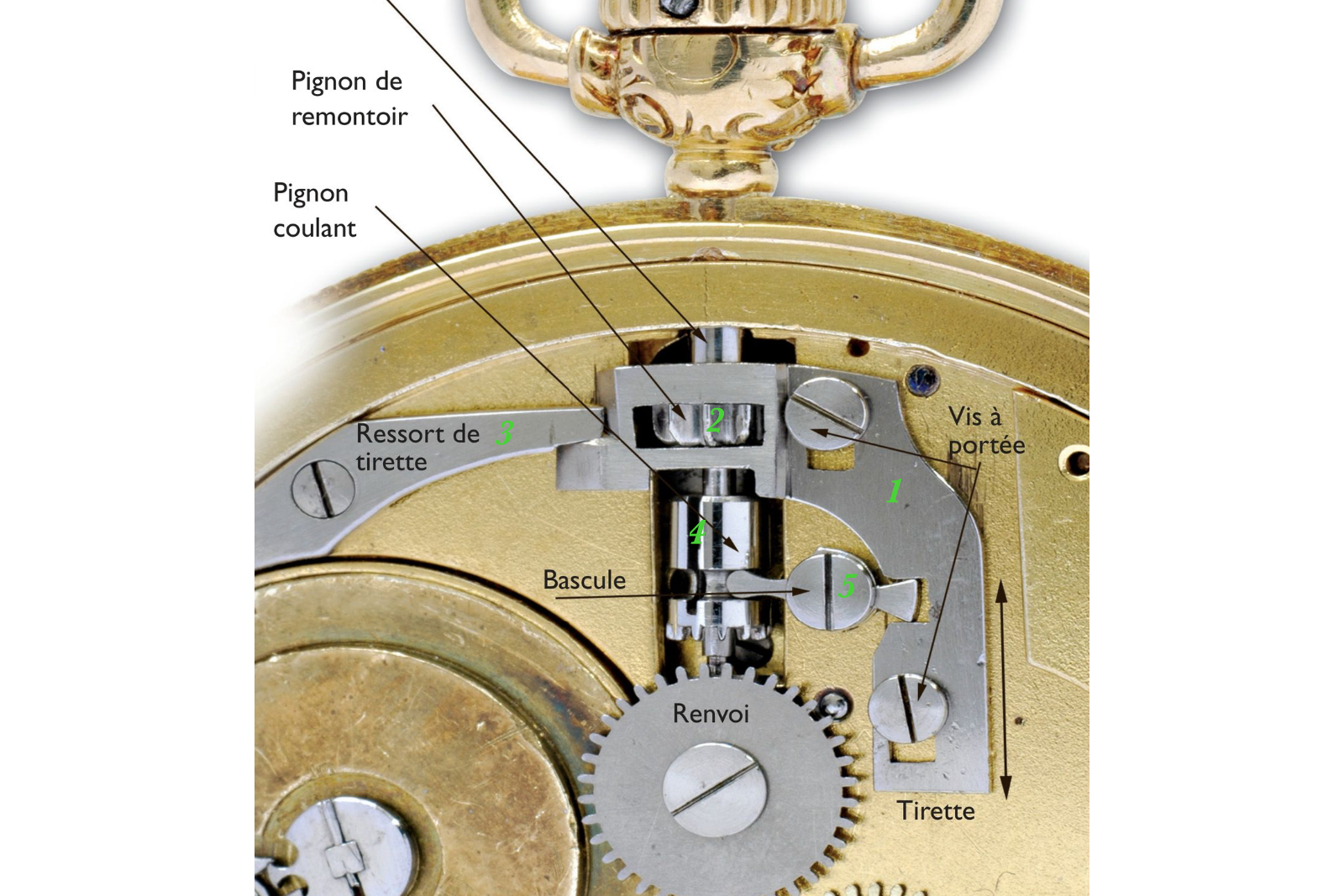
In a common pendant-set keyless arrangement, pulling the crown selects hand setting and returning it selects winding. Lever-set watches instead use a separate lever, frequently accessed at the dial edge after the appropriate bezel is opened. Pin-set watches use a small push-piece. These are descriptions of systems, not permission to manipulate a resistant control. A pendant button on a hunter case may release the cover rather than select setting.
The internal selector differs between historical designs. A later sliding clutch moves along the stem under control of the yoke and setting lever; a rocking-bar arrangement changes wheel engagement differently. Early Philippe keyless work must retain its historical caption rather than serve as a universal drawing of every modern clutch. Match the exact movement before naming a part or interpreting a failure to wind or set.
Manual winding commonly reaches firm resistance when full, but winding feel is not a service report. Grinding, disconnected motion, sudden release or unexpected resistance calls for assessment. Setting can also interact with calendars or striking work, so do not assume that a direction or time interval safe on a plain watch is safe on a repeater. Do not use the hands to force an unresponsive mechanism or force a lever back into place.
Record what is known: winding system, setting system, source of instructions, service history and any observed symptom. Keep case opening, winding and setting as separate operations. A watch that runs briefly can still have wear or deteriorated lubricant. Specialist advice is especially important for fragile springs, chains, unusual controls and complications. Correct identification can be achieved without operating the watch at all.
Keys, arbors and the fusee
The practice of using keys to wind and set timepieces dates back to the introduction of portable watches in the 16th century, remaining the standard method until the mid-19th century. Early watches often required the user to open the caseback to fit a key over the winding-arbor, though some designs necessitated removing the crystal and bezel to access a setting-arbor located at the front of the dial. To address inconsistent torque, many key-wind movements utilized a fusee, a conical pulley connected by a chain to the barrel that helped stabilize power delivery to the escapement.
Written from the encyclopedia entries listed under Sources; each statement was checked against the cited text.
Diagram
Identify controls before applying force
| Evidence | What it describes | Limit |
|---|---|---|
| Key | Separate winding or setting square | Direction and size are object-specific |
| Pendant | May select setting by axial stem movement | Not every crown pulls out |
| Lever | Separate setting selector | Bezel access depends on the case |
| Pin | Push-piece selects setting | A resistant pin is not permission to press harder |
Evidence checklist
- Identify winding and setting separately.
- Retain exact instructions and service history.
- Stop at unexpected resistance.
Operating controls does not establish present mechanical health.