
England · c. 1726
Gridiron Pendulum
Partially verifiedA durable, mercury-free compensation widely used in regulators and fine longcase clocks.
Alternating rods of brass and steel arranged so their different expansions cancel, keeping the effective pendulum length stable.
Background
The gridiron pendulum is a temperature-compensated clock pendulum that was invented by the British clockmaker John Harrison around 1726. It was developed to solve the issue of inaccuracy in standard clock pendulums caused by thermal expansion and contraction. The device functions by using alternating parallel rods made of two metals with different thermal expansion coefficients.
These rods are arranged in a frame so that their differing thermal expansions cancel each other out, which maintains a constant effective pendulum length. Harrison's original design utilized brass and steel rods because pure zinc was not available at that time. Because brass does not expand as significantly as zinc, the original construction required a total of nine rods consisting of five steel and four brass components.
Written from the encyclopedia entries listed under Sources; each statement was checked against the cited text.
How it works
- High thermal expansion rods like brass or zinc push the bob upward while low expansion steel rods pull it downward to ensure the total length remains unchanged.
- The degree of compensation can be adjusted by utilizing a section of the central rod composed of overlapping brass and steel parts joined by a movable pin.
Later history
- John Smeaton introduced an improved five-rod version around 1750 that utilized zinc and steel.
- During the late 19th century, the Dent company created a tubular version of the zinc gridiron that used concentric tubes and a screw mechanism for adjustment.
- The design eventually fell out of favor for high-precision timekeeping because of friction in the rod assembly and the dimensional instability of zinc.
How to verify this yourself
No patent; see Harrison's early regulators and museum catalogue descriptions.
Manufacturers known to have used it
- English and Continental regulator makers
Photographs
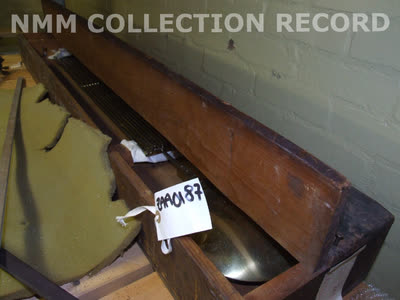
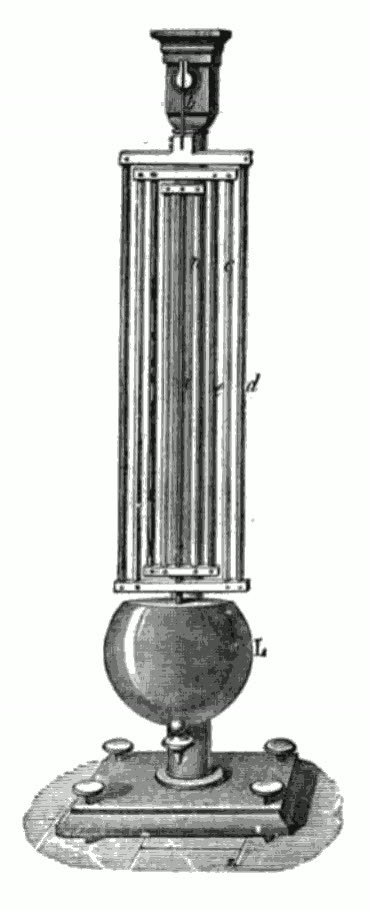
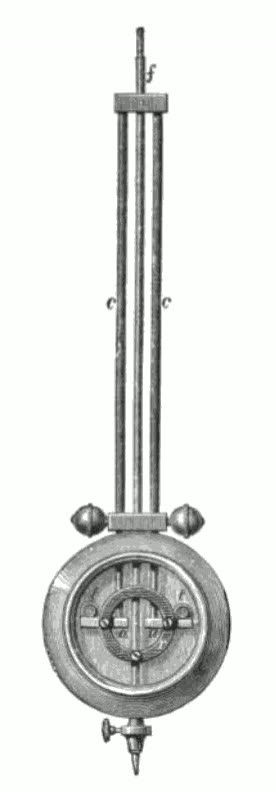
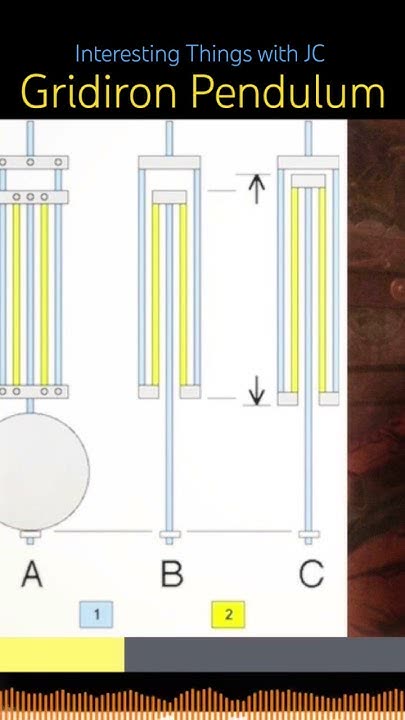
Photographs are illustrative examples of the type, not necessarily the exact object described. Verify details against the source file page.
Sources & references
- Gridiron pendulum, Wikipedia (English), retrieved 2026-10-28 (text CC BY-SA 4.0)
- Royal Museums Greenwich, notes on Harrison's early clocks
- Rawlings, A. L., The Science of Clocks and Watches
Where sources disagree, the disagreement is stated rather than resolved silently.