
Year-going spring-driven table clock with striking and quarter repeat · England
Tompion 'Mostyn' Clock
VerifiedA year-going spring clock: the British Museum's catalogue text (David Thompson) notes that English spring-driven clocks of such long duration did not exist before it, calls Tompion the first in England to meet the challenge and the clock the pinnacle of his achievement as a practical clockmaker.
Technical facts
- Movement
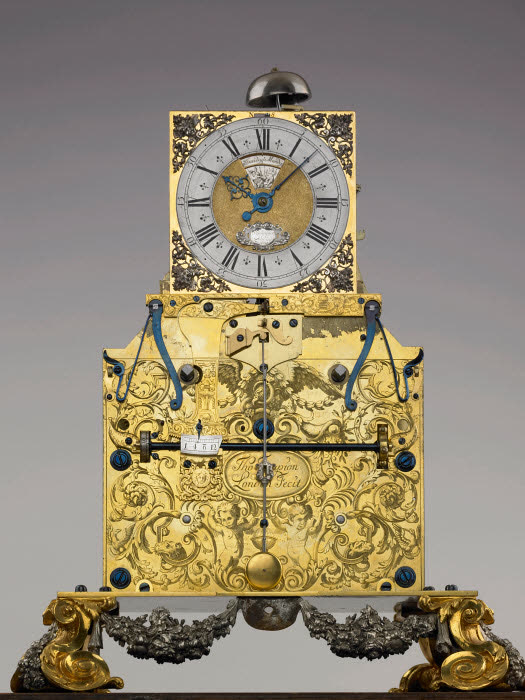
- Spring-driven, year duration: fusee and great wheel driving a six-wheel going train with a small verge escapement, short bob pendulum with spring suspension and worm-geared rise-and-fall regulation; rack-and-snail striking and a pull-cord quarter repeat (British Museum record)
- Case
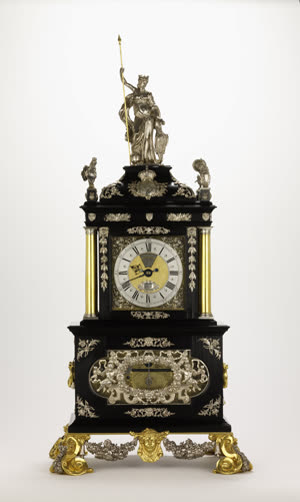
- Ebony veneered onto oak with silver and gilded-brass mounts; the dome bears the royal coat of arms and Britannia (British Museum record)
- Dial
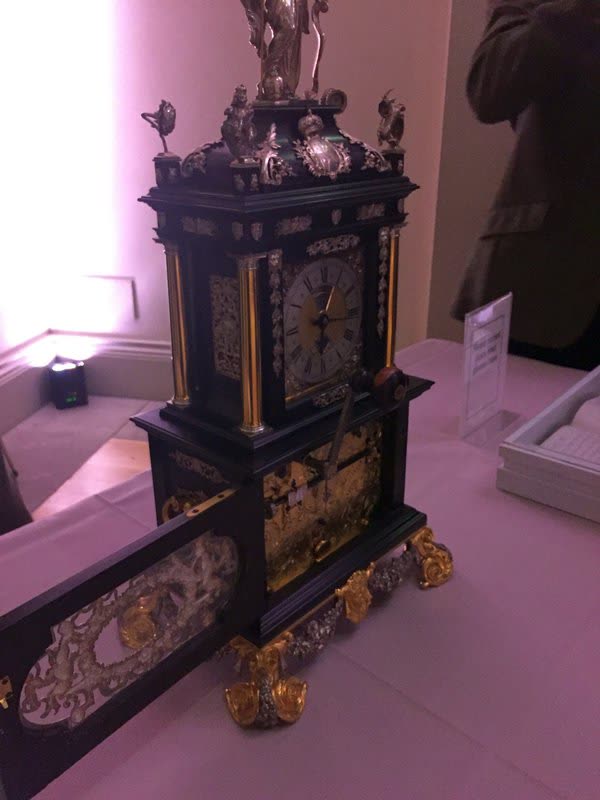
- Gilded brass with matted centre, silvered chapter ring and silver spandrels; apertures show the days of the week and their planets; strike/silent crank at the top
Historical significance
- A year-going spring clock: the British Museum's catalogue text (David Thompson) notes that English spring-driven clocks of such long duration did not exist before it, calls Tompion the first in England to meet the challenge and the clock the pinnacle of his achievement as a practical clockmaker.
- Its provenance is documented: research by Lucy Wood at the Victoria and Albert Museum places it among the contents of King William's 'Little Bedchamber'; it later passed by descent to Lord Mostyn, whose family kept a written record of its annual winding from 1793, and the museum bought it from him in 1982.
Background
Thomas Tompion made the year-going table clock known as 'The Mostyn'; a British Museum exhibition note says it was made to celebrate the coronation of William III and Mary II in 1689, and the museum's catalogue text dates it c. 1690. The spring-driven clock runs for thirteen months on one winding, which required extra wheels in the going train and a stronger mainspring. According to David Thompson, this clock marks the pinnacle of Tompion's practical work, requiring significant power and precision due to the high number of striking events.
The case is constructed of ebony veneered onto oak and is embellished with silver and gilt-brass mounts that display royal heraldry, including the coat-of-arms and the figure of Britannia. The movement incorporates a verge escapement and a short pendulum, regulated by a rise and fall mechanism driven by precision worm gearing.
Written from the sources listed under Sources (makers, museums, auction houses and specialist publications are paraphrased, not reproduced); each statement was checked against the cited text, and claims a maker makes about its own work are attributed to it.
Construction and mechanism
- Apertures in the dial show the days of the week and their corresponding planets.
- A quarter-repeating mechanism allows the clock to strike the time on demand when a cord is pulled on either side of the case.
Later history
- The clock remained with the Mostyn family for generations, who maintained a written tradition of annual winding ceremonies starting around 1793.
- The British Museum bought the clock from Lord Mostyn in 1982, and the Antiquarian Horological Society described the museum's annual winding of it in 2016.
Photographs
Photographs are illustrative examples of the type, not necessarily the exact object described. Verify details against the source file page.
Sources & references
- Mostyn Tompion, year-going table clock (1982,0702.1), British Museum, retrieved 2026-10-30 (paraphrased; text © the publisher)
- The annual winding of the Mostyn Tompion, Antiquarian Horological Society, retrieved 2026-10-30 (paraphrased; text © the publisher)
- Perfect timing: the Mostyn Tompion clock, British Museum International Training Programme, retrieved 2026-10-30 (paraphrased; text © the publisher)
- British Museum, Collection Online, registration number 1982,0702.1 (curator's comments quoting David Thompson, Clocks, London, 2004, pp. 84–87)
Where sources disagree, the disagreement is stated rather than resolved silently.