
Wall regulator clock · United States
Seth Thomas Regulator No. 2
Needs researchA widely produced American precision wall regulator commonly used in period offices, railroad stations and schools as a visible accurate time reference; its long production run and broad presence make individual dating and specification confirmation essential rather than assuming a single fixed specification across the whole run.
Technical facts
- Escapement
- Deadbeat
- Pendulum
- Wood-rod or mercury-compensated pendulum depending on grade and period
Historical significance
- A widely produced American precision wall regulator commonly used in period offices, railroad stations and schools as a visible accurate time reference; its long production run and broad presence make individual dating and specification confirmation essential rather than assuming a single fixed specification across the whole run.
Background
According to RailsWest, the Regulator No. 2 was made with very few changes until 1950 and is probably the longest-produced single model in clock-manufacturing history. The clock was marketed as a small regulator for use in varied settings including offices, schools, and railroad stations. These weight-driven timepieces were constructed with wooden cases that varied in length between 34 and 36.5 inches depending on the period of manufacture.
Over the life of the regulator, Seth Thomas utilized four different movements, designated as the 61, 77, 77A, and 77B, each featuring a Graham deadbeat escapement. The regulator served as a visible and accurate time reference in many railroad stations, sometimes featuring a Montgomery dial.
Written from the sources listed under Sources (makers, museums, auction houses and specialist publications are paraphrased, not reproduced); each statement was checked against the cited text, and claims a maker makes about its own work are attributed to it.
Construction and mechanism
- The clock features an eight-day weight-driven movement with brass plates shaped like a trapezoid.
- The pendulum assembly consists of a wood rod paired with a brass-covered zinc bob.
- The dial is painted on tin and measures 12 inches in diameter.
- Cases were constructed using various woods, including walnut veneer, cherry, oak, and later mahogany.
Later history
- The model was reissued in 1976 as a production run limited to four thousand units.
- Reissue models feature a solid oak bezel and a movement copied from the original ST61 design.
Photographs
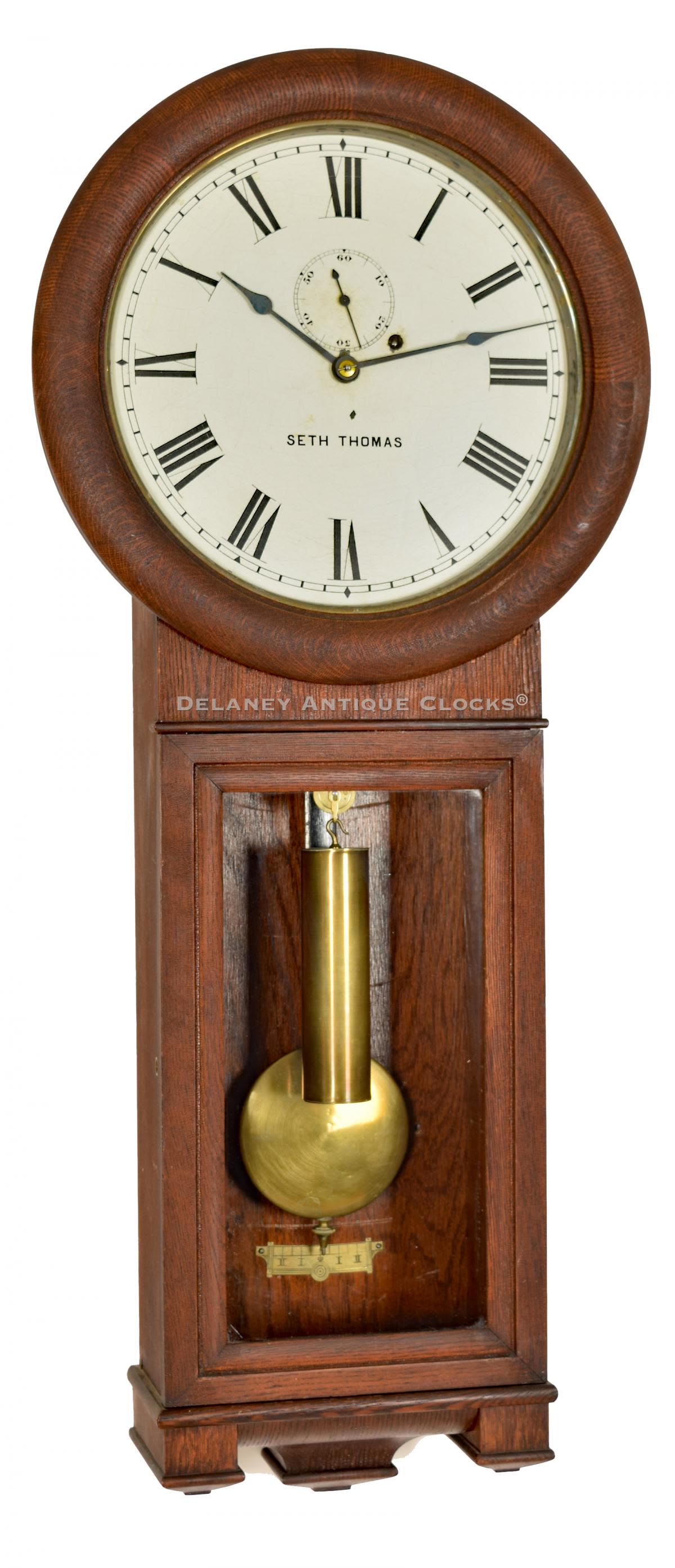
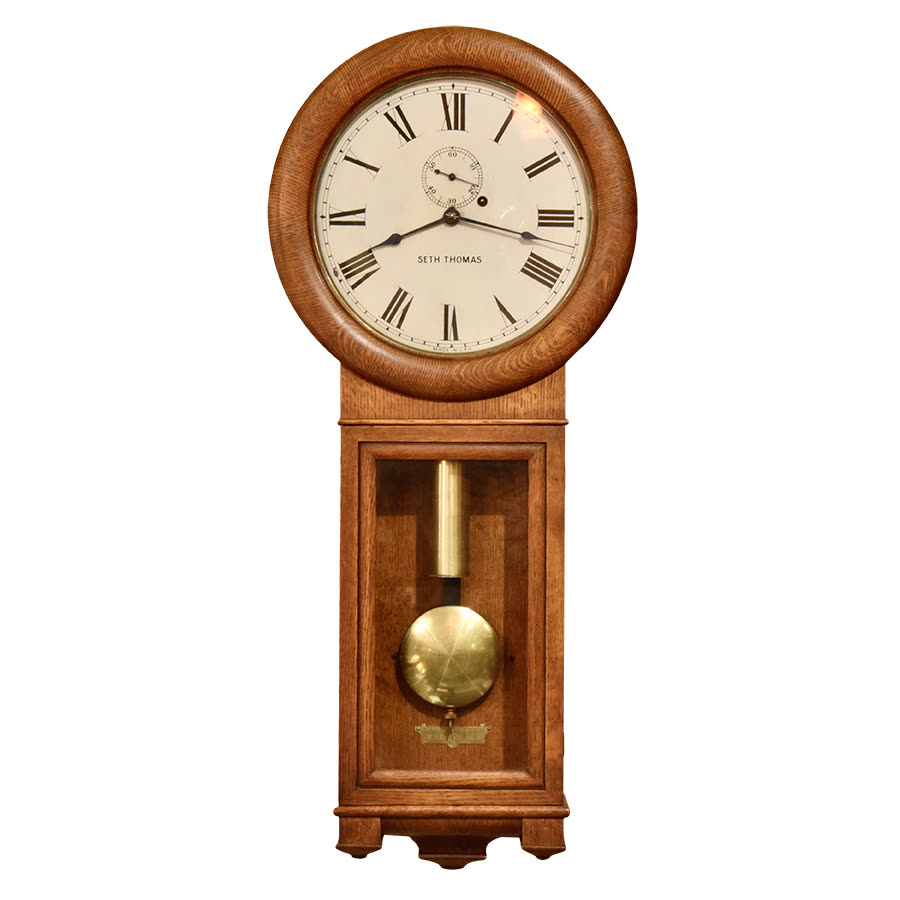
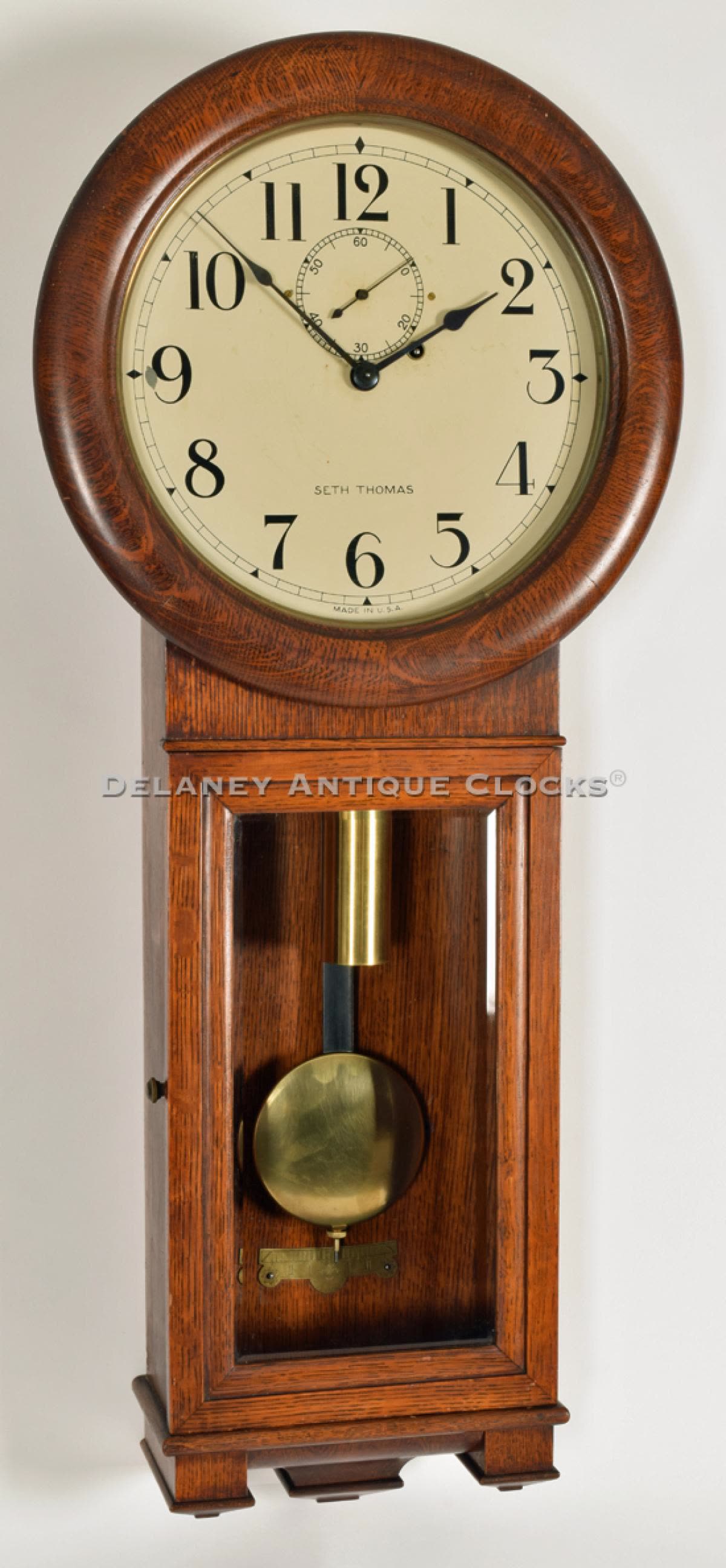
Photographs are illustrative examples of the type, not necessarily the exact object described. Verify details against the source file page.
Sources & references
- Seth Thomas Regulator No. 2 history, Antique Clocks Guy, retrieved 2026-10-30 (paraphrased; text © the publisher)
- Seth Thomas Regulator No. 2 wall clock, Delaney Antique Clocks, retrieved 2026-10-30 (paraphrased; text © the publisher)
- Seth Thomas Clock Co., RailsWest, retrieved 2026-10-30 (paraphrased; text © the publisher)
- NAWCC Bulletin, articles on Seth Thomas regulator production
Where sources disagree, the disagreement is stated rather than resolved silently.