
Portable spring-driven clock · Germany (Nuremberg)
Early German Portable Clocks (Henlein attribution)
Historical attributionHenlein is often called the inventor of the watch; this rests on a short contemporary mention and later tradition. Objects attributed to him are disputed and some have been challenged on technical grounds.
Technical facts
- Attribution
- Contested
Historical significance
- Henlein is often called the inventor of the watch; this rests on a short contemporary mention and later tradition. Objects attributed to him are disputed and some have been challenged on technical grounds.
Background
The pomander watch is a type of small, portable spring-driven clock, often attributed to the Nuremberg locksmith and clockmaker Peter Henlein. Produced in the early 16th century, these ornamental brass clocks were fashionable among the nobility and were designed to be worn as pendants or attached to clothing. The design incorporated clockworks into musk-balls or pomanders, which were small containers fashioned from precious metals for fragrances or disinfectants.
The mainspring that made portable clocks possible, often attributed to him, had appeared in the early 15th century, almost a century before his work. The earliest surviving watch, a fire-gilded pomander watch dated 1505, has been attributed to Henlein. These instruments served as both personal status symbols and functional timekeepers for their high-society owners.
Written from the encyclopedia entries listed under Sources; each statement was checked against the cited text.
Construction and mechanism
- The watch is constructed as a spherical timepiece built into a small fire-gilded metal pomander.
Later history
- Only two specimens of the pomander watch type are known to exist, including one from 1505 and another dated 1530 currently held by the Walters Art Museum.
Photographs
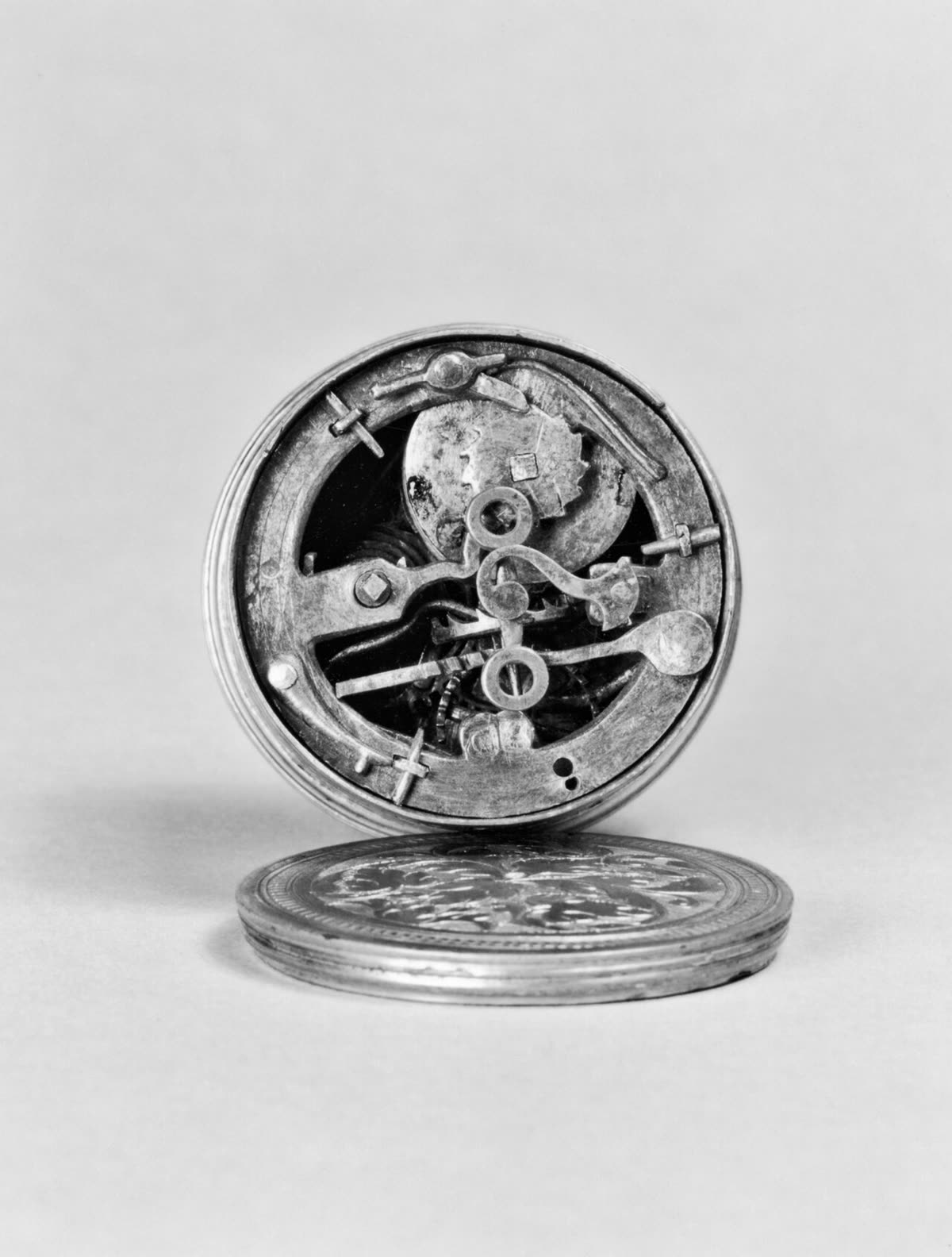
Photographs are illustrative examples of the type, not necessarily the exact object described. Verify details against the source file page.
Sources & references
- Peter Henlein, Wikipedia (English), retrieved 2026-10-28 (text CC BY-SA 4.0)
- Nuremberg eggs, Wikipedia (English), retrieved 2026-10-28 (text CC BY-SA 4.0)
- Germanisches Nationalmuseum publications
- Cardinal, C., The Watch
Where sources disagree, the disagreement is stated rather than resolved silently.