
Chronometer · Paris
Marine clock no 12
VerifiedBuilt in 1774, marine clock no 12 is not described in any of the numerous works that Ferdinand Berthoud wrote on his marine chronometers.
Technical facts
- Inventory number
- MIH IV-84
- Object type
- Chronometer
- Place of production
- Paris
- Dating
- 1774
- Materials and techniques (catalogue wording)
- Bois, métal argenté, laiton
- Dimensions (catalogue)
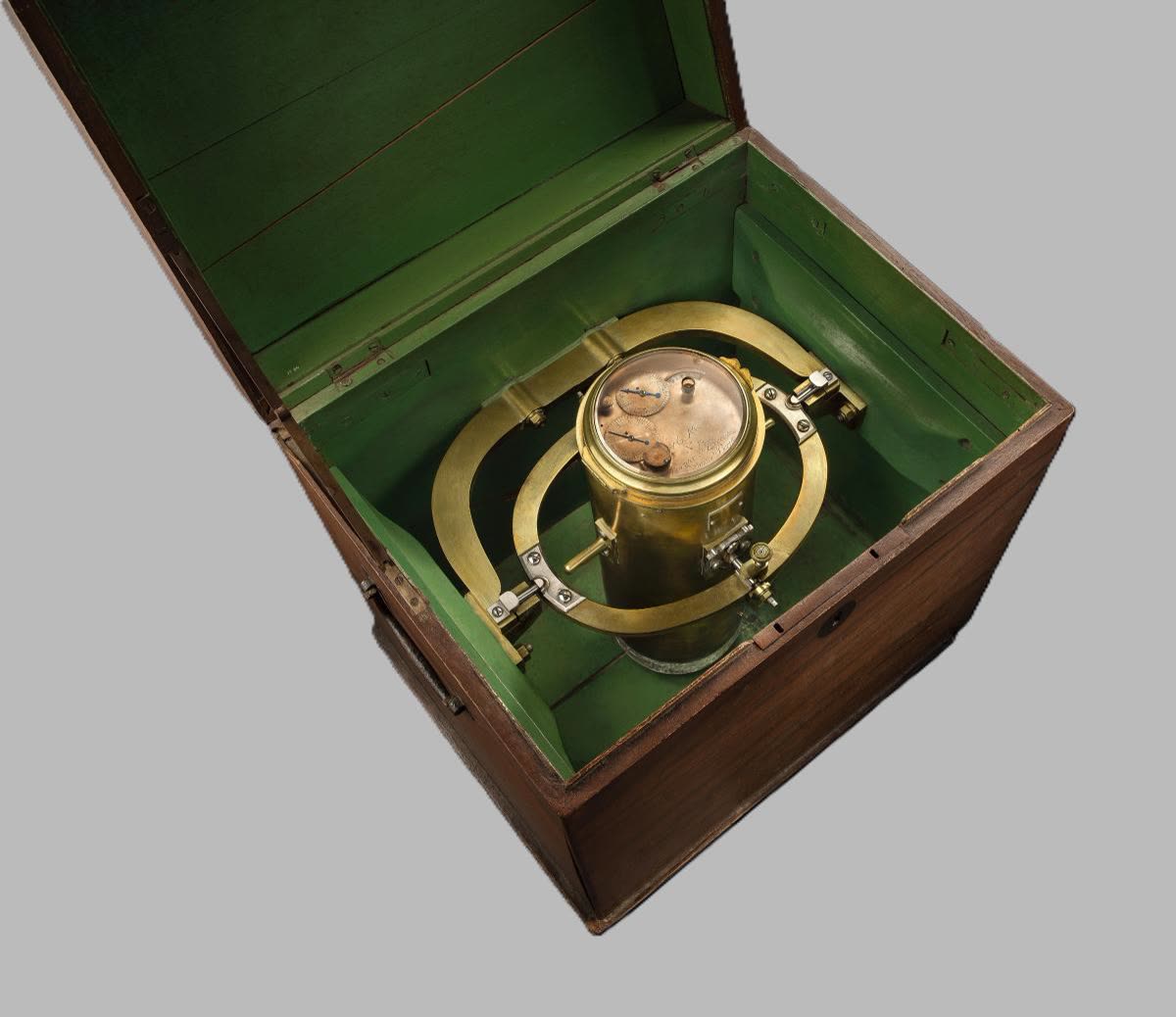
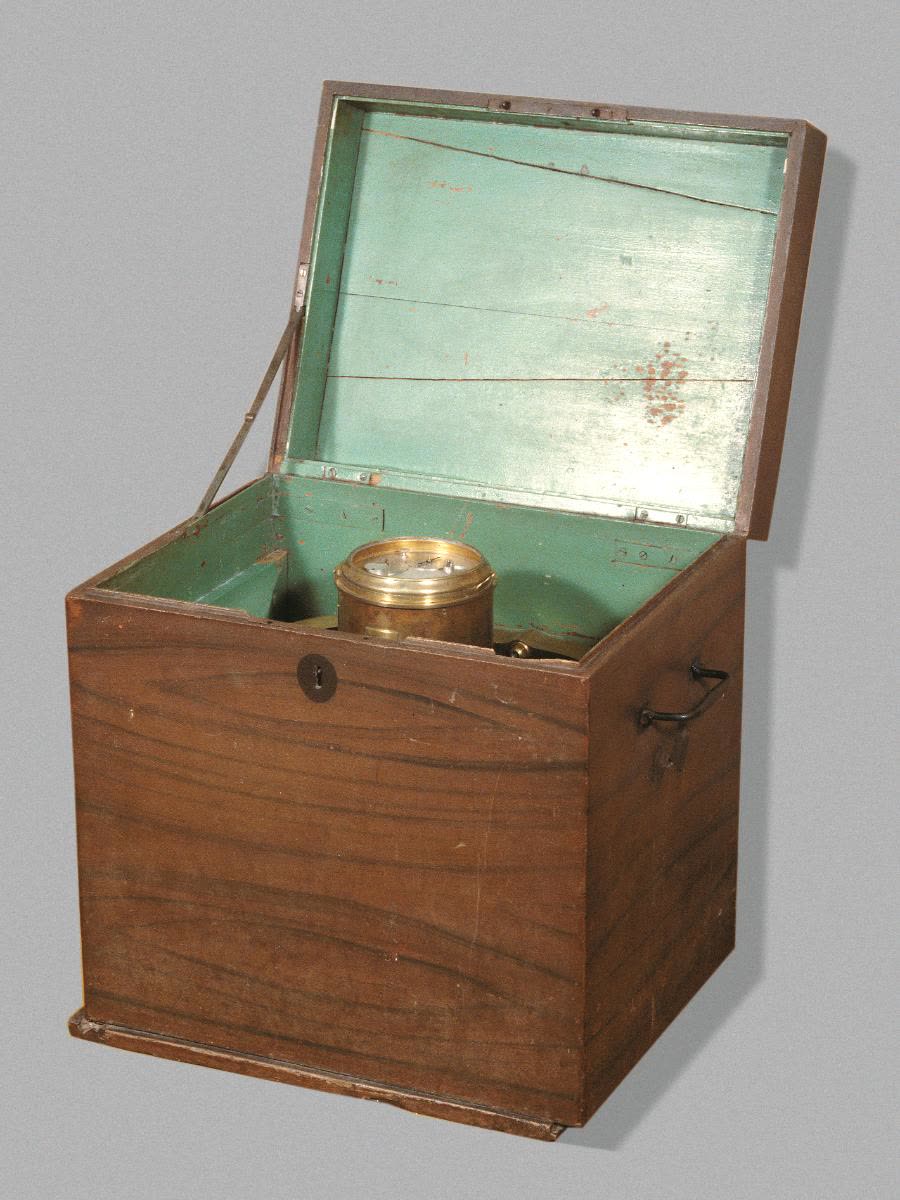
- dimensions min/max: 501 x 600 mm; H: 50 cm L: 57 cm P: 45 cm (caisse).; H: 35 cm D: 15 cm (mouvement).
- Inscriptions (catalogue)
- H M N° 12 Inventée et Exécutée par Ferdinand Berthoud 1774. (Cadran)
Historical significance
- Built in 1774, marine clock no 12 is not described in any of the numerous works that Ferdinand Berthoud wrote on his marine chronometers.
- It was based on the model of clock no 10, which F. Berthoud described in his Traité des horloges marines (Treatise on Marine Clocks), published in 1773, on pages 331 to 344. F. Berthoud obviously thought he had attained perfection with clock no10, as he entitled Chapter XIII, which described it, "The Construction of a marine Clock, to be the simplest and most perfect based on the theory and experiments made on Clocks nos 6, 7, 8, etc".
- Marine clock no 11, part of the collection at the Museum of Industrial Arts and Crafts in Paris, was also based on the principles of no 10. It was originally fitted with a mainspring, which was replaced later with a driving-weight. Marine clock no 16, in the Beyer Watch Museum in Zurich, is also based on the principles of no 10.
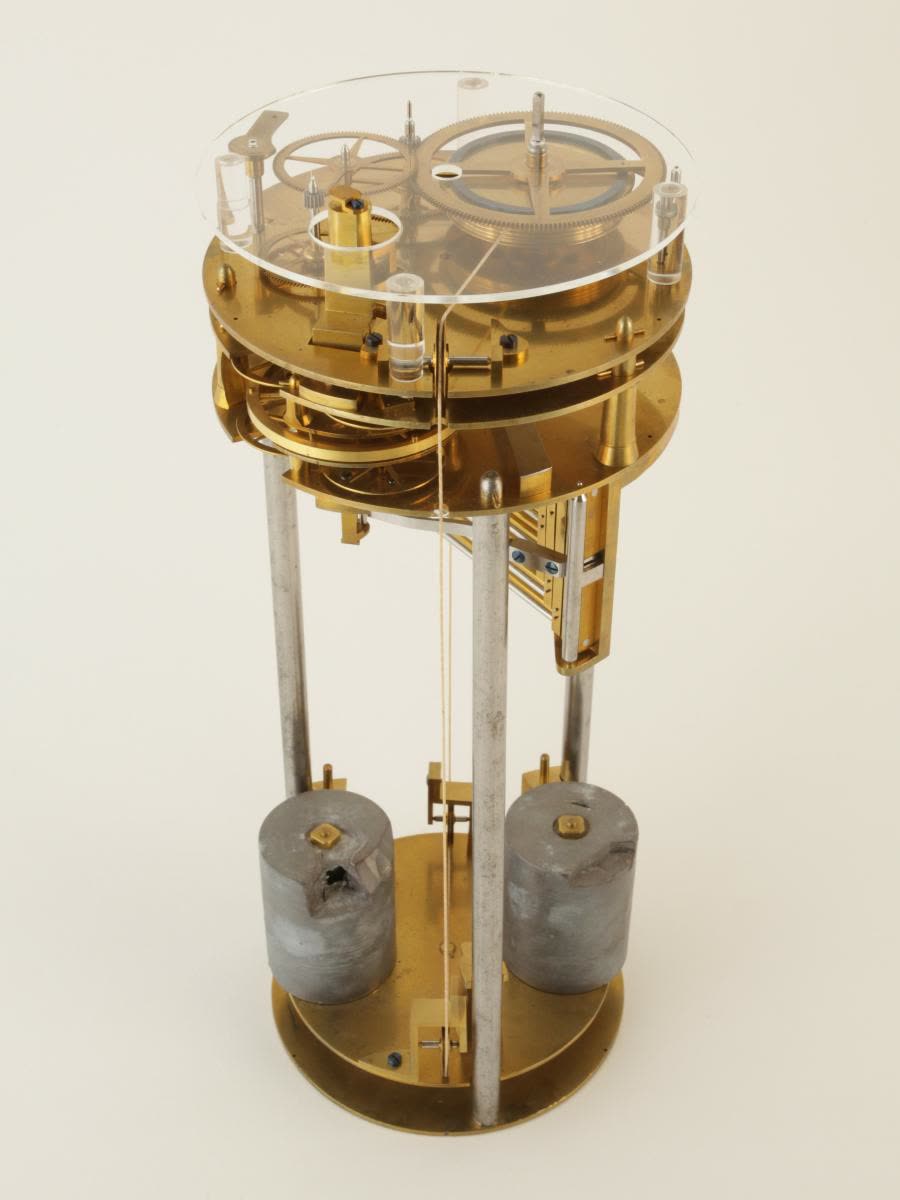
- Like the pieces mentioned above, marine clock n° 12 is fitted in a wooden box with a gimbal suspension. It has a driving weight and a pivoted detent escapement. The balance is suspended by a steel strip, and its pivots turn between anti-friction rollers. The gridiron thermal compensation device is based on the system invented by John Harrison. The silver-plated metal dial has an aperture showing the hours in Roman numerals, two offset dials indicating the minutes and seconds, and a device to operate the balance brake.
- F. Berthoud obtained excellent results with his marine clock n° 8. Built in 1767, it underwent tests at sea in 1768 and 1769, monitored by Fleurieu and Pingré, and then in 1771 and 1772, monitored by Verdun, Borda and Pingré. Despite the extreme complexity of this kind of movement and the inconvenience of using a weight as the driving force in a marine chronometer, it was only with extreme reluctance that he decided to produce marine clocks with a mainspring, which were easier to handle. He had recommended using the driving weight because "the driving force has to be a weight since, as we have proved, a weight is not only preferable to a spring because of the regularity of its movement, but it is also not liable to any kind of accident and, what is more, the disposition of a weight greatly improves the suspension by keeping the clock more exactly in the same horizontal position."
Photographs
Photographs are illustrative examples of the type, not necessarily the exact object described. Verify details against the source file page.
Sources & references
- Musée international d'horlogerie, online collection record, inv. IV-84: https://collection.mih.ch/fr/collection/item/30565/
Where sources disagree, the disagreement is stated rather than resolved silently.