
Longcase clock · La Chaux-de-Fonds
Horloge à une roue
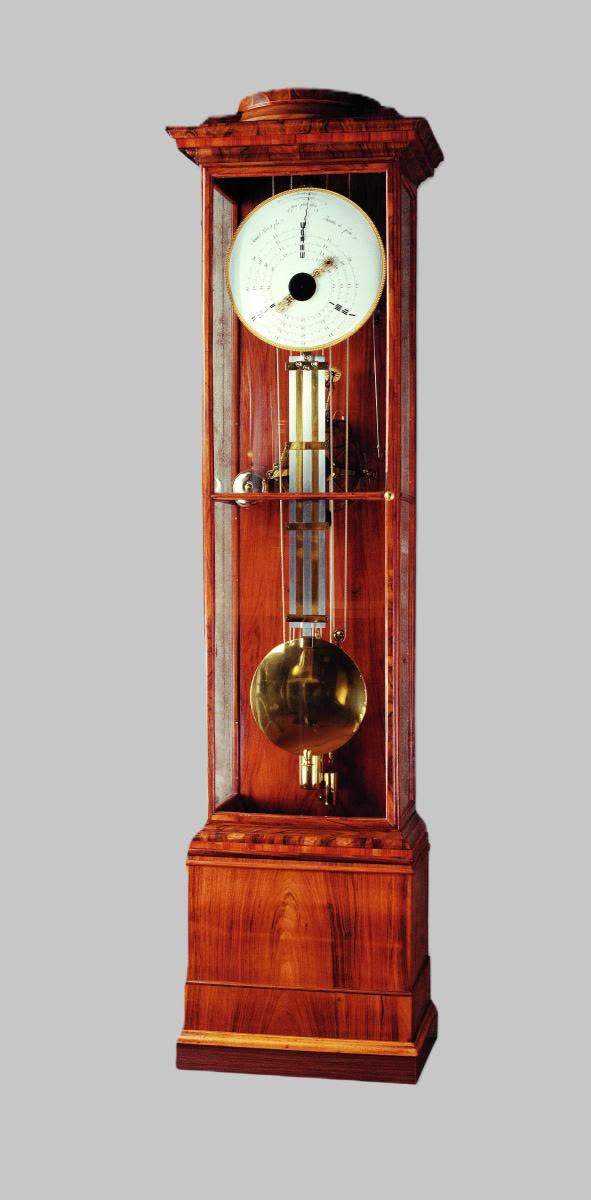
VerifiedBuilt in La Chaux-de-Fonds by Samuel Roy and his three sons, this clock has only one wheel for the movement and one for the striking mechanism. Made without any pinions, it only needs to be wound every eight days and indicates the hours, minutes and seconds. A full strike sounds the hours at every quarter.
Technical facts
- Inventory number
- MIH IV-541
- Museum title (French)
- Horloge à une roue
- Object type
- Longcase clock
- Place of production
- La Chaux-de-Fonds
- Dating
- 1780
- Materials and techniques (catalogue wording)
- Bois, Laiton, Acier, Émail
- Materials (English translation)
- Wood, Brass, Steel, Enamel
- Dimensions (catalogue)
- Dimensions: 195.0 x 50.0 x 32.0 cm; diam.: cadran 34.00 cm
- Inscriptions (catalogue)
- Samuel Roi et fils invente et fecit (cadran)
- Inscriptions (English translation)
- Samuel Roi et fils invente et fecit (cadran)
Historical significance
- Built in La Chaux-de-Fonds by Samuel Roy and his three sons, this clock has only one wheel for the movement and one for the striking mechanism. Made without any pinions, it only needs to be wound every eight days and indicates the hours, minutes and seconds. A full strike sounds the hours at every quarter.
- The eleven-kilogram pendulum, with its steel and brass rods, the winding system and the striking mechanism under the main movement can all be seen through the three glazed sides of the walnut-veneered case.
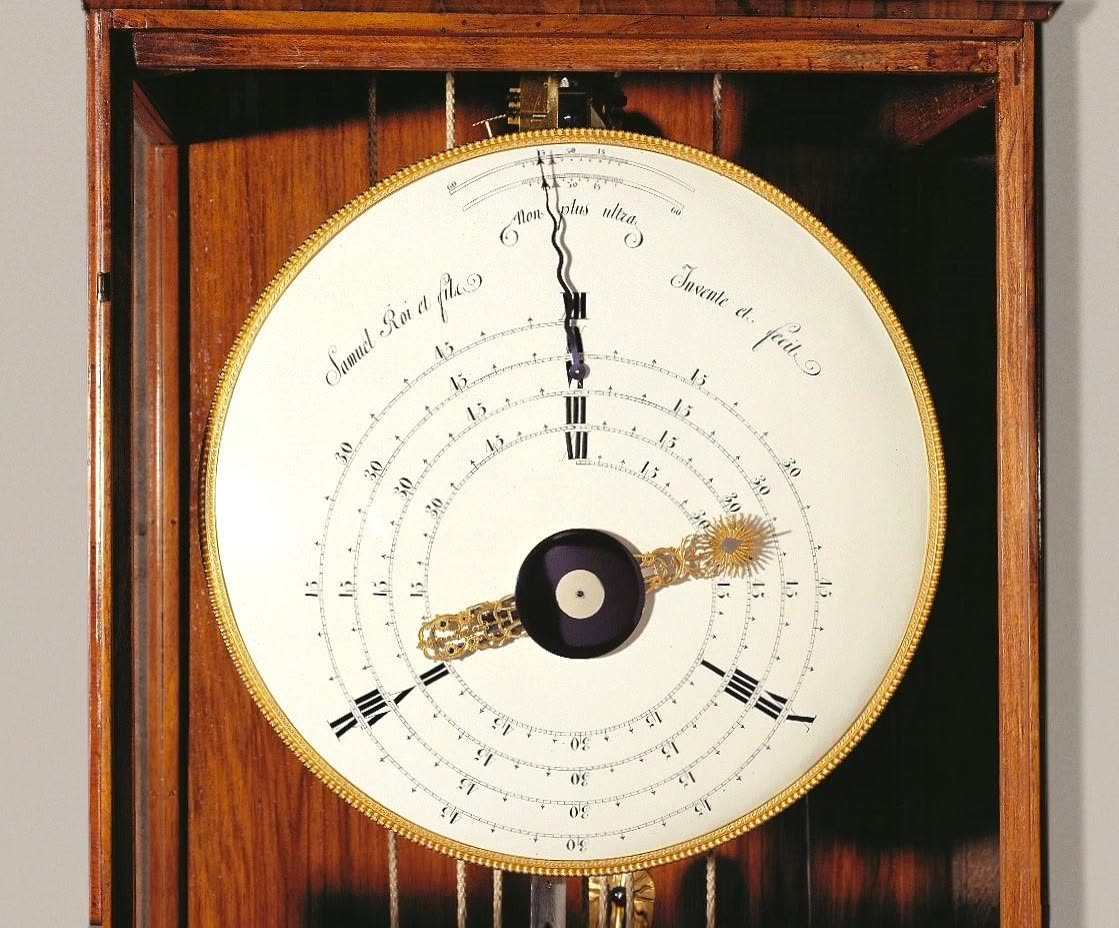
- The large dial, which bears the clockmaker's signature as well as the inscription Non plus ultra, shows the hours and minutes with numbers painted in a spiral line. A single hand indicates both the hour and minute; as it follows the spiral line, its length automatically increases. When it gets to twelve o'clock, the hand shortens by dropping onto the XII below, and then starts round the spiral again.
- There is no need, therefore, for the usual gear-train of the motion work. The seconds hand moves from left to right for one minute, then back for the next one.
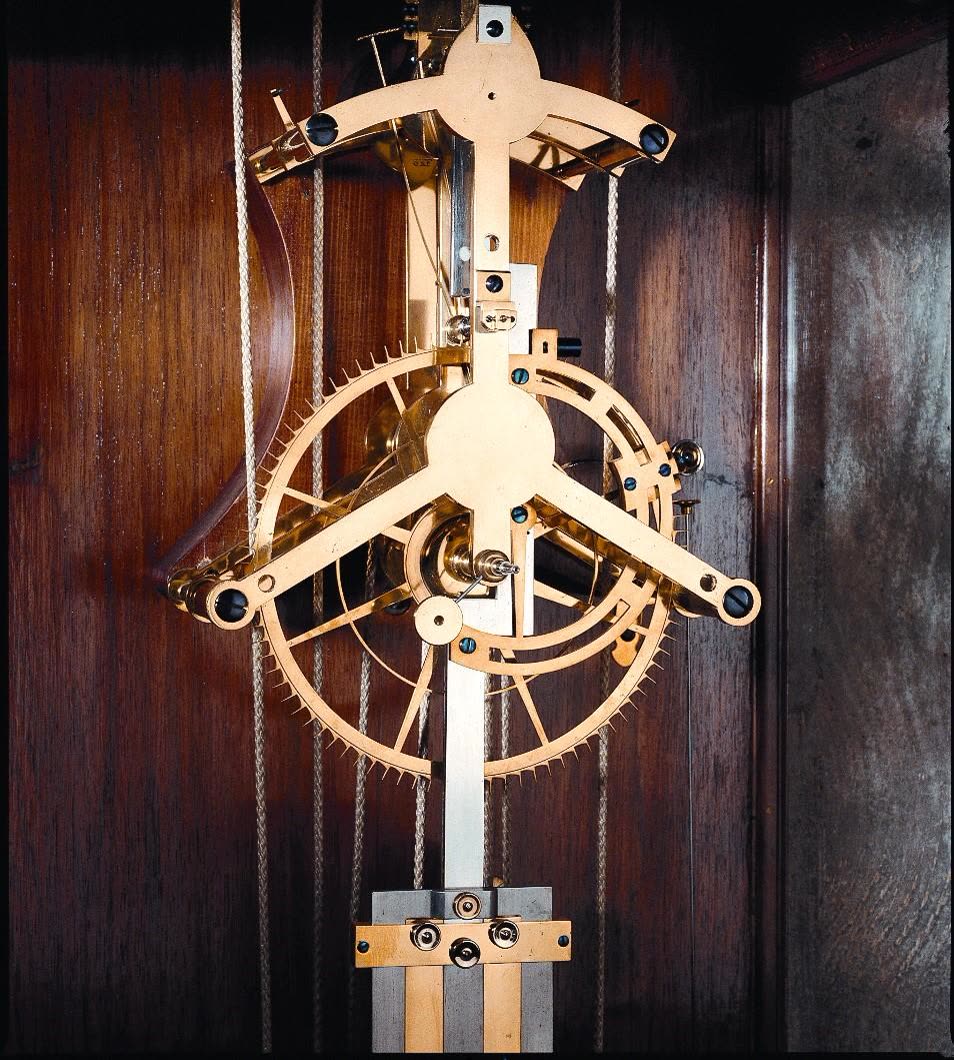
- The movement has only one wheel, functioning as both driving-wheel and escape wheel. It has ninety teeth and makes one revolution every three hours.
- To increase the clock's running time, Samuel Roy used a Huygens endless cord winding-mechanism with muffled weight and counterpoise, comprising eight pulleys through which the cord has to pass very precisely. Thus, the weight only drops by one quarter of the length of cord freed, increasing the power reserve to eight days between windings. Furthermore, by pulling on the length of cord which connects the ratchet to the pulley, the counterpoise drops and the weight lifts without modifying the driving force, which therefore remains constant.
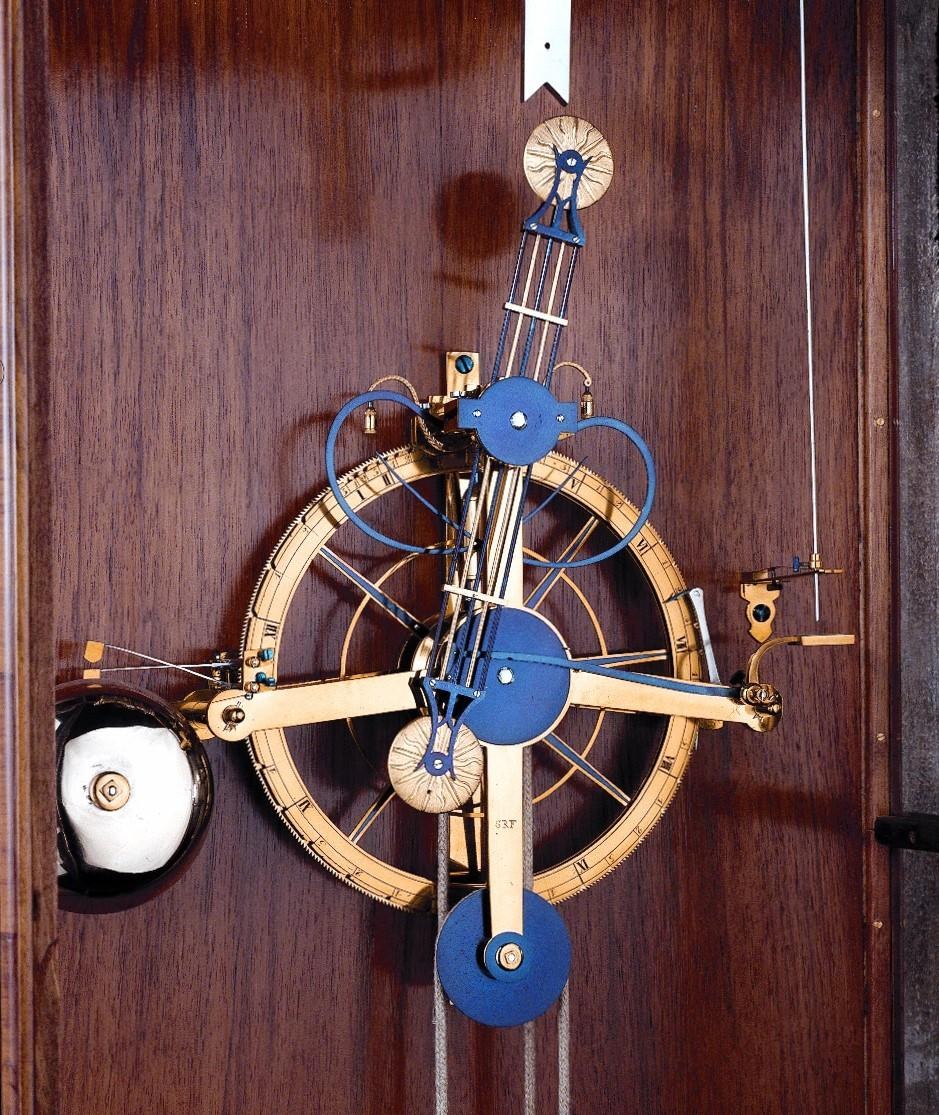
- The striking mechanism, like the movement, has only one wheel. This comprises the hour and quarter-hour locking-plate, the pin wheel for lifting the strike hammers, the driving wheel of the striking mechanism, which is equipped with a weight, and, finally, a "fast-and-slow" device with the aid of an additional pendulum. This pendulum regulates the speed of the striking mechanism; it is partially poised and hooks to the detent until it is freed again when the clock has struck the right number of blows.
- Another one-wheel clock, signed Leroy and Sons in Paris and on display in the British Museum, is based on the same principle. It is described in Traité d'horlogerie de Lepaute, written in 1755, in the chapter entitled Pendule à une roue faite en 1751 (One wheel clock made in 1751).
Photographs
Photographs are illustrative examples of the type, not necessarily the exact object described. Verify details against the source file page.
Sources & references
- Musée international d'horlogerie, online collection record, inv. IV-541: https://collection.mih.ch/fr/collection/item/35183/
Where sources disagree, the disagreement is stated rather than resolved silently.