
Table clock · Bâle
Table clock with automata
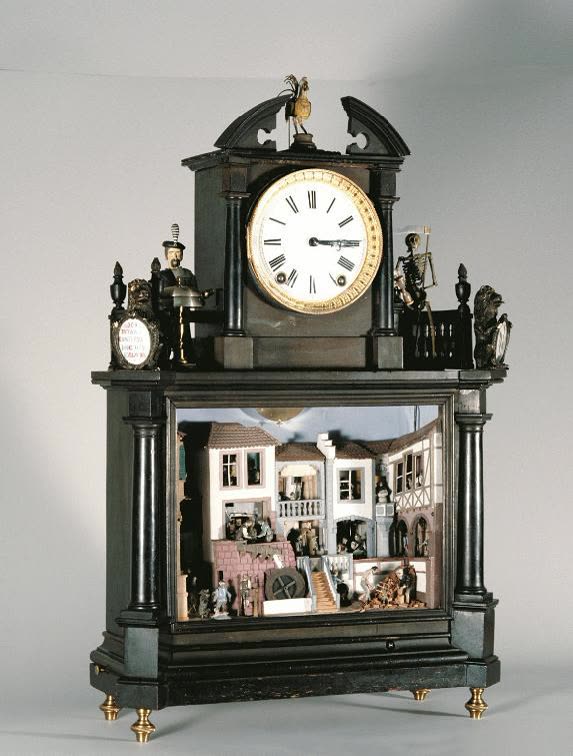
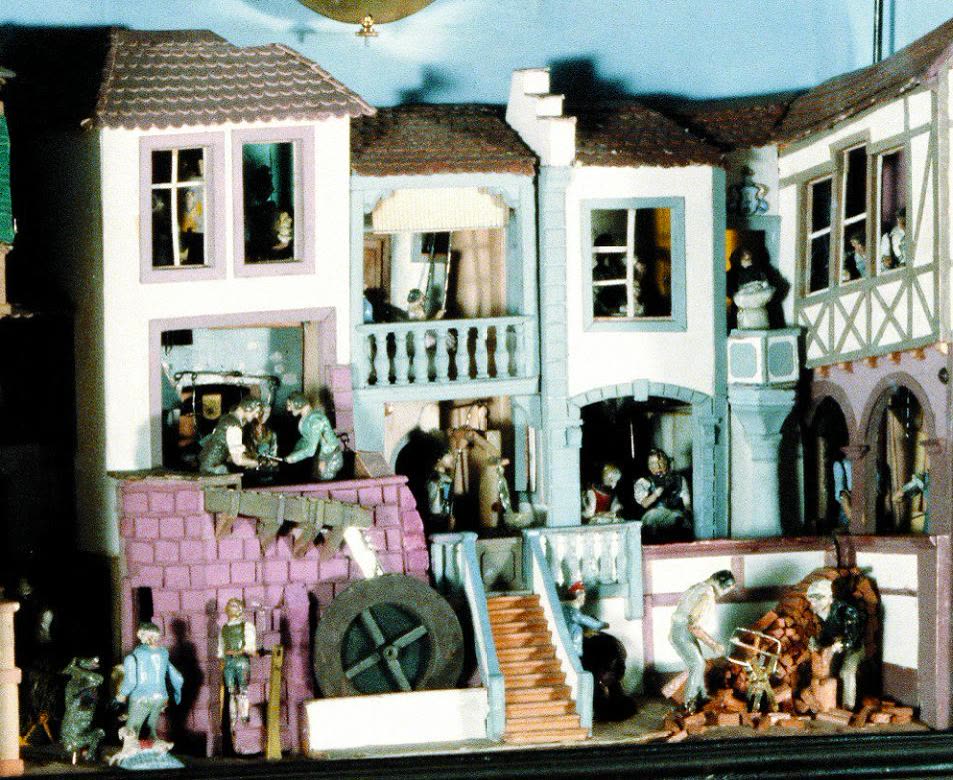
VerifiedBeneath the clock, a street scene displays thirty figures (blacksmiths, woodcutters, laundresses, barber, bear handler, knife-grinder, acrobat, musicians, etc.). They represent inhabitants of the city of Basel engaged in their daily activities, selected by Emil Wick, who was a native of the city. On either side of the clock, whose dial appears at the center of a pediment crowned by a rooster, a Basel herald strikes the hours and half-hours on two bells, while Death, armed with his scythe, turns an hourglass at each hour.
Technical facts
- Inventory number
- MIH IV-512
- Object type
- Table clock
- Place of production
- Bâle
- Dating
- last quarter of the 19th c.
- Materials and techniques (catalogue wording)
- Bois, Laiton, Technique peinture
- Inscriptions (catalogue)
- DEO JUVANTE CONSTRUXIT HOC OPUS EMIL WICK
Historical significance
- Beneath the clock, a street scene displays thirty figures (blacksmiths, woodcutters, laundresses, barber, bear handler, knife-grinder, acrobat, musicians, etc.). They represent inhabitants of the city of Basel engaged in their daily activities, selected by Emil Wick, who was a native of the city. On either side of the clock, whose dial appears at the center of a pediment crowned by a rooster, a Basel herald strikes the hours and half-hours on two bells, while Death, armed with his scythe, turns an hourglass at each hour.
- Emil Wick, a native of Basle, built one of these models of each of his five godchildren.
- Realistic observation and humor are combined in this work. Another, almost identical clock was described by Alfred Chapuis, who cites the names of several Old Basel residents playfully caricatured in this scene. The Kunsthistorisches Museum in Basel preserves a simpler example.
Photographs
Photographs are illustrative examples of the type, not necessarily the exact object described. Verify details against the source file page.
Sources & references
- Musée international d'horlogerie, online collection record, inv. IV-512: https://collection.mih.ch/fr/collection/item/19527/
Where sources disagree, the disagreement is stated rather than resolved silently.