
Table clock · Paris
Atmos table clock
VerifiedPatented in 1928 by J.-L. Reutter, in Paris, this "perpetual" clock uses the energy produced by variations in the ambient temperature. A thermal motor at the back of the clock transforms thermal energy into mechanical energy and winds the clock's mainspring.
Technical facts
- Inventory number
- MIH IV-36
- Object type
- Table clock
- Place of production
- Paris
- Dating
- c. 1932
- Materials and techniques (catalogue wording)
- Mercure, Gaz, Laiton, Verre, Élinvar
- Dimensions (catalogue)
- dimensions: 30 x 20 x 15 cm
- Inscriptions (catalogue)
- Atmos Pendule perpétuelle (cadran)
Historical significance
- Patented in 1928 by J.-L. Reutter, in Paris, this "perpetual" clock uses the energy produced by variations in the ambient temperature. A thermal motor at the back of the clock transforms thermal energy into mechanical energy and winds the clock's mainspring.
- The balance is suspended from an Elinvar wire; it oscillates twice a minute about its own axis, alternately rotating in opposite directions.
- The ATMOS clock was developed in 1930 by the Compagnie générale de radiologie in Paris, in collaboration with its inventor, Jean-Léon Reutter. From 1936, it was manufactured and sold by Jaeger-LeCoultre, in Le Sentier.
- The early models, like the one described here, date from 1932. They have a rotating thermal motor using mercury and liquefied gas, as well as a clock movement made in Cluses, which was replaced in 1933 by a new movement made in Le Sentier.
Photographs
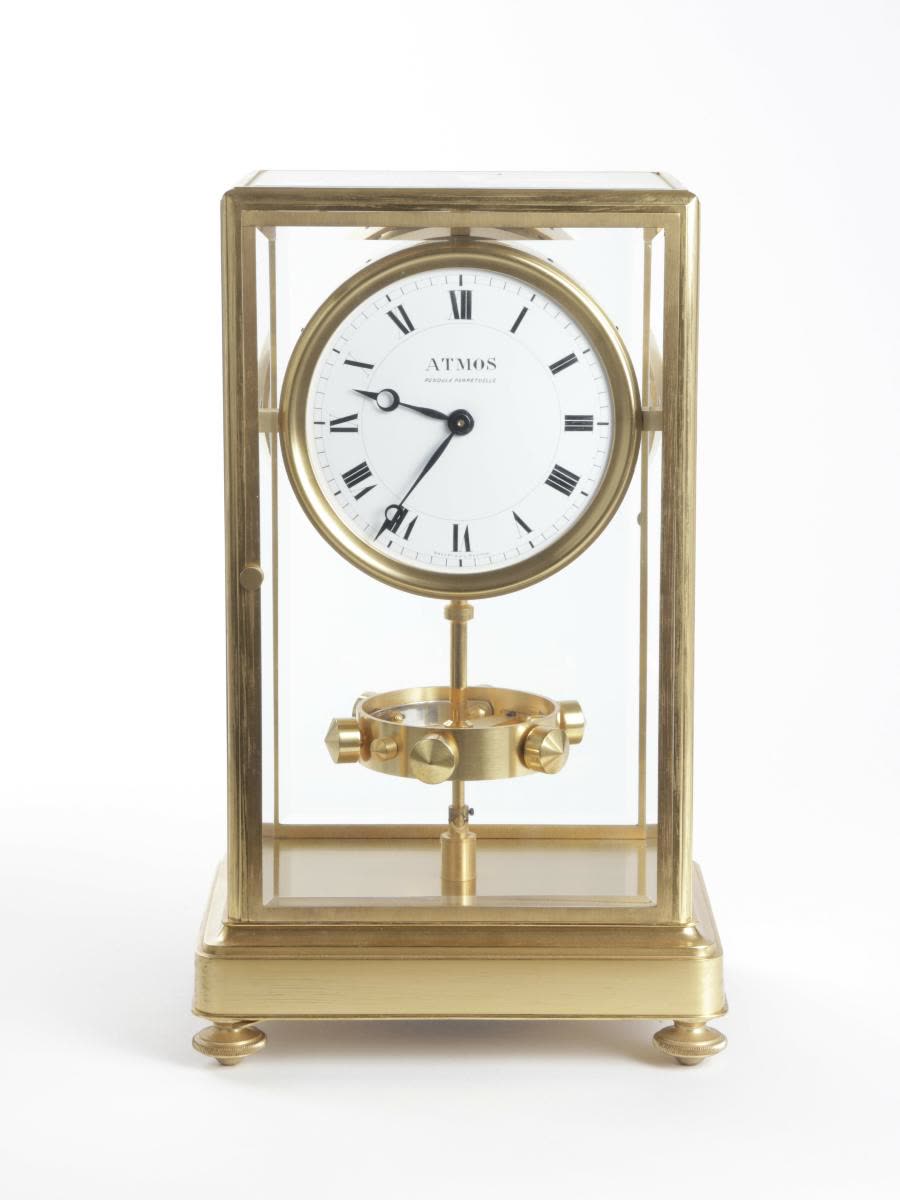
Photographs are illustrative examples of the type, not necessarily the exact object described. Verify details against the source file page.
Sources & references
- Musée international d'horlogerie, online collection record, inv. IV-36: https://collection.mih.ch/fr/collection/item/38255/
Where sources disagree, the disagreement is stated rather than resolved silently.