
Mantel/table pendulum clock · Paris
Régulateur d'observatoire à sonnerie des secondes
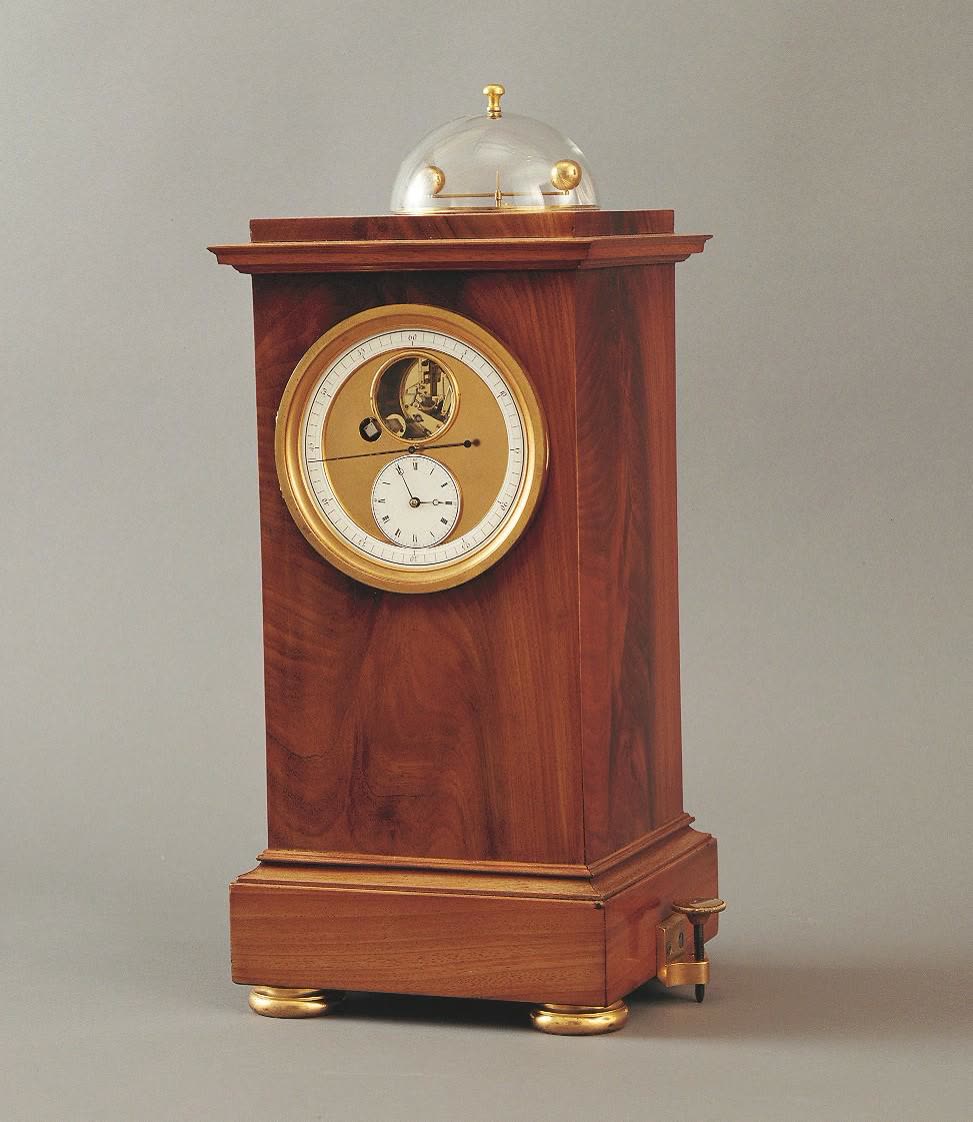
VerifiedThe mahogany case has simple moulding. The contrast between the wood and metal adds considerable elegance as it highlights the combination of straight lines and circles.
Technical facts
- Inventory number
- MIH IV-336
- Object type
- Mantel/table pendulum clock
- Place of production
- Paris
- Dating
- 1815
- Materials and techniques (catalogue wording)
- Bois, Laiton, Acier, Émail
- Dimensions (catalogue)
- Dimensions: 43.0 x 17.0 x 18.0 cm
- Inscriptions (catalogue)
- N°3 (gravé à divers endroits)
Historical significance
- The mahogany case has simple moulding. The contrast between the wood and metal adds considerable elegance as it highlights the combination of straight lines and circles.
- The centre annular seconds dial and the small eccentric hour and minute dial, both in white enamel, stand out against a gilded metal false plate. The workings of the escapement can be observed through a circular aperture above the hour and minute dial.
- The movement, with a spring housed in a large toothed barrel, is fitted with a gridiron compensation pendulum, a knife-edge suspension, and a constant force escapement. The dropping of a small platinum weight, pivoted on a lever, impulses the pendulum; the weight is then raised by the mainspring, after which it is freed again by the pendulum on the return of the vibration. It functions, therefore, like a single-beat escapement, with the pendulum receiving the impulse from one direction and causing the unlocking in the other. This means that the independent seconds can be displayed, despite the fact that the pendulum beats half-seconds. A hammer, raised by the mainspring at the same time as the platinum weight of the escapement, strikes the seconds on a gong. This mechanism can be disconnected by a small lever on the side of the dial.
- A ball regulator, visible under a glass dome on top of the clock, extends the pendulum above its suspension. This foliot-shaped regulator was built on the principle of Baron Gaspard de Prony's invention (1755-1839). By pivoting on its stem, it modifies the inertia of the pendulum. This precision timing works on a silver annular dial engraved with a 90° scale. The whole piece is stabilised by a heavy lead weight fixed to the inside of the case.
- The certificate was made out in 1967 by the Breguet company and points out that, "although this clock has neither a name nor a number, it can be identified as Breguet's work because it is identical in every detail to N° 1064 in one of our early sales books, sold to Mr de Prony on 2 September 1815, and to another in the British Museum (Ilbert Collection). Another definite mark of identification is the two rectangular openings in the plate with the engraved letter "à" in between. This is all that remains of the mark "Breguet à Paris", the words "Breguet" and "Paris" having disappeared when the openings were added later to make the striking mechanism louder. This clock has N° 3 engraved in various places, while the one in the British Museum has N° 4."
Photographs
Photographs are illustrative examples of the type, not necessarily the exact object described. Verify details against the source file page.
Sources & references
- Musée international d'horlogerie, online collection record, inv. IV-336: https://collection.mih.ch/fr/collection/item/35812/
Where sources disagree, the disagreement is stated rather than resolved silently.