
Table clock · Paris
Régulateur à pression constante
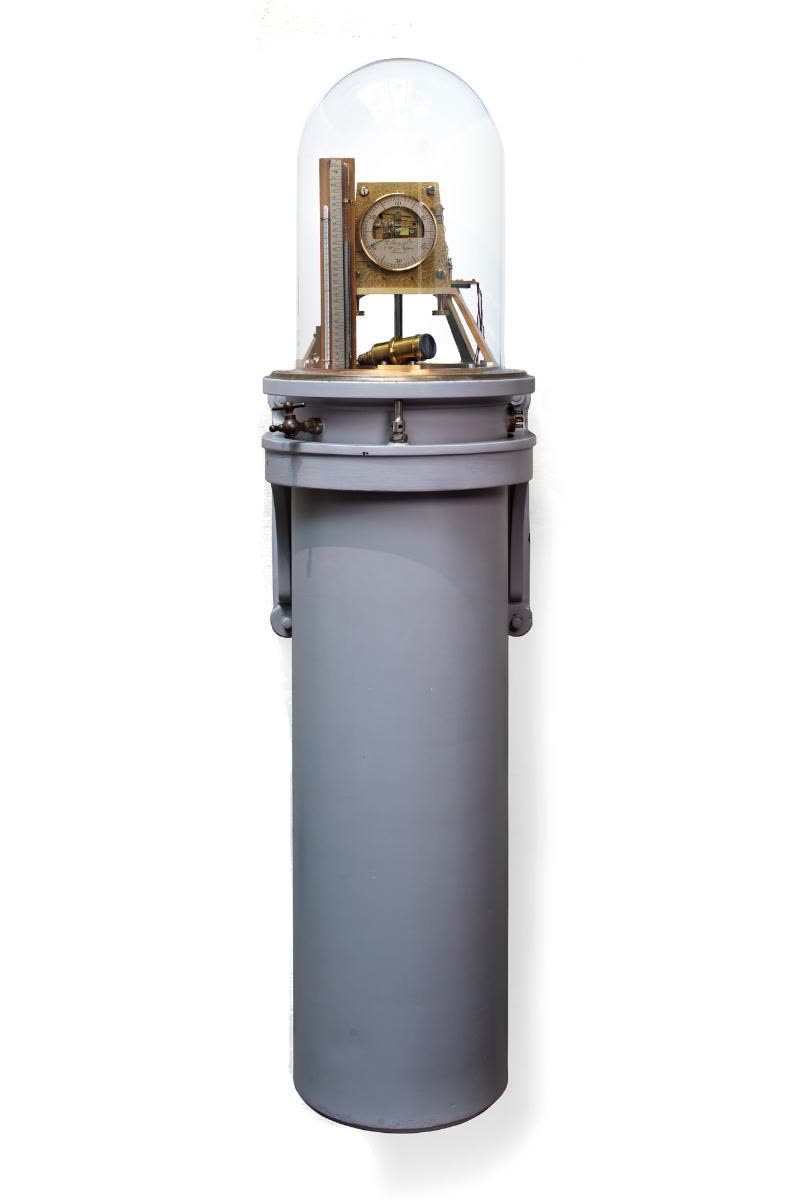
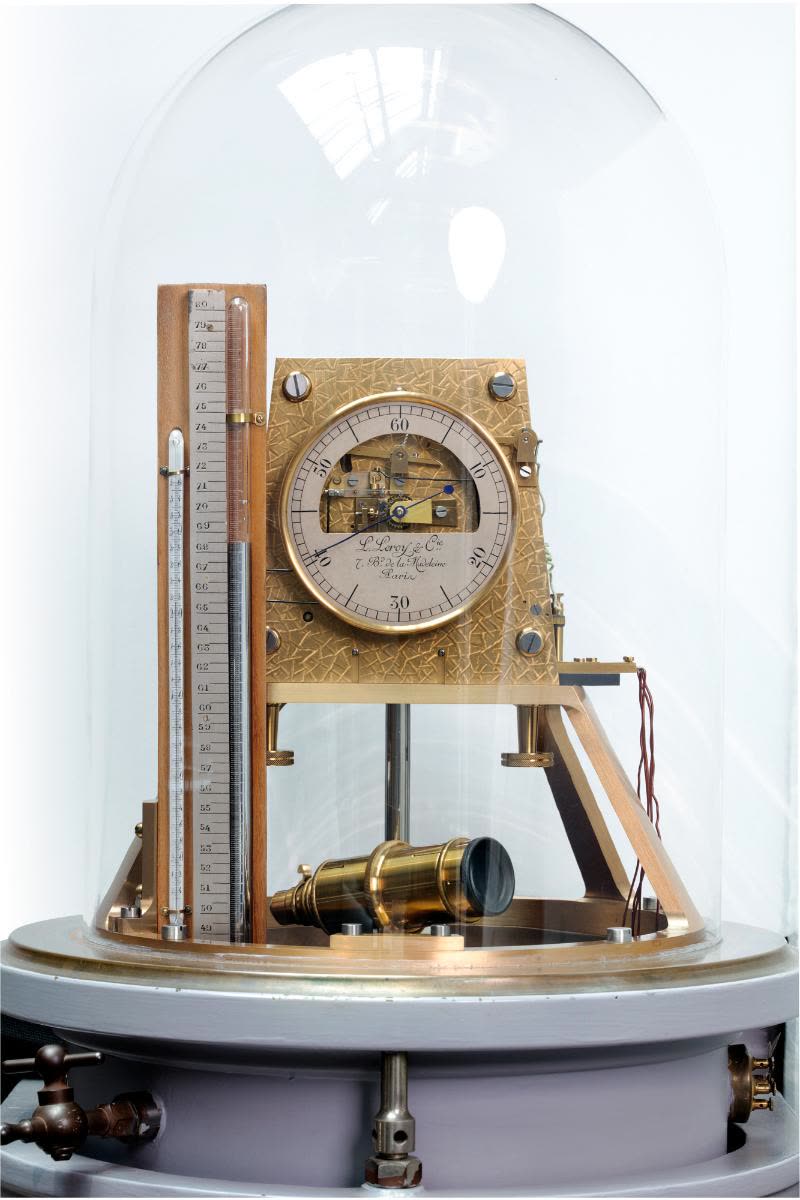
VerifiedThis clock is housed in a metal cylinder hermetically sealed by a glass dome. Designed to operate under constant pressure, it was the master clock at the Neuchâtel Observatory from 1925 to 1957.
Technical facts
- Inventory number
- MIH IV-157
- Object type
- Table clock
- Place of production
- Paris
- Dating
- 1931
- Materials and techniques (catalogue wording)
- Bronze, Laiton, Acier, Invar, Verre
- Dimensions (catalogue)
- Dimensions: 145.0 x 31.0 x 31.0 cm
- Inscriptions (catalogue)
- L. Leroy & Cie 7Bd de la Madeleine A Paris (cadran)
Historical significance
- This clock is housed in a metal cylinder hermetically sealed by a glass dome. Designed to operate under constant pressure, it was the master clock at the Neuchâtel Observatory from 1925 to 1957.
- In addition to a barometer and thermometer, the electric movement, which only indicates seconds, has a Reid escapement and an invar-rod pendulum.
- The amplitude of the pendulum, marked on a graduated sector on its rod, can be read through a microscope.
- To lessen the effect of variations in atmospheric pressure on the pendulum, some precision clock manufacturers, one of whom was S. Riefler of Munich, began, at the end of the 19th century, to put movements inside hermetic domes, where pressure could be reduced by pumping out the air.
Photographs
Photographs are illustrative examples of the type, not necessarily the exact object described. Verify details against the source file page.
Sources & references
- Musée international d'horlogerie, online collection record, inv. IV-157: https://collection.mih.ch/fr/collection/item/35656/
Where sources disagree, the disagreement is stated rather than resolved silently.