
Table clock · Allemagne
Tischuhr in Form einer Monstranz
VerifiedMonstrance table clock. Anonymous Germany. Mid-17th century.
Technical facts
- Inventory number
- MIH IV-155
- Museum title (French)
- Horloge de table en forme d'ostensoir
- Object type
- Table clock
- Place of production
- Allemagne
- Dating
- 1640 - 1660
- Materials and techniques (catalogue wording)
- Laiton, Argent, Acier
- Materials (English translation)
- Brass, Silver, Steel
- Dimensions (catalogue)
- diam.: de la base 105.00 mm; Dimensions: hauteur 320.0 cm; poids: 1855.500 g
Historical significance
- Monstrance table clock. Anonymous Germany. Mid-17th century.
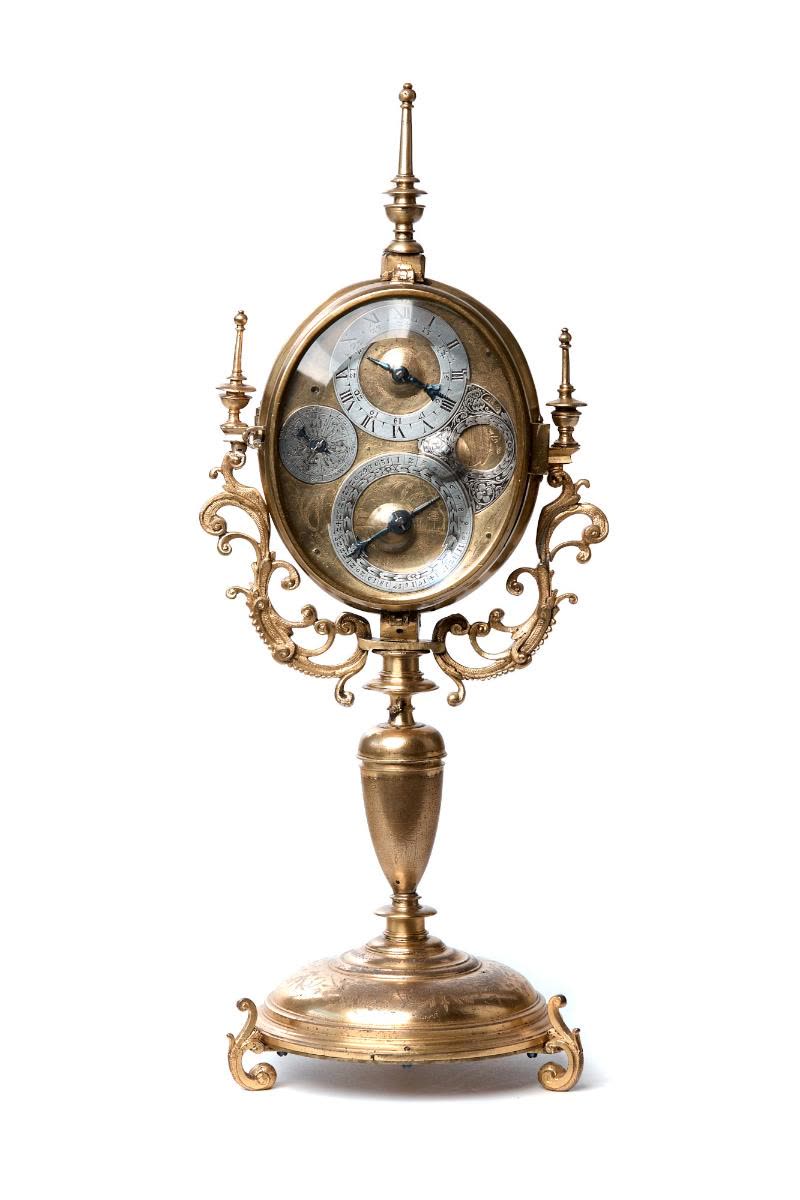
- The moulded circular base rests on three palm-leaf feet. The clock case is framed by cast and pierced brass ornaments.
- The moulded circular base, stamped with floral decorations, rests on three palm-leaf feet. The clock case, placed on a central column, is framed by cast and pierced brass ornaments surmounted by finials.
- Four silver dials, applied on a gilded brass back plate engraved with floral motifs, indicate, at the top, the hours engraved in Roman (I to XII) and Arabic (13 to 24) numerals with a blued steel hand; at the bottom, the date, where the 2's are shaped like Z's, a feature of German clocks; on the left, the days of the week, represented by their planetary signs; and on the right, the phases and age of the moon in two apertures.
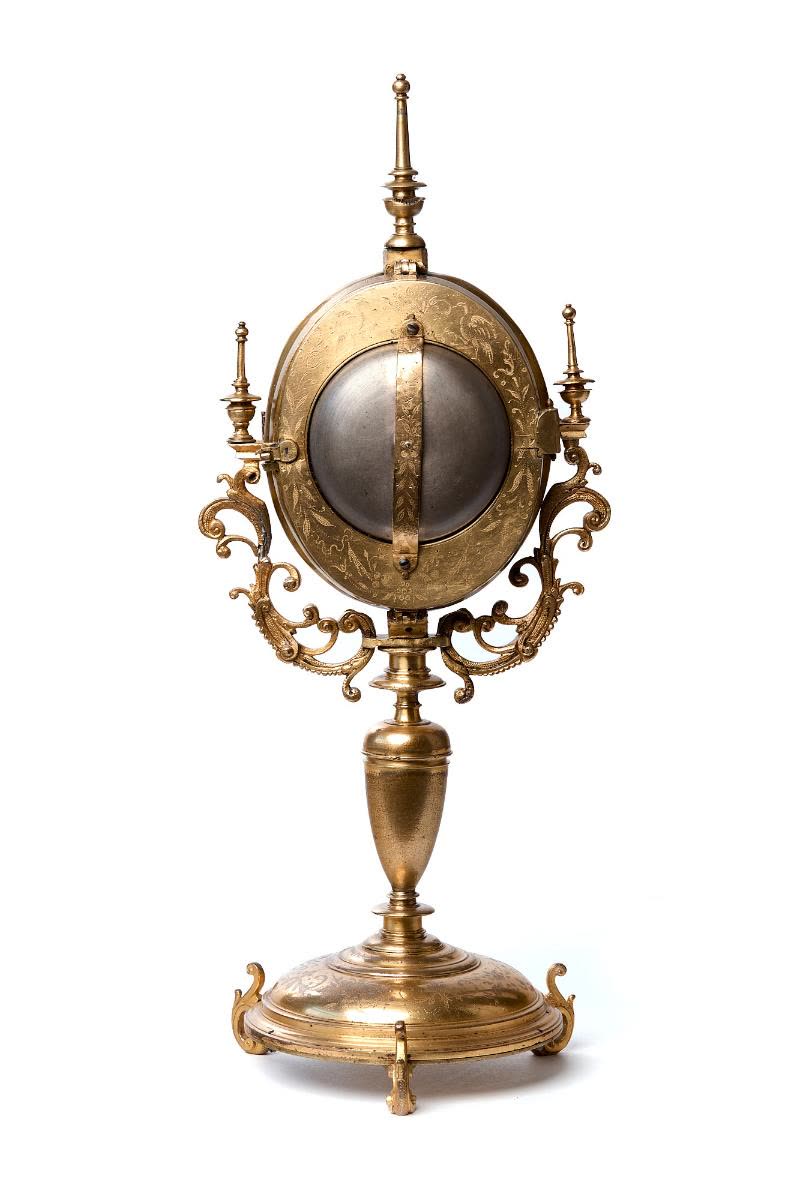
- As well as an hour-strike, the oval movement has a fusee and chain, a verge escapement, and a steel annular balance without balance spring, which pivots in a single-footed balance cock, engraved and pierced with scrolls and strawberry flowers.
- The locking-plate, which is on the back plate and takes the place of the striking-work dial, is engraved with Arabic numerals from 1 to 12 and surmounted by a fixed blued steel pointer.
- Die kreisförmige, fassonnierte und mit geprägtem Blumendekor geschmückte Basis ruht auf drei Palmettenfüssen. Das Uhrgehäuse auf einer zentralen Säule wird umrahmt von gegossenem und gestanztem Zierwerk aus Messing, gekrönt von Fialen.
- Vier silberne Zifferblätter auf einer Platte aus vergoldetem Messing mit geprägten Blumenmotiven dienen als Anzeige: oben, mit Zeiger aus gebläutem Stahl, die als römische (I bis XII) und arabische (13 bis 24) Ziffern für die Stunden; unten das Datum (die Zahl 2 weist die Form eines Z auf, ein typisches Merkmal deutscher Uhren); links der Wochentag, wiedergegeben durch sein Planetenzeichen und rechts Mondphasen und -alter in zwei eingelassenen Fenstern.
- Ovales Uhrwerk mit Stundenschlag und Kettenschnecke, Spindelhemmung, stählerne Radunrast ohne Spirale mit einfüssigem Unruhkloben, mit Rankenwerk und Erdbeerblüten graviert und durchbrochen. Die Schlossscheibe auf der hinteren Werkplatte, die als Schlagwerkzifferblatt fungiert, ist mit arabischen Ziffern von 1 bis 12 graviert; darüber ein feststehender Indexzeiger aus gebläutem Stahl.
Photographs
Photographs are illustrative examples of the type, not necessarily the exact object described. Verify details against the source file page.
Sources & references
- Musée international d'horlogerie, online collection record, inv. IV-155: https://collection.mih.ch/fr/collection/item/36194/
Where sources disagree, the disagreement is stated rather than resolved silently.