
Mantel/table pendulum clock · Paris
Régulateur astronomique
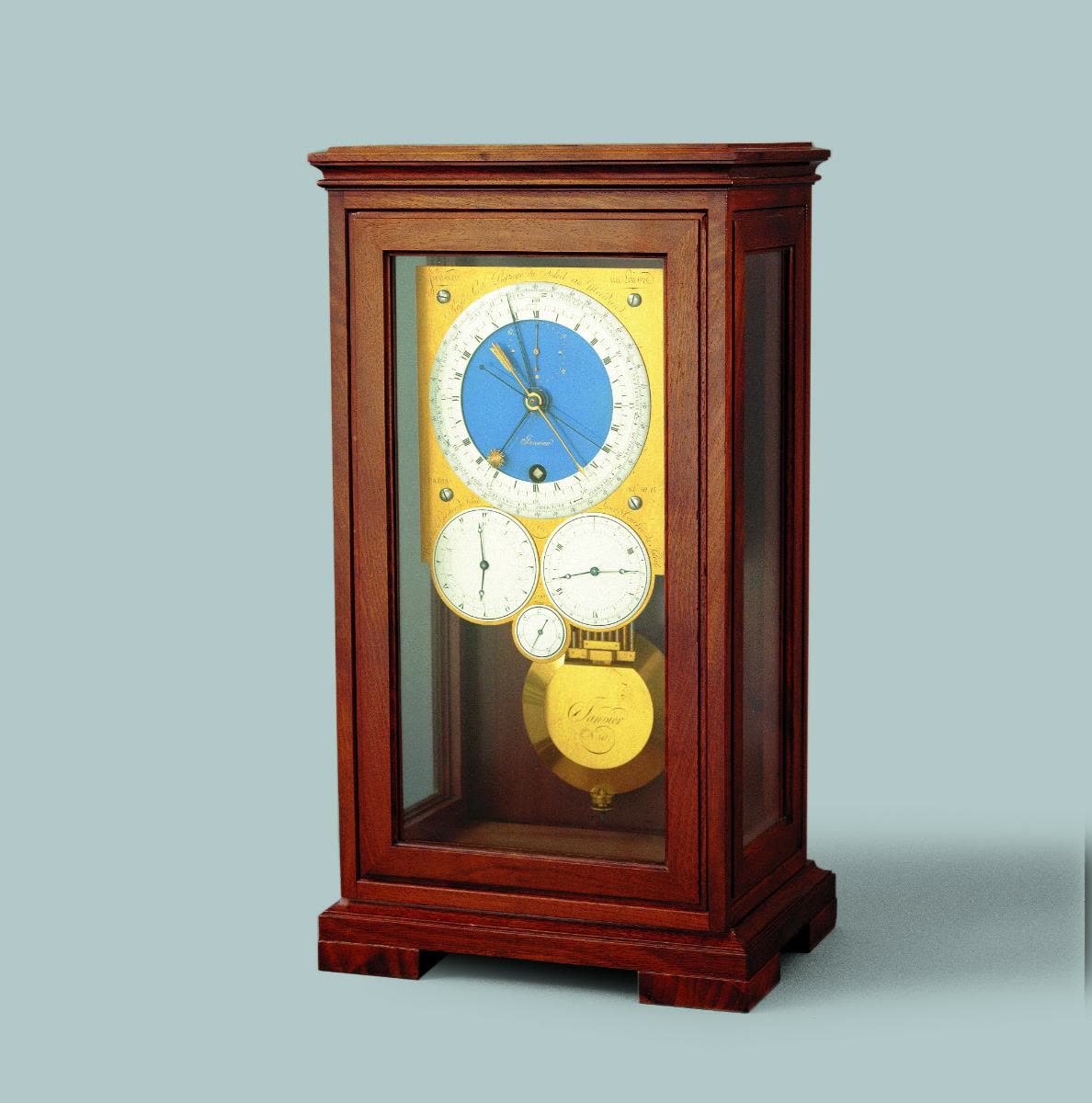
VerifiedThe main dial has two hands - one decorated with a sun, the other arrow-shaped - to indicate the duodecimal hours and minutes. A blued steel hand on the exterior ring shows the date as well as the months of the Gregorian calendar and the signs of the zodiac.
Technical facts
- Inventory number
- MIH IV-143
- Object type
- Mantel/table pendulum clock
- Place of production
- Paris
- Dating
- 1802
- Materials and techniques (catalogue wording)
- Bois, Laiton, Émail, Acier
- Dimensions (catalogue)
- Dimensions: 48.5 x 26.5 x 20.0 cm
- Inscriptions (catalogue)
- Janvier au Louvre, N° 347; 7/1802 (plaque du cadran)
Historical significance
- The main dial has two hands - one decorated with a sun, the other arrow-shaped - to indicate the duodecimal hours and minutes. A blued steel hand on the exterior ring shows the date as well as the months of the Gregorian calendar and the signs of the zodiac.
- The clockmaker has signed the blue enamel centre of the dial, which indicates the phases and the age of the moon. The dial plate bears the inscription Réglé sur le passage du soleil au méridien (Adjusted to the passage of the sun at midday) and the latitude of Paris, 48° 50' 15".
- The lower right dial has two hands to show the times of sunrise and sunset. The lower left dial has two graduations: on the outside, a hand indicates the time adjusted to sunset using Turkish numerals from one to twelve; on the inside, a hand making one revolution every twenty-four hours indicates decimal time. The hand on the small bottom centre dial gives the days of the week.
- The movement, which has a pin-wheel escapement, is housed in a plain mahogany case typical of the work of the cabinet-maker Schwerdfeger. The gear-trains can be seen through the three glazed sides. The pendulum, with a knife-edge suspension, is compensated for temperature variations; its bob bears Janvier's signature and N° 347.
- "Designed to record the time in the manner of Orientals whose day begins at sunset", this clock won Antide Janvier a gold medal when he presented it, along with other complicated pieces, at the Public Exhibition of French Industrial Products in Year 10 (French Republican calendar). It was originally made for the Ottoman ambassador Effey Ali Effendi, who left France in 1798 before it was completed (cf. Augarde, op cit.).
Photographs
Photographs are illustrative examples of the type, not necessarily the exact object described. Verify details against the source file page.
Sources & references
- Musée international d'horlogerie, online collection record, inv. IV-143: https://collection.mih.ch/fr/collection/item/36379/
Where sources disagree, the disagreement is stated rather than resolved silently.