
Atomic clock · Neuchâtel
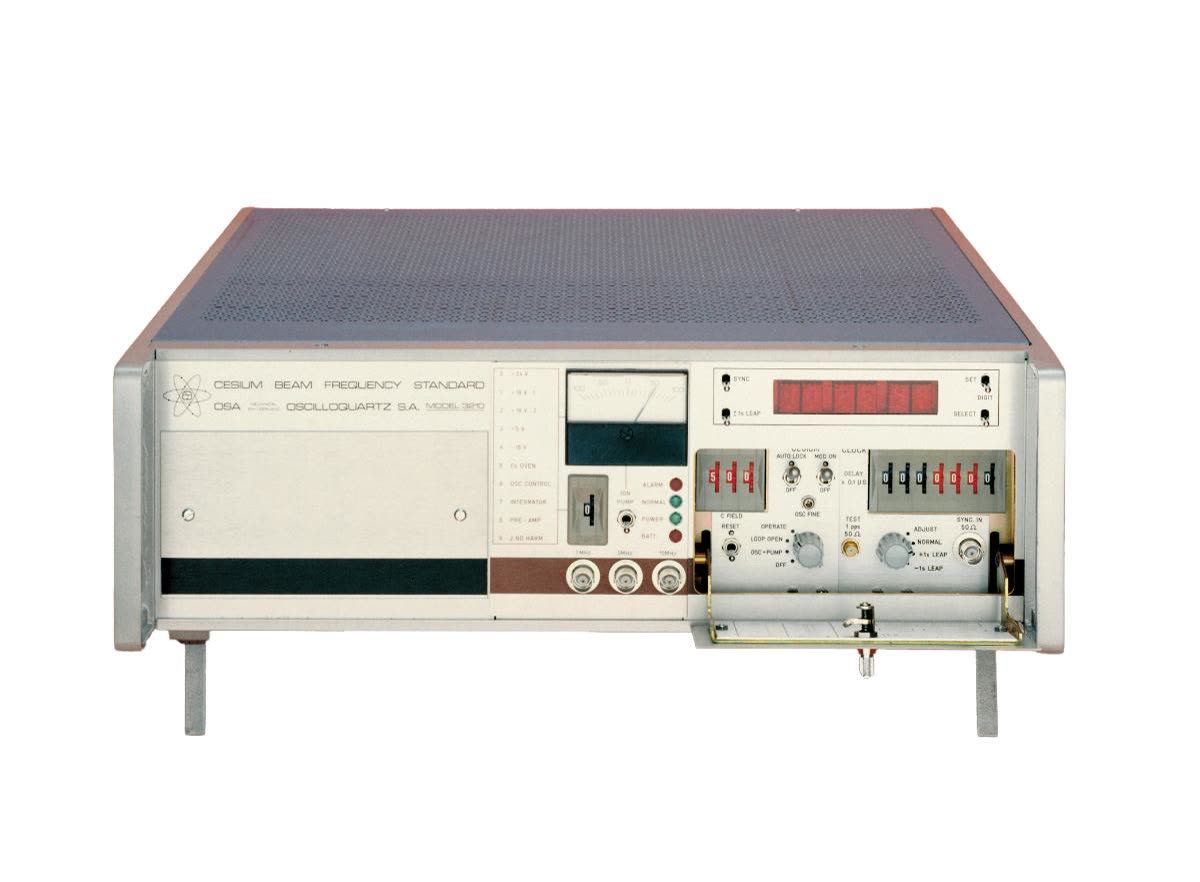
Maquette d'étalon atomique de temps et de fréquence à césium
VerifiedLike all other kinds of clocks, the atomic clock is based on the application of a periodic phenomenon, the use of highly stable micro-wave electromagnetic oscillations (measured in gigahertz) that are emitted by caesium in certain conditions.
Technical facts
- Inventory number
- MIH IV-1130
- Object type
- Atomic clock
- Place of production
- Neuchâtel
- Dating
- c. 1976
- Materials and techniques (catalogue wording)
- Aluminium, divers
- Dimensions (catalogue)
- dimensions d'exposition: 13.1 x 42.8 x 45.6 cm
Historical significance
- Like all other kinds of clocks, the atomic clock is based on the application of a periodic phenomenon, the use of highly stable micro-wave electromagnetic oscillations (measured in gigahertz) that are emitted by caesium in certain conditions.
- An atomic clock is, in essence, nothing more than a quartz clock locked to an atomic frequency standard, in this case caesium. The quartz clock is the oscillator, while the atomic standard provides an extremely accurate frequency. In the clock presented here, the frequency of the quartz oscillator (5 MHz) is disciplined by the caesium frequency (9.193 GHz).
- The distinguishing feature of an atomic clock is its extremely high level of precision. With this atomic frequency standard, the value of the frequency of the micro-wave created by the caesium atoms can be reproduced with the relatively low margin of error of ± 10-13 (± 1 second every 3,000 years).
Photographs
Photographs are illustrative examples of the type, not necessarily the exact object described. Verify details against the source file page.
Sources & references
- Musée international d'horlogerie, online collection record, inv. IV-1130: https://collection.mih.ch/fr/collection/item/12867/
Where sources disagree, the disagreement is stated rather than resolved silently.