
Pocket watch · Londres
Double case watch by John Arnold
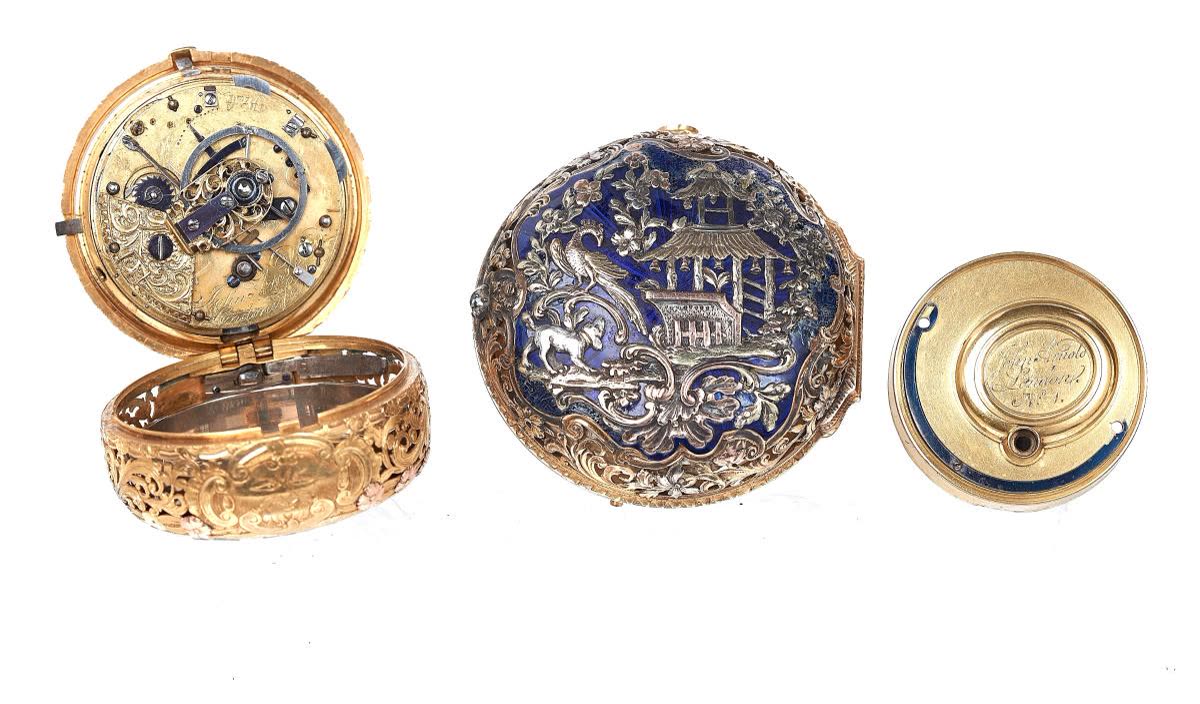
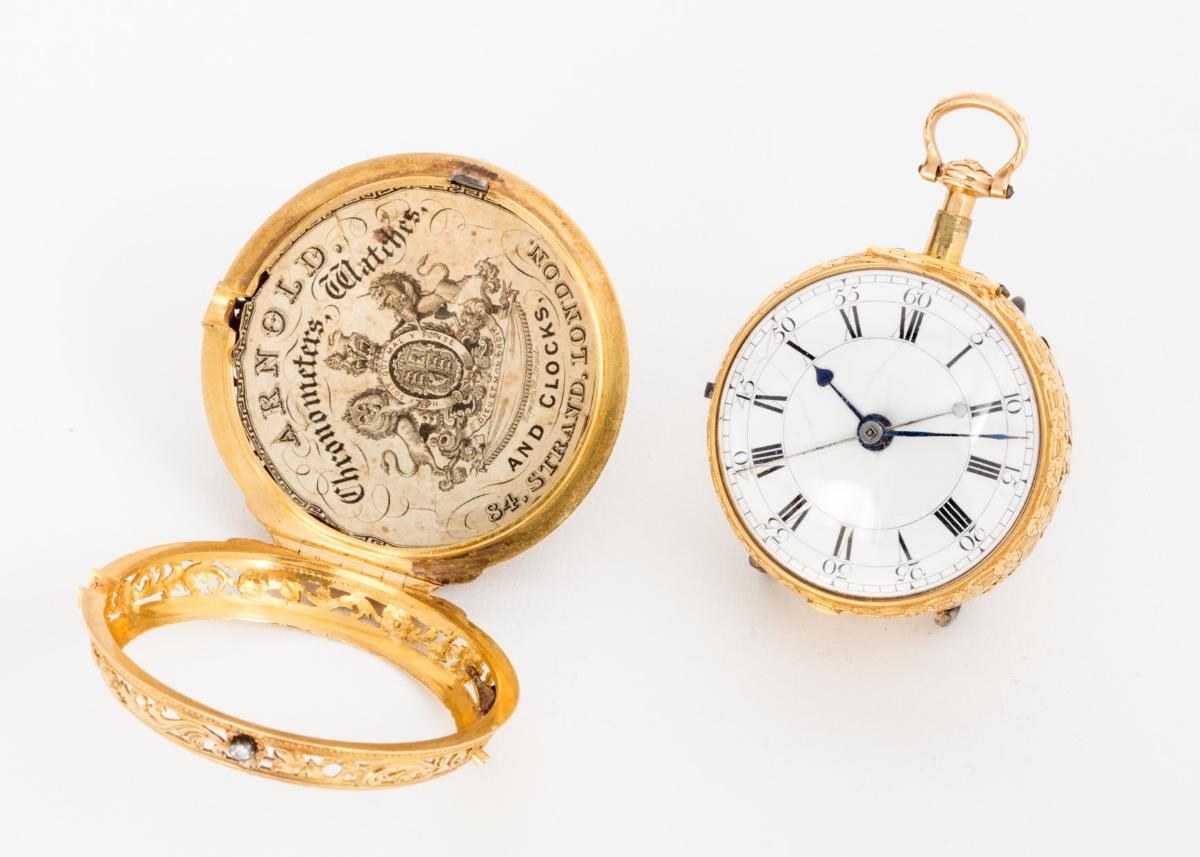
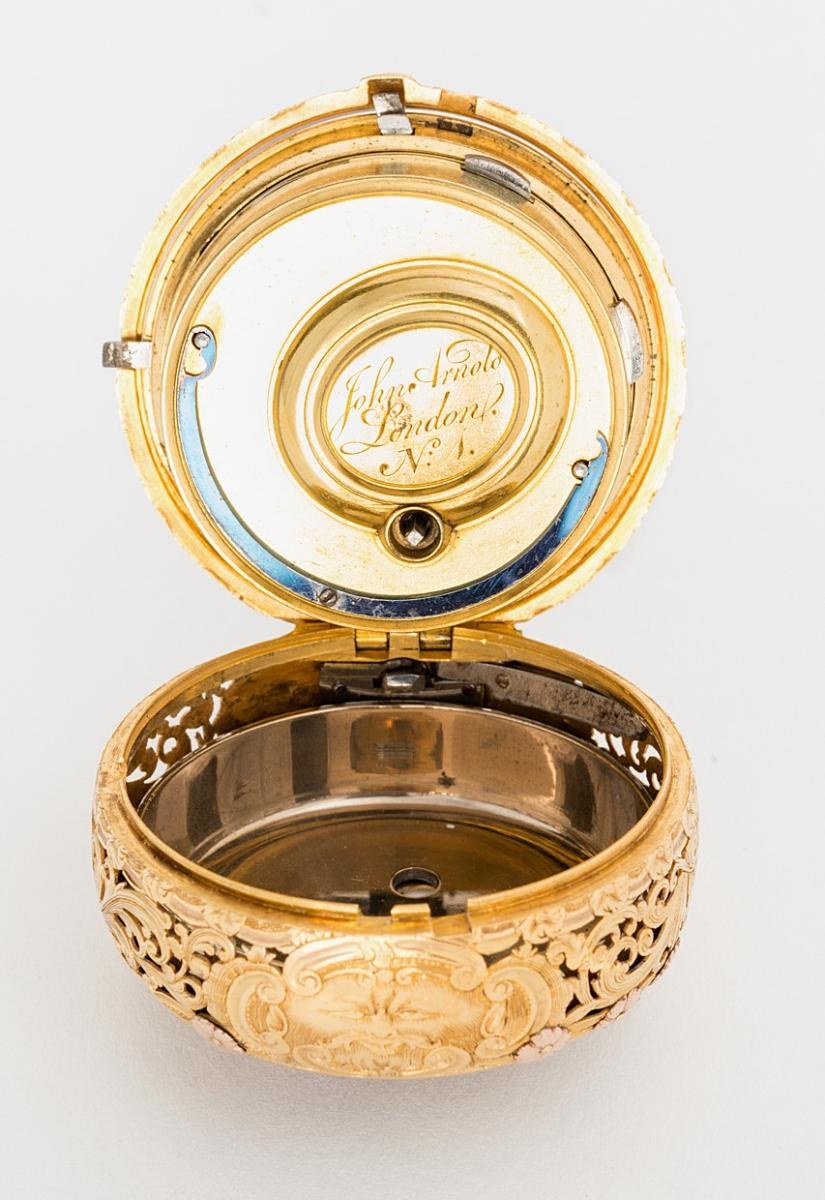
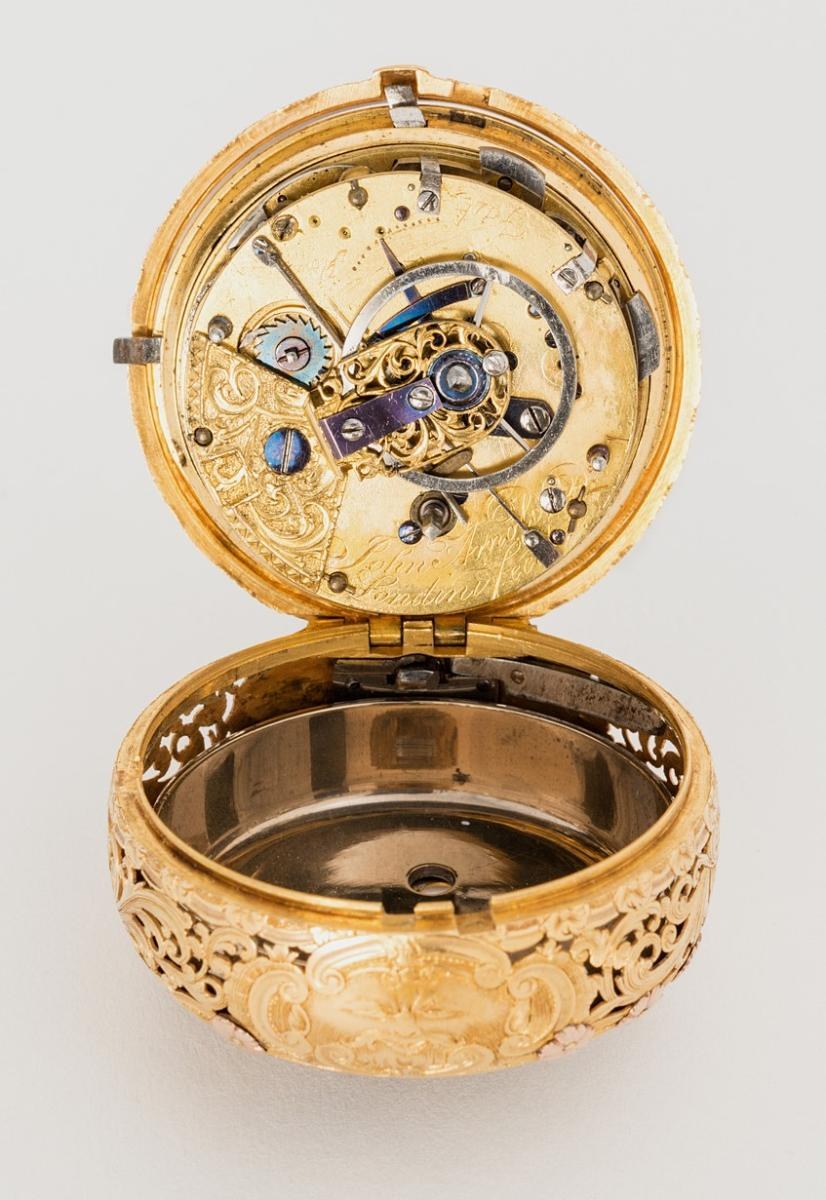
VerifiedWatch with pair case.Dust cap signed: John Arnold London N1. Watch paper with trademark of watchmaker “Arnold, Chronometers, Watches and Clocks, 84 Strand, London” on inside of outer case. Movement signed: John Arnold Londini fecit N° 1. Circa 1768.
Technical facts
- Inventory number
- MIH I-563
- Museum title (French)
- Montre à double boîtier
- Object type
- Pocket watch
- Place of production
- Londres
- Dating
- 1768
- Materials and techniques (catalogue wording)
- ors de couleur, laiton, émail, diamants
- Materials (English translation)
- colored golds, brass, enamel, diamonds
- Dimensions (catalogue)
- dimensions min/max: 41 x 45 mm; poids: 139.500 g
- Inscriptions (catalogue)
- DA et poinçon de garantie pour 1768 (lettre n) (Fond du boîtier extérieur); John Arnold London N1 (Cache-poussière); Arnold Chronometers , Watches and Clocks, 84 Strand London (Fond du boîtier extérieur); John Arnold Londini fecit N° 1 (Mouvement)
- Inscriptions (English translation)
- DA and hallmark for 1768 (letter n) (on the back of the outer case); John Arnold London N1 (dust cover); Arnold Chronometers , Watches and Clocks, 84 Strand London (on the back of the outer case); John Arnold Londini fecit N° 1 (movement)
Historical significance
- Watch with pair case.Dust cap signed: John Arnold London N1. Watch paper with trademark of watchmaker “Arnold, Chronometers, Watches and Clocks, 84 Strand, London” on inside of outer case. Movement signed: John Arnold Londini fecit N° 1. Circa 1768.
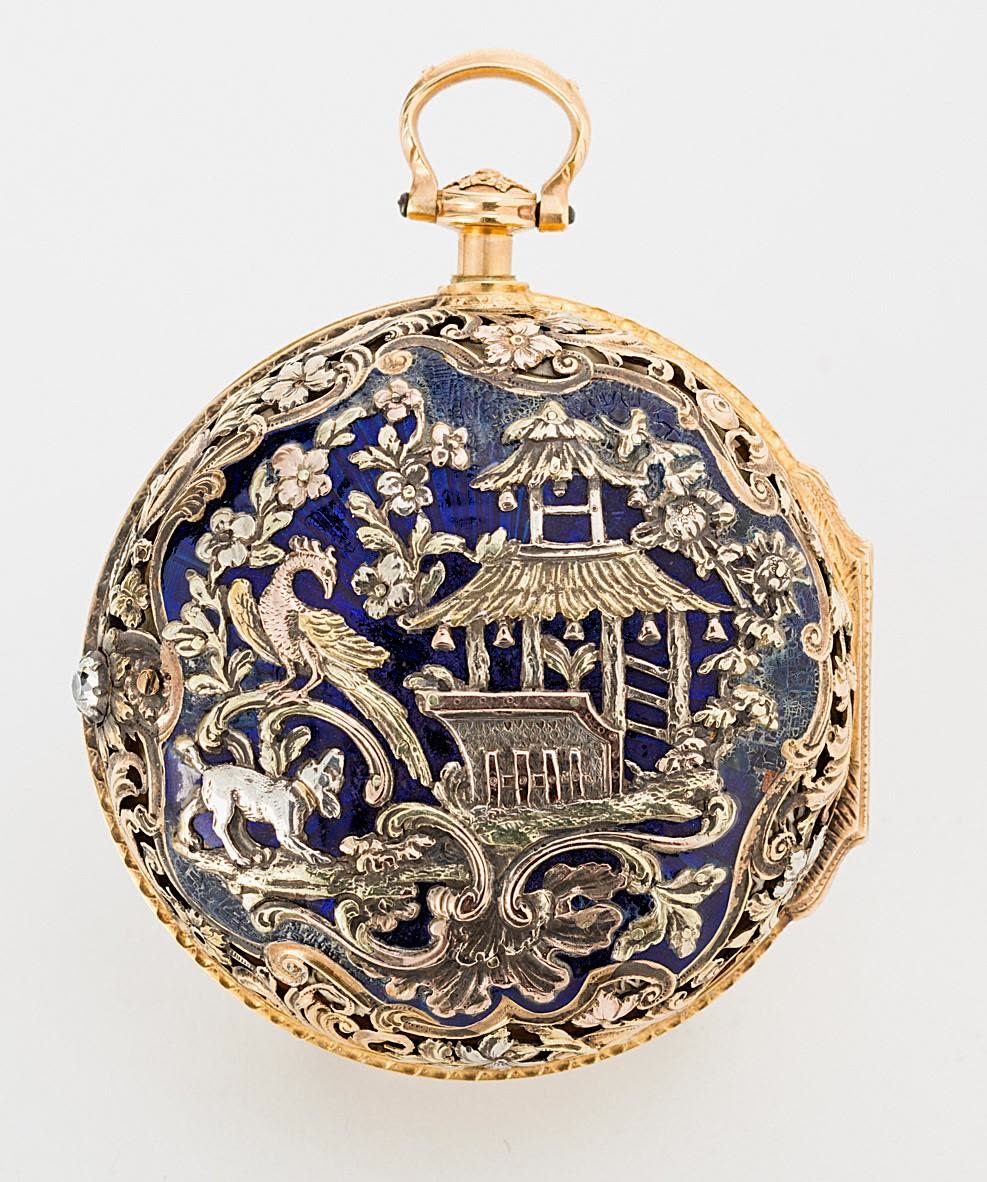
- The outer case has an ornate rocaille decoration. Engraved on multicoloured golds, it is composed of a Chinese pagoda, a dog, and a bird on a branch. Applied on a blue enamel background, these engraved and pierced motifs are framed by gold scrolls with flowerets.
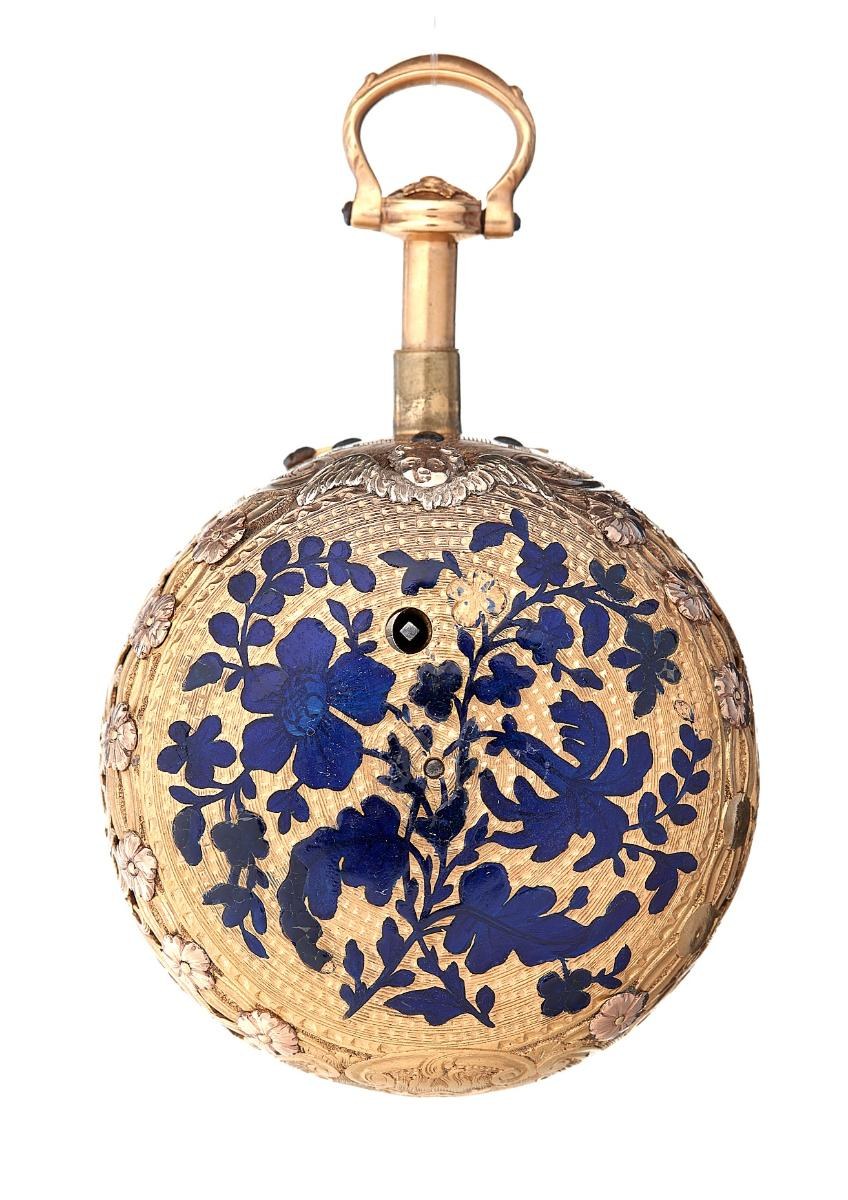
- The inner case elegantly repeats the combination of blue enamel and gold on the outer case. A flower decoration in blue enamel stands out on the case-back. The caseband is engraved and pierced with a scroll frieze of acanthus leaves, interrupted by a mask. The refinement of the case is further accentuated by the engraving of the pendant head and the two applied acanthus leaves on the bow.
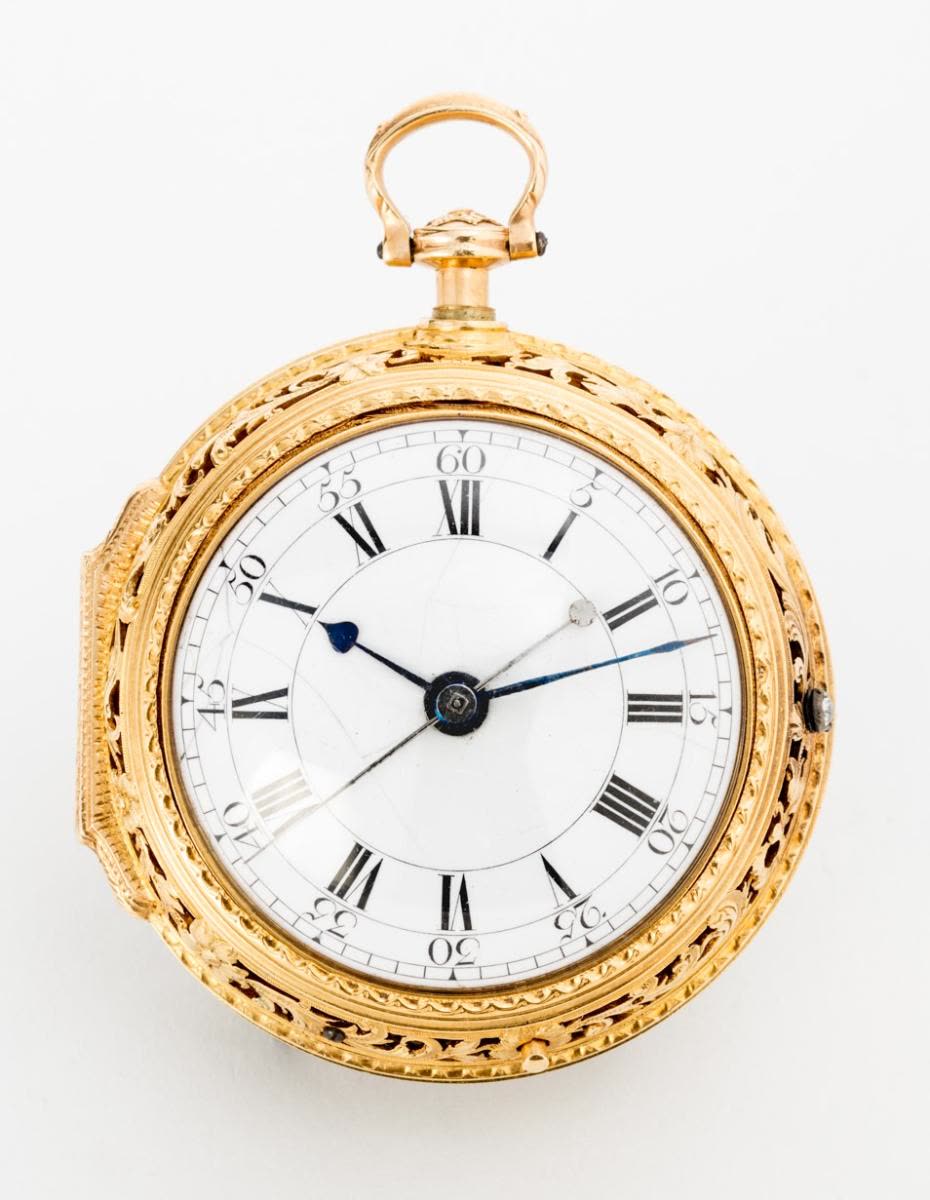
- The white enamel dial is painted with black Roman numerals for the hours and Arabic numerals for the minutes. Besides the hour and minute hands, Arnold introduced a polished steel centre seconds hand.
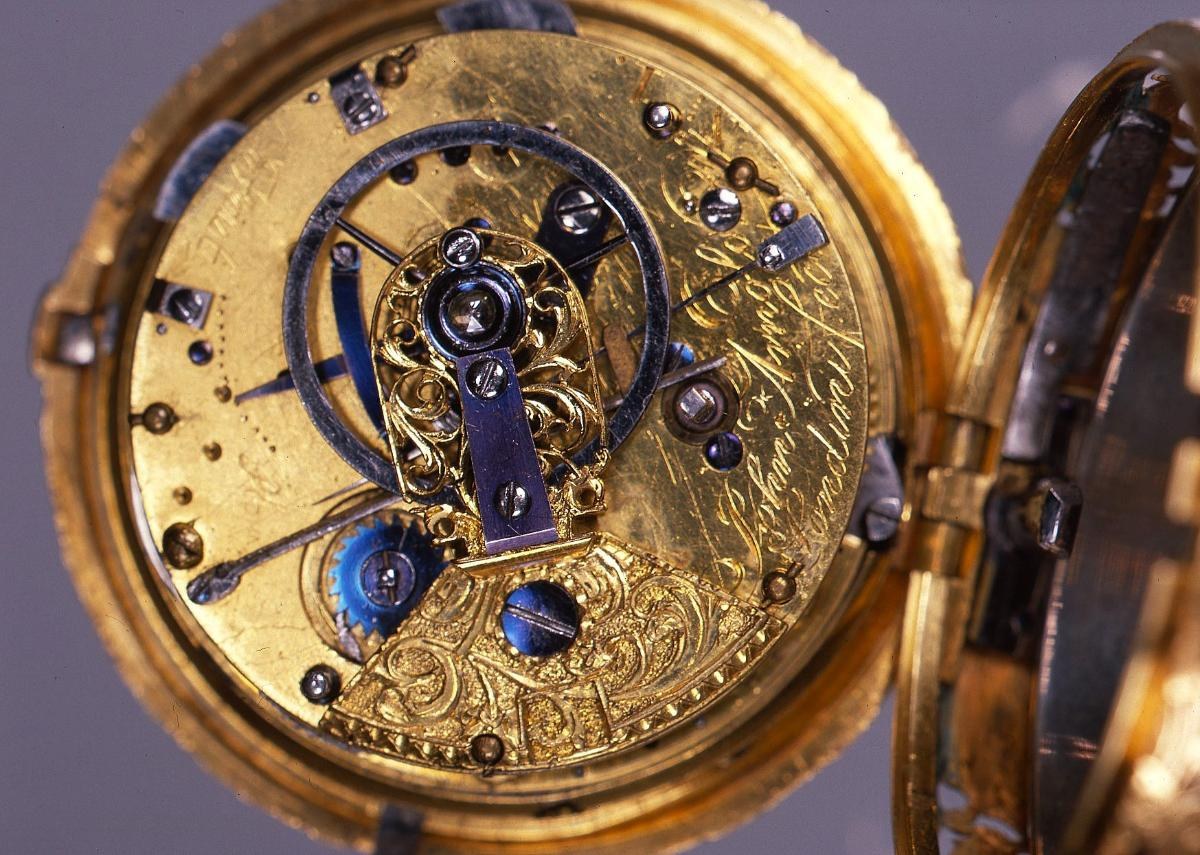
- The movement, which is protected by a dust cap, has a fusee with chain and a cylinder escapement, characterized by a steel wheel. The balance cock, pierced and engraved with scrolls, has a jewelled endpiece. The three-armed balance is polished steel.
- The original features of this movement are the thermal compensation, obtained by a bimetallic strip acting on the balance spring, a system that was also used by Arnold in his first marine chronometers, and in a rather unusual kind of minute repeating which sounds the hours, then groups of 10 minutes, and finally the remaining minutes.
- History: Made around 1768 for King George III, who gave it to one of his equerries, Colonel Price.
- Taschenuhr mit Doppelgehäuse. Staubdeckel signiert: John Arnold London N1. Papier mit der Marke des Uhrmachers “Arnold Chronometers, Watches and Clocks, 84 Strand London” im Boden des Aussengehäuses. Uhrwerk signiert: John Arnold Londini fecit No 1. Um 1768.
- Ein Fantasie-Dekor, angelehnt an den Rocaille-Stil, schmückt das Aussengehäuse. Graviert in verschiedenfarbiges Gold sind erkennbar ein Gebäude chinesischer Art, ein Hund und ein auf einem Zweig sitzender Vogel. Die auf blauem Email applizierten Motive werden umrahmt von gravierten und durchbrochenen Blütenranken in Gold.
- Mit grosser Finesse nimmt das Innengehäuse das Zusammenspiel von blauem Email und Gold des Aussengehäuses auf. Auf dem Boden ist ein Dekor aus Blüten in blauem Email sichtbar. Der Gehäusemittelteil ist graviert und durchbrochen mit einem Rankenfries aus Akanthusblättern, das von einer Maske unterbrochen wird. Die Eleganz des Gehäuses wird unterstrichen durch die Gravuren am Bügelkopf und durch zwei Akanthusblätter auf dem Ring.
- Das Zifferblatt aus weissem Email trägt gemalte schwarze Ziffern, römische für die Stunden und arabische für den Fünf-Minuten-Index. Zusätzlich zu Stunden- und Minutenzeiger hat der Uhrmacher bei diesem Modell eine Sekundenanzeige durch einen Sekundenzeiger aus poliertem Stahl aus der Mitte eingefügt.
- Das Werk, durch einen Staubdeckel geschützt, ist ausgestattet mit einer Schnecke mit Kette und einer Zylinderhemmung, die sich durch ein Stahlrad auszeichnet. Der durchbrochene und mit Rankenornamenten gravierte Unruhkloben verfügt über einen Deckstein. Die dreiarmige Unruh ist aus poliertem Stahl. Die Besonderheit dieses Werks liegt in der thermischen Kompensation durch eine lineare Bimetallklinge, die auf die Spirale wirkt; das System wurde vom gleichen Uhrmacher auch in seinen ersten Marinechronometern verwendet. Eine weitere Besonderheit bildet die ungewöhnliche Minutenrepetition: sie schlägt die Stunden, die seit der vollen Stunde vergangenen 10-Minuten-Tranchen und schliesslich die zusätzlichen Minuten.
Photographs
Photographs are illustrative examples of the type, not necessarily the exact object described. Verify details against the source file page.
Sources & references
- Musée international d'horlogerie, online collection record, inv. I-563: https://collection.mih.ch/fr/collection/item/39009/
Where sources disagree, the disagreement is stated rather than resolved silently.