
Pocket watch · La Chaux-de-Fonds
Chronomètre à tourbillon
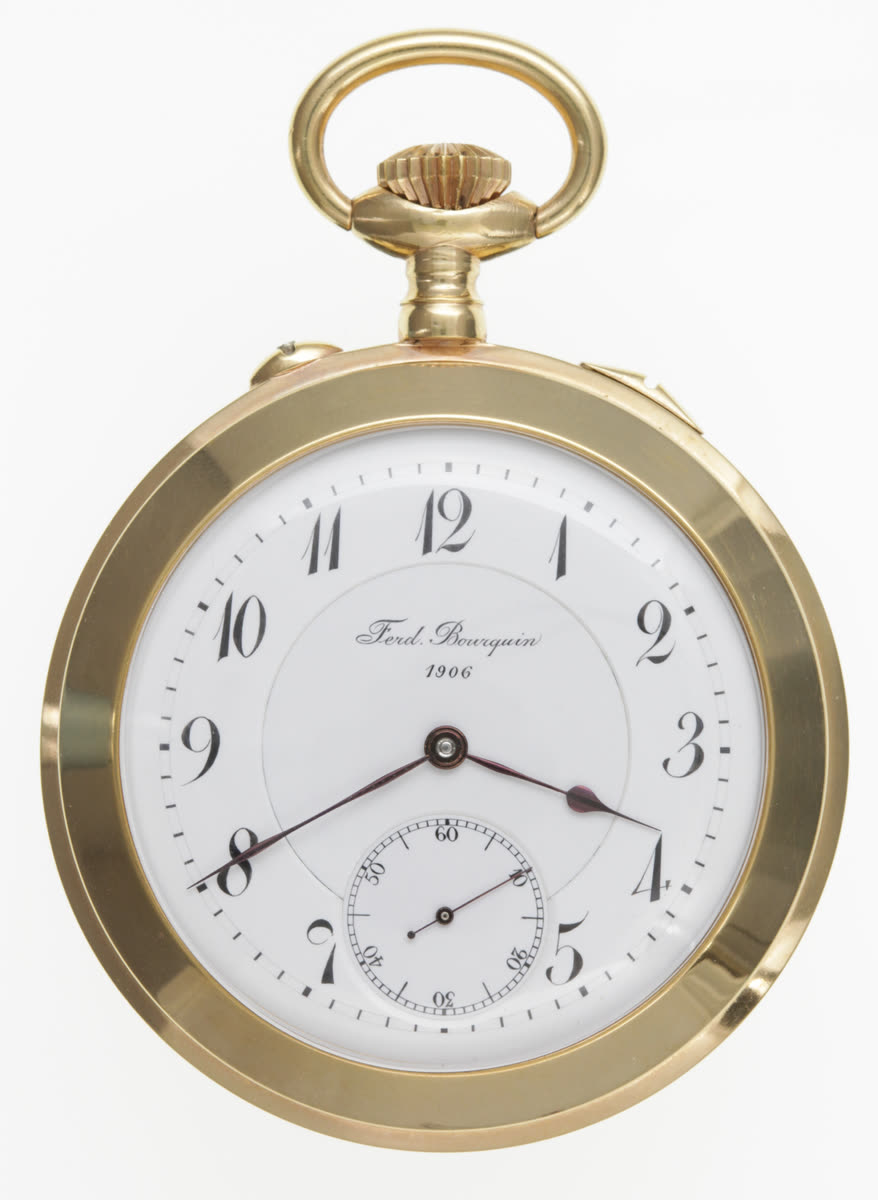
VerifiedThe gilded brass case has two glazed bezels. A small slide on the case band, adjacent to the pendant, permits engagement of the crown to wind the spring. The hands are set using a push piece.
Technical facts
- Inventory number
- MIH I-516
- Object type
- Pocket watch
- Place of production
- La Chaux-de-Fonds
- Dating
- 1906-1909
- Materials and techniques (catalogue wording)
- laiton doré, émail, acier, or
- Dimensions (catalogue)
- Dimensions: 82.5 x 59.1 x 18.7 mm; poids: 141.000 g
- Inscriptions (catalogue)
- Ferd. Bourquin 1906 (Cadran)
Historical significance
- The gilded brass case has two glazed bezels. A small slide on the case band, adjacent to the pendant, permits engagement of the crown to wind the spring. The hands are set using a push piece.
- The white enamel dial, with its sunk centre and small seconds dial, has black painted Arabic numerals for the hours and blued steel hands. The hour hand is spade-shaped.
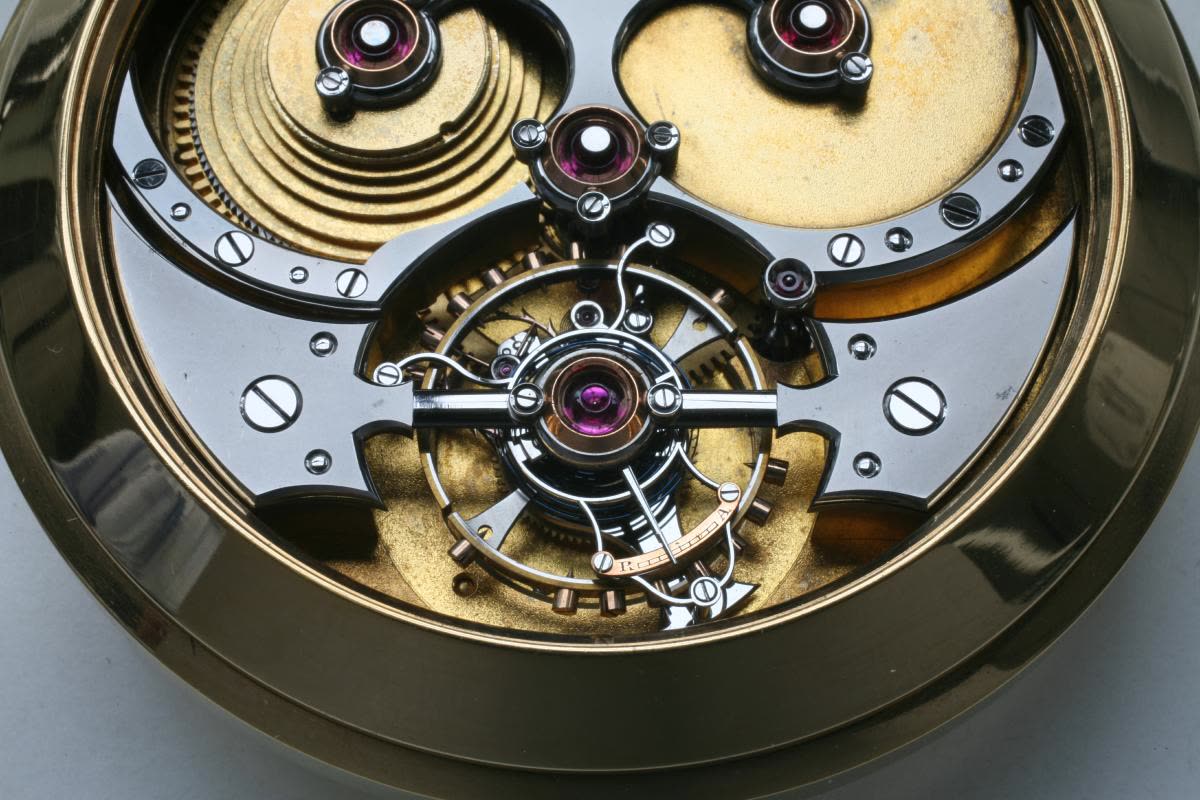
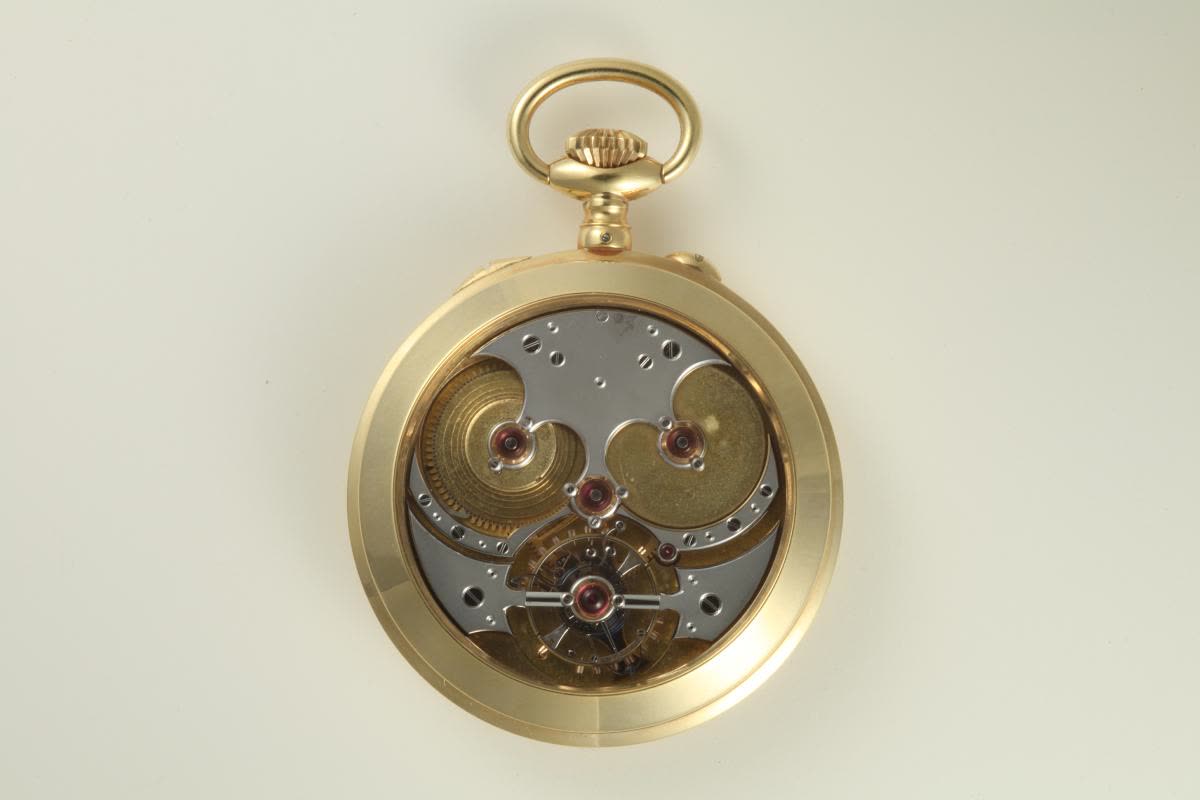
- Executed in the tradition of 19th century tourbillon chronometers, the movement has a “reversed” fusee. With this arrangement, the chain crosses over the centres of the barrel and fusee, relieving the pressure of the pivots of the latter. All the bridges are steel with polished bevels. The rubies of the fusee, barrel, centre wheel and carriage are placed in gold settings retained by screws.
- The polished steel carriage makes one revolution a minute, with three beats per second (21,600 vibrations per hour). The lower pivot carries the second hand. The form of the carriage shows the influence of Ernest Guinand and Auguste Grether, well-known adjusters and manufacturers of tourbillons from the Neuchâtel Jura. The carriage has a pivoted detent escapement, a compensation balance with gold screws, and a steel balance spring with a Breguet overcoil. The tip of the index rests on a pink gold regulating sector, screwed to the carriage.
- This chronometer was made between 1903 and 1906 by Ferdinand Bourquin, as a diploma project at the School of Horology, La Chaux-de-Fonds. The symmetrical position of the fusee and barrel, both placed beneath a pierced-steel bridge with a matt surface and polished bevelled edges, give this watch a particular elegance.
Photographs
Photographs are illustrative examples of the type, not necessarily the exact object described. Verify details against the source file page.
Sources & references
- Musée international d'horlogerie, online collection record, inv. I-516: https://collection.mih.ch/fr/collection/item/36475/
Where sources disagree, the disagreement is stated rather than resolved silently.