
Pocket watch · Londres
Montre à remontage automatique
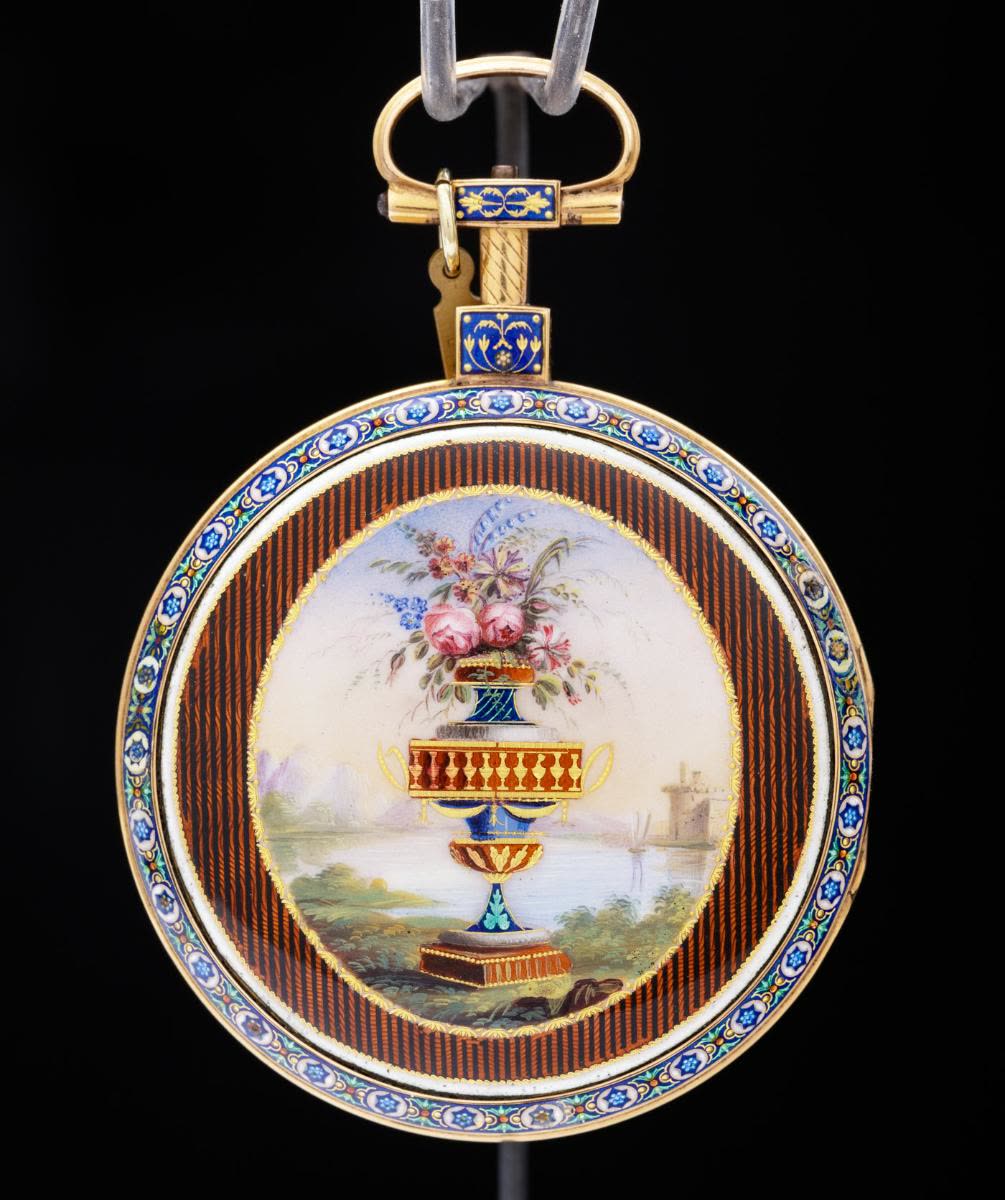
VerifiedThe case-back is decorated with an oval medallion depicting an urn of flowers against the backdrop of a mountain landscape with a lake, ruins, a fortress and a sailing boat. The flowered vase motif, inspired by the art of classical antiquity, was common on watches dating from the last quarter of the 18th century and from the neoclassical period in general. The circumference is decorated with a brown translucent enamel on guilloché and a frieze of multicoloured motifs in champlevé enamel.
Technical facts
- Inventory number
- MIH I-494
- Object type
- Pocket watch
- Place of production
- Londres
- Dating
- 1770 - 1790
- Materials and techniques (catalogue wording)
- or, émail, laiton doré
- Dimensions (catalogue)
- dimensions min/max: 46 x 50 mm; ép.: 20.00 mm
- Inscriptions (catalogue)
- Jaquet-Droz & Leschot London (Mouvement)
Historical significance
- The case-back is decorated with an oval medallion depicting an urn of flowers against the backdrop of a mountain landscape with a lake, ruins, a fortress and a sailing boat. The flowered vase motif, inspired by the art of classical antiquity, was common on watches dating from the last quarter of the 18th century and from the neoclassical period in general. The circumference is decorated with a brown translucent enamel on guilloché and a frieze of multicoloured motifs in champlevé enamel.
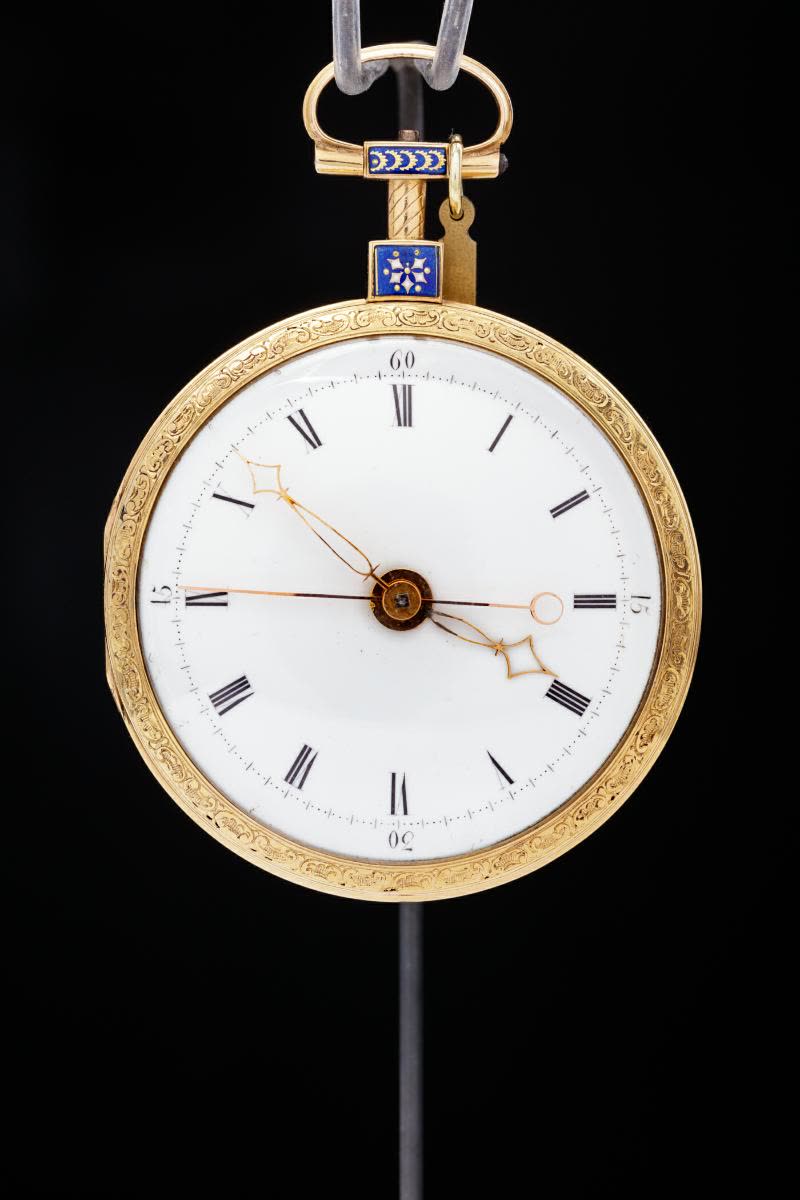
- The white enamel dial has hour and minute hands in finely pierced gold and a large centre- seconds hand.
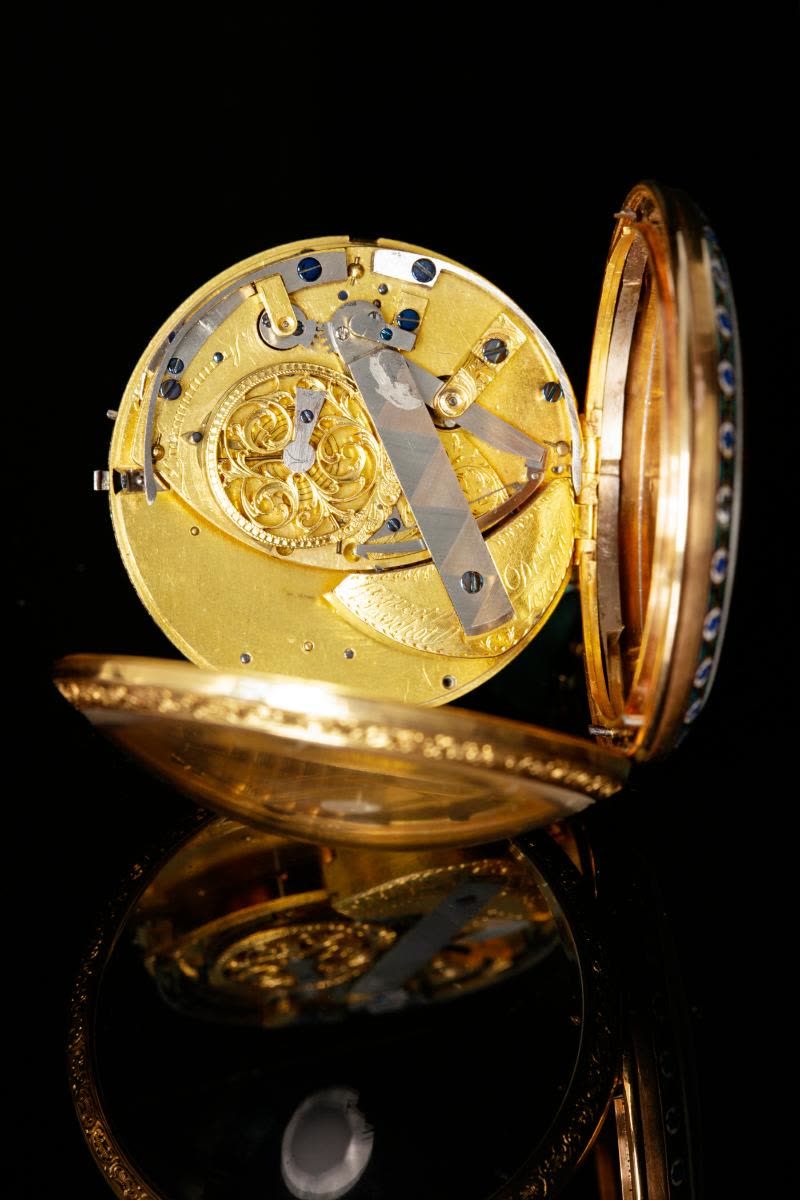
- This “perpetual” watch has an automatic winding device for the mainspring working on the principle that the wearer’s movement produce oscillations of a gold weight. The movement, which has no fusee, is fitted with a cylinder escapement consisting of a brass escape wheel and a steel cylinder. The circular balance cock, pierced with asymmetrical scrolls, covers a balance with a regulating spring.
- Jaquet-Droz & Leschot comprised three horologists from La Chaux-de-Fonds, all of whom acquired an international reputation during the second half of the 18th century: Pierre Jaquet-Droz (1721-1790), his son Henri-Louis (1752-1791), and his adopted son Jean-Frédéric Leschot (1746-1824). Having officially become partners in 1773, they sold watches and clocks, celebrated for their stylistic designs and complicated movements, throughout Europe and even the Orient.
- The case described here reveals a skilful combination of the main techniques used by enamellers: translucent enamel, champlevé enamels and enamel painting.
Photographs
Photographs are illustrative examples of the type, not necessarily the exact object described. Verify details against the source file page.
Sources & references
- Musée international d'horlogerie, online collection record, inv. I-494: https://collection.mih.ch/fr/collection/item/38663/
Where sources disagree, the disagreement is stated rather than resolved silently.