
Pocket watch · Paris
Tact watch
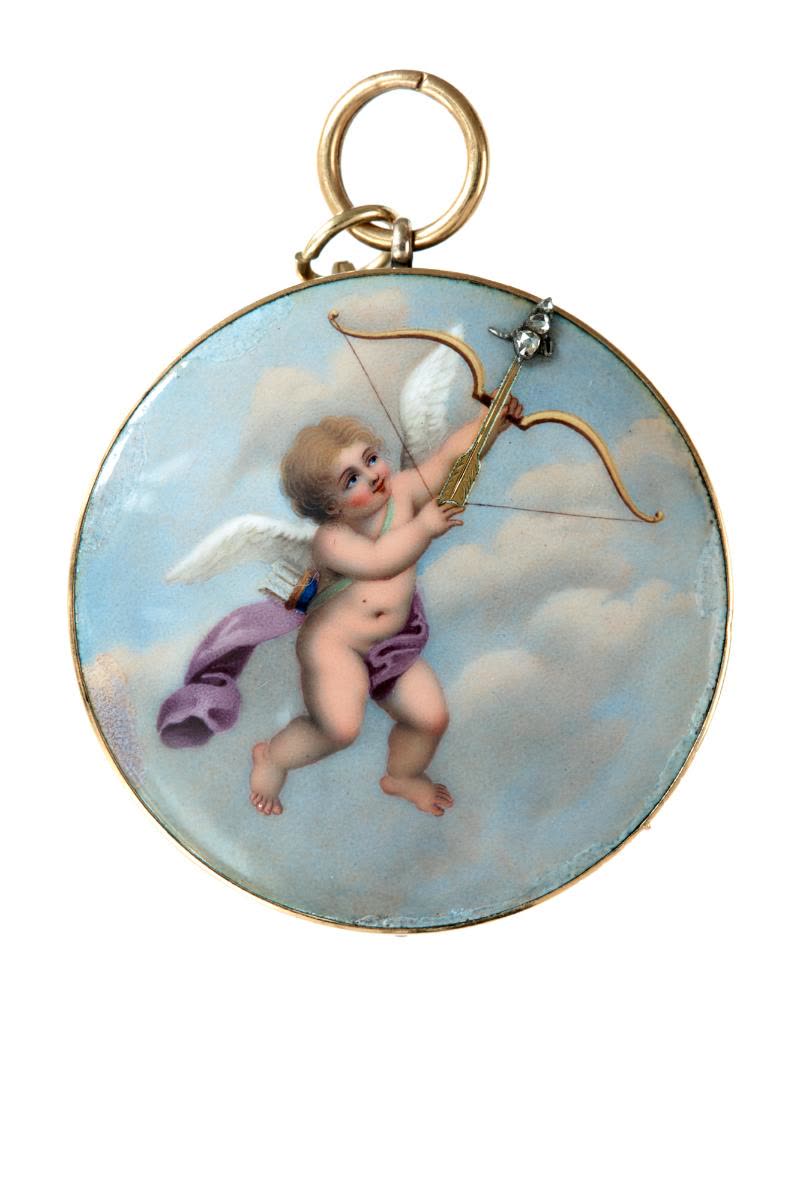
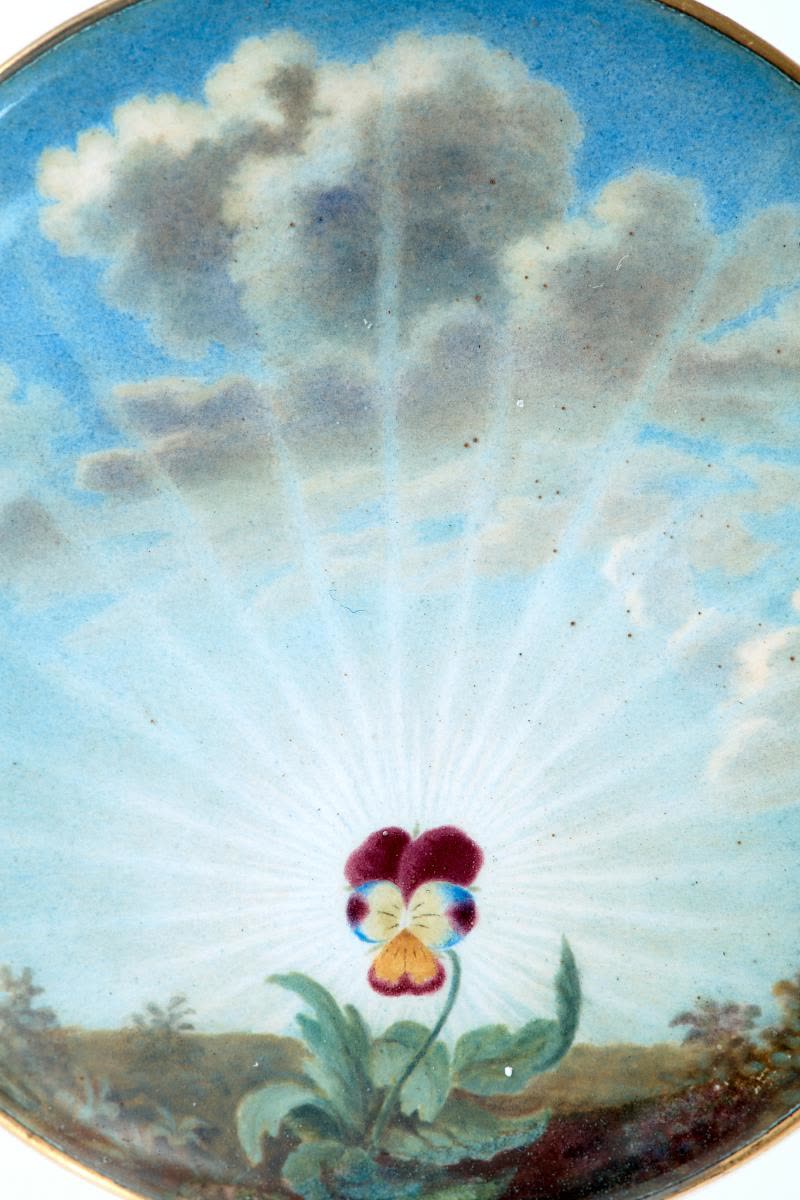
VerifiedThe enamel painting on the case cover depicts rays of light bursting forth from a pansy, the symbol of remembrance, against the backdrop of a cloudy sky. On the rotating enamelled case-back, Cupid fires a gold arrow whose tip, set with brilliants, points to the hours engraved in Arabic numerals on the silver caseband. A tactile reading of the time is possible by means of the protruding buttons at 3, 6, and 9 o’clock.
Technical facts
- Inventory number
- MIH I-493
- Object type
- Pocket watch
- Place of production
- Paris
- Dating
- 1790 - 1810
- Materials and techniques (catalogue wording)
- or, argent, émail, laiton
- Dimensions (catalogue)
- Dimensions: 50.5 x 39.5 x 8.4 mm
- Inscriptions (catalogue)
- Breguet N° 602 (Cache-poussière); Breguet N° 602 (Mouvement)
Historical significance
- The enamel painting on the case cover depicts rays of light bursting forth from a pansy, the symbol of remembrance, against the backdrop of a cloudy sky. On the rotating enamelled case-back, Cupid fires a gold arrow whose tip, set with brilliants, points to the hours engraved in Arabic numerals on the silver caseband. A tactile reading of the time is possible by means of the protruding buttons at 3, 6, and 9 o’clock.
- A small, silvered eccentric dial, engraved with the hours in Arabic numerals, can be seen through the pierced dome. Two blued steel “jumping” hands indicate the hours and minutes.
- The movement, with individual cocks, is fitted with a central hanging barrel, a ruby cylinder escapement with a twelve-toothed steel escape wheel, a brass three-armed balance, and a flat balance spring. The watch can be regulated through the dome by a pin affixed to the blued steel index.
- The International Watch Museum has two other à tact watches: one, bearing the number 3801 (Inv. I-473) and made by Breguet and Son, was sold in 1826 to Mr. Rigaud. It has a gold case with an engine-turned back and a movement fitted with a lever escapement. The other (Inv. I-1325) comes from the workshop of Basile-Charles Le Roy: based on the same principles as Breguet’s watches, it has an enamelled case and a movement with a virgule escapement.
- This kind of à tact watch was invented by A.-L. Breguet between 1796 and 1800. Not only could it be used to tell the time in the dark or, if one was in company, by discreetly touching the case-middle, it could also measure a period of time. When the à tact hand or case-back was turned until it met resistance, the watch would continue to function, while the à tact hand remained stationary.
Photographs

Photographs are illustrative examples of the type, not necessarily the exact object described. Verify details against the source file page.
Sources & references
- Musée international d'horlogerie, online collection record, inv. I-493: https://collection.mih.ch/fr/collection/item/38837/
Where sources disagree, the disagreement is stated rather than resolved silently.