
Pocket watch · Fleurier
“Chinese” watch, Movement and dial signed: Vaucher Frères
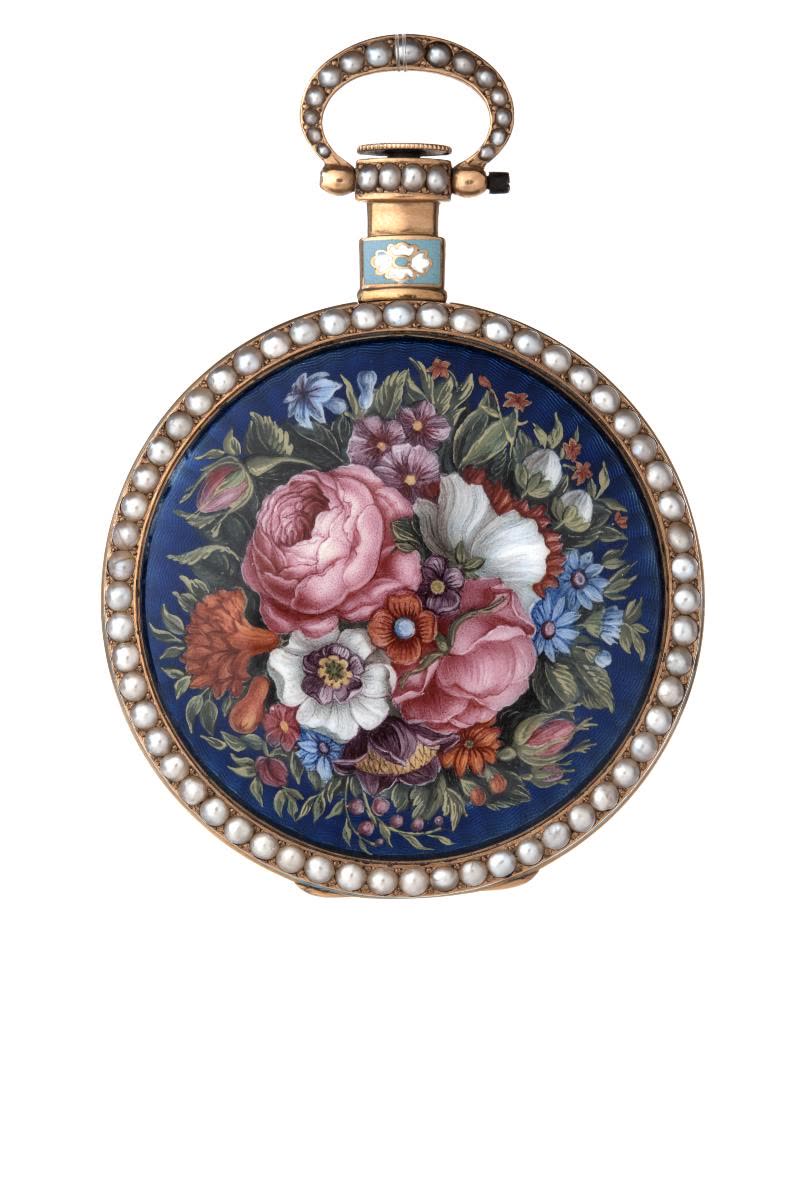
VerifiedThe engine-turned case-back is covered with blue translucent enamel, with a bouquet of flowers painted on it. The two bezels, as well as the pendant and bow, are decorated with half-pearls. The caseband and the base of the pendant are covered with turquoise champlevé enamel. The back opens by means of a spring lever released via the pendant. The movement is in a gilded brass ring separate from the case. The glazed dome, pierced for winding and hand-setting, has case-springs and may be opened by releasing a catch.
Technical facts
- Inventory number
- MIH I-402
- Object type
- Pocket watch
- Place of production
- Fleurier
- Dating
- 1830 - 1850
- Materials and techniques (catalogue wording)
- or, perles, émail, acier
- Dimensions (catalogue)
- Dimensions: 75.5 x 52.4 x 17.0 mm; poids: 87.000 g
- Inscriptions (catalogue)
- Vaucher Fleurier (Cadran); Vaucher Fleurier (Mouvement)
Historical significance
- The engine-turned case-back is covered with blue translucent enamel, with a bouquet of flowers painted on it. The two bezels, as well as the pendant and bow, are decorated with half-pearls. The caseband and the base of the pendant are covered with turquoise champlevé enamel. The back opens by means of a spring lever released via the pendant. The movement is in a gilded brass ring separate from the case. The glazed dome, pierced for winding and hand-setting, has case-springs and may be opened by releasing a catch.
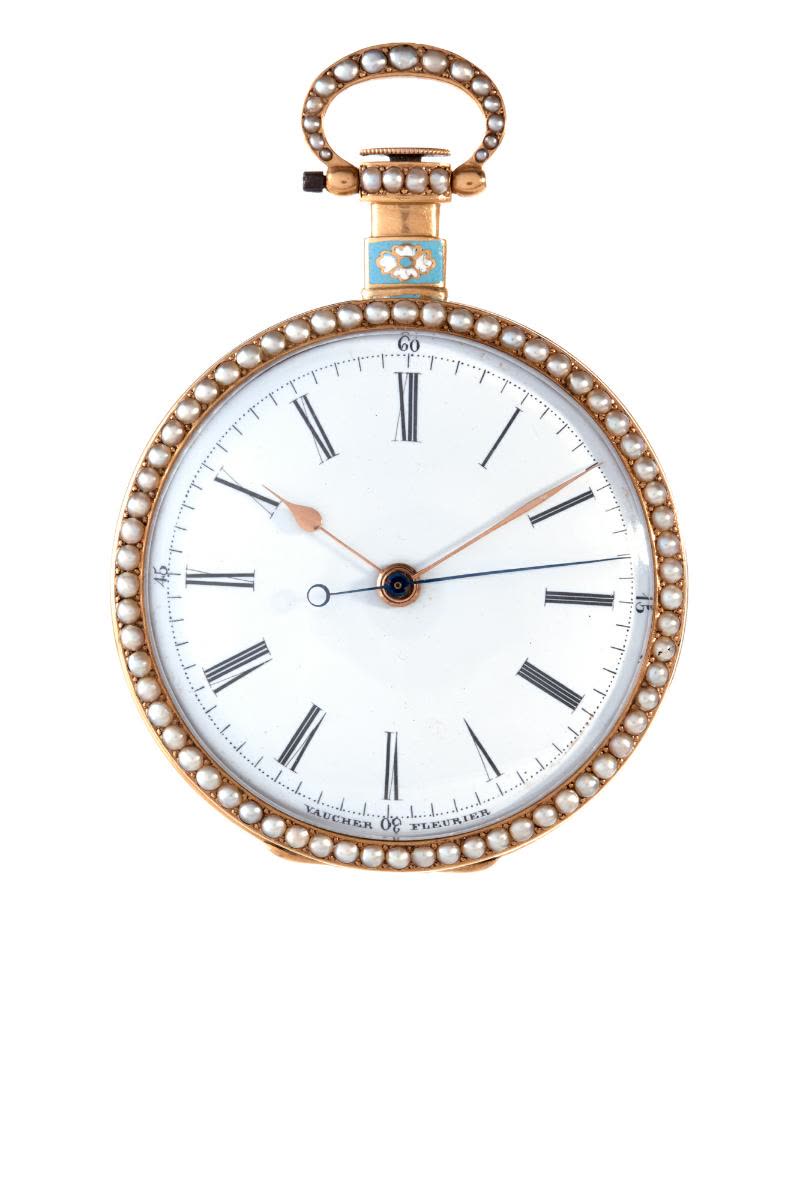
- The slightly cambered enamel dial has fine black painted Roman numerals for the hours, gilded brass spade-shaped hour and minute hands, and a blued steel centre seconds hand.
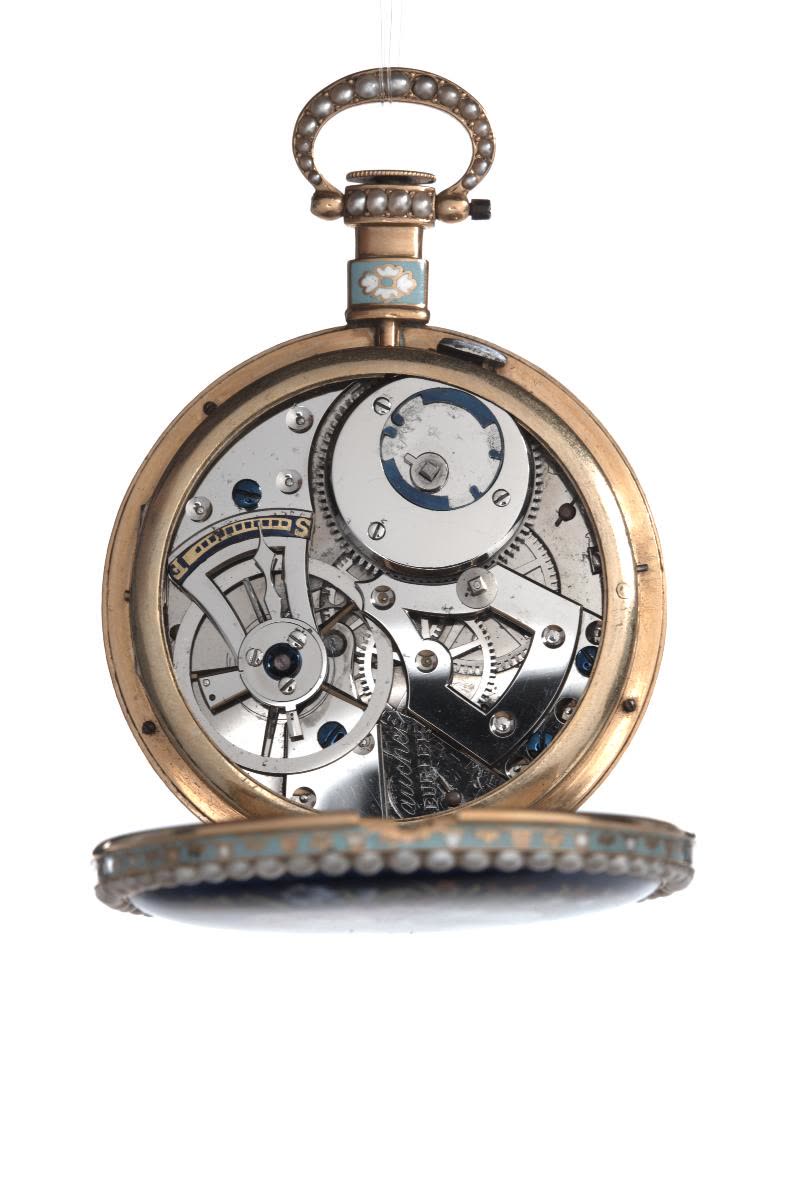
- The polished steel movement, which has a cylinder escapement, is characteristic of the watches produced for the Chinese market in the Travers Valley. The stopwork is a sliding ring in a recess of the barrel. The fourth wheel is placed at the centre to drive the centre seconds hand.
- The Bovets and Juvets from Fleurier, Charles-Henri Vaucher, and later the Vaucher Brothers were the main exporters of watches to China. Whenever they needed enamel cases for their high quality watches, they turned to the Geneva workshops, which were renowned for their enamel work.
Photographs
Photographs are illustrative examples of the type, not necessarily the exact object described. Verify details against the source file page.
Sources & references
- Musée international d'horlogerie, online collection record, inv. I-402: https://collection.mih.ch/fr/collection/item/39058/
Where sources disagree, the disagreement is stated rather than resolved silently.